. 2009 Apr 1;18(2):78-83.
doi: 10.1111/j.1467-8721.2009.01613.x.

Why do People Hurt Themselves? New Insights Into the Nature and Functions of Self-Injury

Affiliations

Why do People Hurt Themselves? New Insights Into the Nature and Functions of Self-Injury

Matthew K Nock. Curr Dir Psychol Sci. .

Abstract

Nonsuicidal self-injury (NSSI) is a prevalent but perplexing behavior problem in which people deliberately harm themselves without lethal intent. Research reveals that NSSI typically has its onset during early adolescence; most often involves cutting or carving the skin; and appears equally prevalent across sexes, ethnicities, and socioeconomic statuses. Less is known about why people engage in NSSI. This article presents a theoretical model of the development and maintenance of NSSI. Rather than a symptom of mental disorder, NSSI is conceptualized as a harmful behavior that can serve several intrapersonal (e.g., affect regulation) and interpersonal (e.g., help-seeking) functions. Risk of NSSI is increased by general factors that contribute to problems with affect regulation or interpersonal communication (e.g., childhood abuse) and by specific factors that influence the decision to use NSSI rather than some other behavior to serve these functions (e.g., social modeling). This model synthesizes research from several different areas of the literature and points toward several lines of research needed to further advance the understanding of why people hurt themselves.


Figures
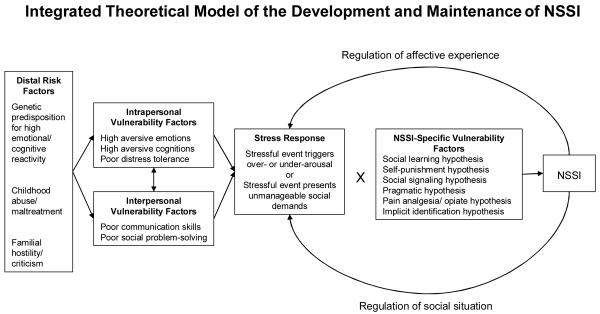
Figure 1
Figure 1
An integrated theoretical model of nonsuicidal self-injury (NSSI). This model proposes that NSSI is maintained because it is an effective means of immediately regulating aversive affective experiences and social situations. The risk of NSSI is increased by the presence of distal factors (e.g., childhood maltreatment) that can lead to intrapersonal and interpersonal vulnerabilities (e.g., poor communication skills) to respond to stressful life events in an ineffective manner (e.g., inability to effectively communicate the need for help). Although these risk factors could predispose a person to a number of forms of psychopathology, the likelihood of engaging in NSSI is increased by an additional set of NSSI-specific vulnerability factors (e.g., social learning).
Figure 2
Figure 2
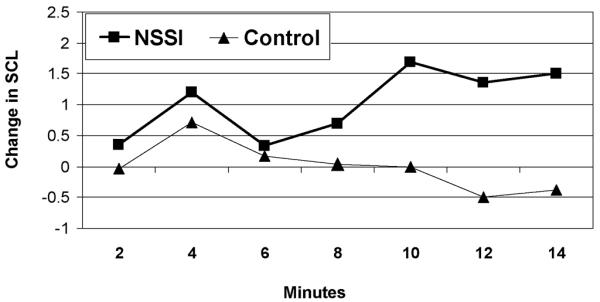
Change in skin conductance level (SCL) during a distressing/frustrating card-sorting task for those with a recent history of NSSI (n = 62) compared to a non-injurious control group (n = 30). The full study is reported in Nock and Mendes (2008).
Figure 3
Figure 3
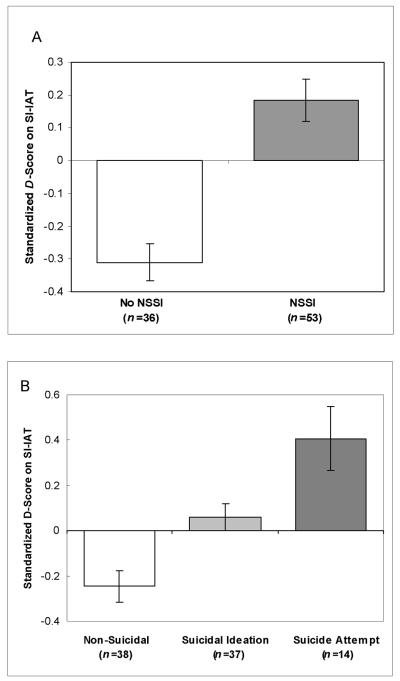
Results of an Implicit Association Test (IAT) measuring the strength of associations between self-injury and the self for those with and without a history of nonsuicidal self-injury (NSSI; A) and for those with or without a history of suicidal thoughts or suicide attempts (regardless of NSSI status; B). In both experiments, self-injury was represented by images of cut skin (versus images of non-cut skin) and the self was represented by words related to the self (“I,” “mine,” “me”) (versus words related to others, e.g., “they,” “them,” “their”). Positive scores represent a stronger association between self-injury and the self (i.e., faster responding on a computer-based test when self-injury and the self are paired on the same computer key), and negative scores represent a stronger association between non-injury and the self. The difference between self-injurers and non-injurers was large and statistically significant, as was the differences between each of the three groups in panel B. The full studies are reported in Nock and Banaji (2007a & b).

References

    1. Glassman LH, Weierich MR, Hooley JM, Deliberto TL, Nock MK. Child maltreatment, non-suicidal self-injury, and the mediating role of self-criticism. Behaviour Research and Therapy. 2007;45:2483–2490. - PMC - PubMed
    1. Hagen EH, Watson P, Hammerstein P. Gestures of despair and hope: A view on deliberate self-harm from economics and evolutionary biology. Biological Theory. 2008;3:123–138.
    1. Haines J, Williams CL, Brain KL, Wilson GV. The psychophysiology of self-mutilation. Journal of Abnormal Psychology. 1995;104:471–489. - PubMed
    1. Hauser MD. The evolution of communication. MIT Press; Cambridge, MA: 1996.
    1. Hayes SC, Wilson KG, Gifford EV, Follette VM, Strosahl K. Experimental avoidance and behavioral disorders: A functional dimensional approach to diagnosis and treatment. Journal of Consulting and Clinical Psychology. 1996;64:1152–1168. - PubMed

LinkOut - more resources