


doi: 10.1016/j.ins.2008.11.012.
Agent-based modeling of host-pathogen systems: The successes and challenges
Affiliations
- PMID: 20161146
- PMCID: PMC2731970
- DOI: 10.1016/j.ins.2008.11.012
Item in Clipboard
Agent-based modeling of host-pathogen systems: The successes and challenges
Inf Sci (N Y).
.
Abstract
Agent-based models have been employed to describe numerous processes in immunology. Simulations based on these types of models have been used to enhance our understanding of immunology and disease pathology. We review various agent-based models relevant to host-pathogen systems and discuss their contributions to our understanding of biological processes. We then point out some limitations and challenges of agent-based models and encourage efforts towards reproducibility and model validation.
Figures
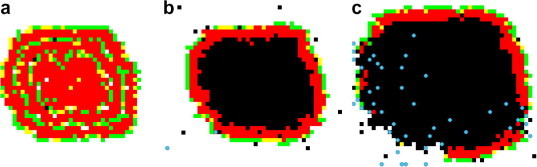
Effect of the regeneration rule on the infection dynamics. From left to right: (a) using a global rule where dead cells are replaced at a rate proportional to the total number of uninfected cells; (b) using a local rule where dead cells are only replaced when an immediate uninfected neighbor is dividing; (c) when using the local rule, dead cells can only be regenerated once the infection wave has been breached by the immune cells. Using the same infection and death rate, a local regeneration rule results in a larger number of dead cells but a smaller number of infected cells compared to a non-spatial global rule. The images are screenshots taken from MASyV’s ma_immune client , and represent a 2-D tissue patrolled by immune cells (blue) where each lattice site corresponds to a tissue cell which can either be uninfected (white), dead (black), or in various stages of infection (green, yellow, red). (For interpretation of the references to color in this figure legend, the reader is referred to the web version of this article.)
References
-
- Alarcon T., Byrne H.M., Maini P.K. A multiple scale model for tumor growth. SIAM Multiscale Model. Simul. 2005;3(2):440–475.
-
- An G. In silico experiments of existing and hypothetical cytokine-directed clinical trials using agent-based modeling. Crit. Care Med. 2004;32(10):2050–2060. - PubMed
-
- An G. Concepts for developing a collaborative in silico model of the acute inflammatory response using agent-based modeling. J. Crit. Care. 2006;21(1):105–110. - PubMed
-
- An G.C. Agent-based computer simulation and SIRS: building a bridge between basic science and clinical trials. Shock. 2001;16(4):266–273. - PubMed
Grants and funding
LinkOut - more resources
Full Text Sources