


Decreasing procedural pain over time of left prefrontal rTMS for depression: initial results from the open-label phase of a multi-site trial (OPT-TMS)
- PMID: 20161310
- PMCID: PMC2699309
- DOI: 10.1016/j.brs.2008.09.001
Decreasing procedural pain over time of left prefrontal rTMS for depression: initial results from the open-label phase of a multi-site trial (OPT-TMS)
Abstract
Background: There is much interest in whether daily left prefrontal repetitive transcranial magnetic stimulation (rTMS) over several weeks may become a clinically useful antidepressant treatment. Although rTMS appears largely safe, many patients report that this procedure is somewhat painful, which may restrict its ultimate appeal and utility. We analyzed interim results from the open-label phase of a multi-site randomized trial of rTMS as a treatment for depression to investigate whether the procedural pain of left prefrontal rTMS changes over time.
Methods: Patients with unipolar depression who had failed to respond during at least three weeks of the sham-controlled double-masked rTMS were then offered three more weeks (15 sessions) of open-label rTMS. Retrospective pain ratings and state emotional factors from 20 subjects were assessed using visual analog scales (VAS) recorded on computers before and after each treatment (289 sessions).
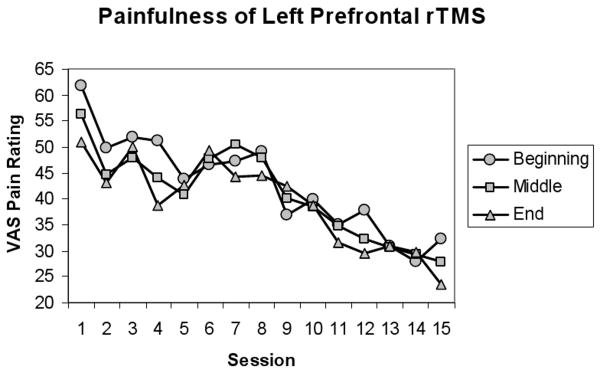
Results: Over the 15 treatment sessions, subjective reports of the painfulness of rTMS decreased 48% from baseline. This reduction, although greatest in the first few days, continued steadily (average 2.11 points per session) over the 3 weeks of treatment. The analysis found a significant effect for rTMS-session (p<0.0001) on rTMS-procedural pain over and above changes in subjective emotional states.
Conclusion: The procedural pain of left, prefrontal rTMS decreases over time, apparently independently of other emotional changes. Since rTMS scalp pain may decline over time, physicians and patients may decide to continue treatment despite initial discomfort. These observational data can be better tested once the data from the blinded phase of the trial becomes available.
Conflict of interest statement
Conflicts of Interest: MUSC holds several TMS related patents. Drs. George and Sackeim are advisory board members for Neuronetics, Inc.
Figures



References
-
- Borckardt JJ, Smith AR, Hutcheson K, Johnson K, Nahas Z, Anderson B, et al. Reducing pain and unpleasantness during repetitive transcranial magnetic stimulation. J ECT. 2006 Dec;22(4):259–64. - PubMed
-
- O'Reardon JP, Solvason HB, Janicak PG, Sampson S, Isenberg KE, Nahas Z, et al. Efficacy and safety of transcranial magnetic stimulation in the acute treatment of major depression: a multisite randomized controlled trial. Biological Psychiatry. 2007 Dec 1;62(11):1208–16. - PubMed
-
- Fox P, Ingham R, George MS, Mayberg H, Ingham J, Roby J, et al. Imaging human intra-cerebral connectivity by PET during TMS. Neuroreport. 1997 Aug 18;8(12):2787–91. - PubMed
-
- George MS, Wassermann EM, Williams WA, Steppel J, Pascual-Leone A, Basser P, et al. Changes in mood and hormone levels after rapid-rate transcranial magnetic stimulation (rTMS) of the prefrontal cortex. J Neuropsychiatry Clin Neurosci. 1996 Spring;8(2):172–80. - PubMed
-
- Pazzaglia PJ, George MS, Post RM, Rubinow DR, Davis CL. Nimodipine increases CSF somatostatin in affectively ill patients. Neuropsychopharmacology. 1995 Aug;13(1):75–83. - PubMed
Publication types
MeSH terms
Grants and funding
- R01 MH069929/MH/NIMH NIH HHS/United States
- K08 MH070615/MH/NIMH NIH HHS/United States
- R01 MH069886/MH/NIMH NIH HHS/United States
- K23 NS050485/NS/NINDS NIH HHS/United States
- R01MH069887/MH/NIMH NIH HHS/United States
- R01MH069929/MH/NIMH NIH HHS/United States
- R01 MH069896/MH/NIMH NIH HHS/United States
- R01MH069886/MH/NIMH NIH HHS/United States
- R01 MH069895/MH/NIMH NIH HHS/United States
- R01MH069895/MH/NIMH NIH HHS/United States
- K08MH070615/MH/NIMH NIH HHS/United States
- R01MH069896/MH/NIMH NIH HHS/United States
- K23NS050485/NS/NINDS NIH HHS/United States
- R01 MH069887/MH/NIMH NIH HHS/United States
LinkOut - more resources
Full Text Sources
Other Literature Sources
Medical
