


doi: 10.1134/S1063771009040034.
FOCUSING OF HIGH POWER ULTRASOUND BEAMS AND LIMITING VALUES OF SHOCK WAVE PARAMETERS
Affiliations
- PMID: 20161349
- PMCID: PMC2776740
- DOI: 10.1134/S1063771009040034
Item in Clipboard
FOCUSING OF HIGH POWER ULTRASOUND BEAMS AND LIMITING VALUES OF SHOCK WAVE PARAMETERS
Acoust Phys.
.
Abstract
In this work, the influence of nonlinear and diffraction effects on amplification factors of focused ultrasound systems is investigated. The limiting values of acoustic field parameters obtained by focusing of high power ultrasound are studied. The Khokhlov-Zabolotskaya-Kuznetsov (KZK) equation was used for the numerical modeling. Solutions for the nonlinear acoustic field were obtained at output levels corresponding to both pre- and post- shock formation conditions in the focal area of the beam in a weakly dissipative medium. Numerical solutions were compared with experimental data as well as with known analytic predictions.
Figures
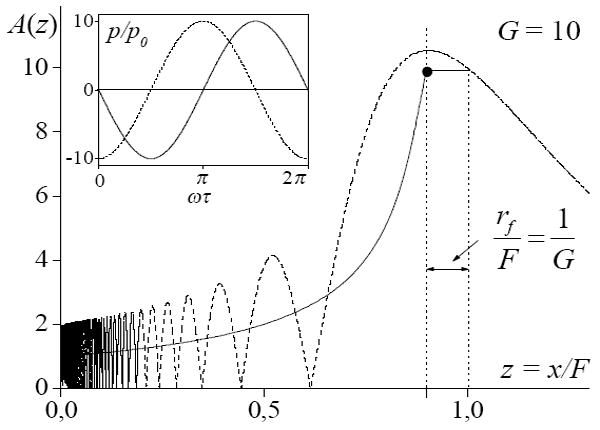
Distributions of the dimensionless amplitude of harmonic wave along the axis z = x/F of the piston transducer for 1D spherically convergent wave (solid line) and linear focused beam (dashed line) with the focusing gain G = 10. The waveforms of the same amplitude are shown in the small figure (for linear focused beam - in the geometrical focus, for 1D spherical convergent wave - at the distance z = 1/G prefocally).
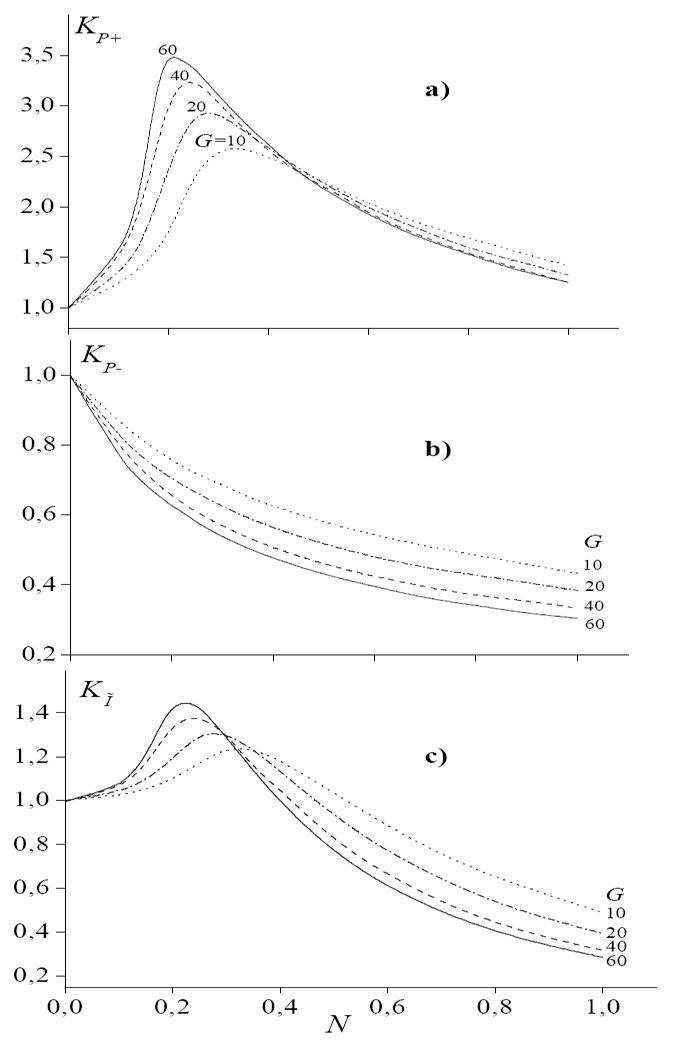
Dependences of correction factors to the focusing gains in nonlinear beam on nonlinear parameter N for the peak positive p+F (a) and peak negative p−F (b) pressures, and intensity IF (c). Correction factors are defined as KP+ = p+F/p0G, KP− = p−F/p0G, and KĨ = IF/I0G2, where G is the linear focusing gain of the source (G = 10, 20, 40, 60).
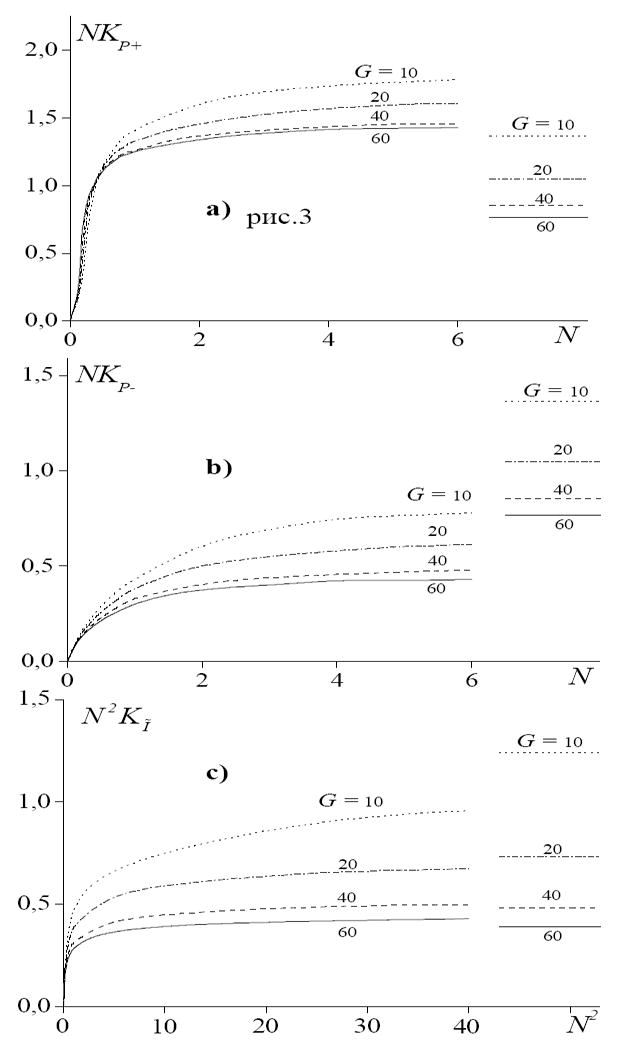
Saturation curves at the focus for dimensionless peak pressures (NKP± ~ p±F, a, b) and intensity Ĩ (N2KĨ~ IF, c). The value of parameter N is proportional to the source pressure output p0, the curves are presented for various values of G = 10, 20, 40, 60. Shown on the right are the approximate saturation values given by the analytic solution, Eq. 5.
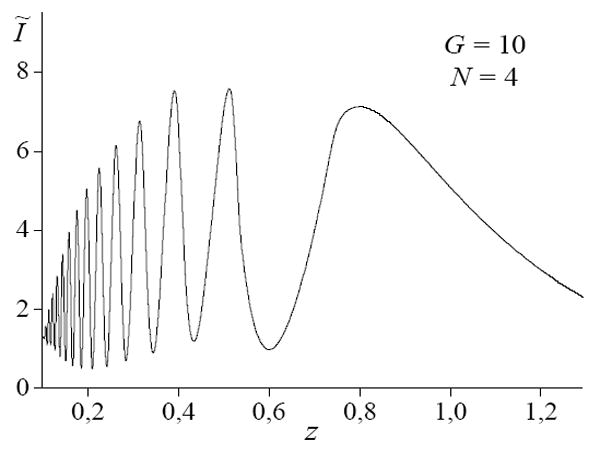
Distribution of the dimensionless intensity Ĩ along the beam axis under conditions of well developed shocks (G = 10, N = 4).
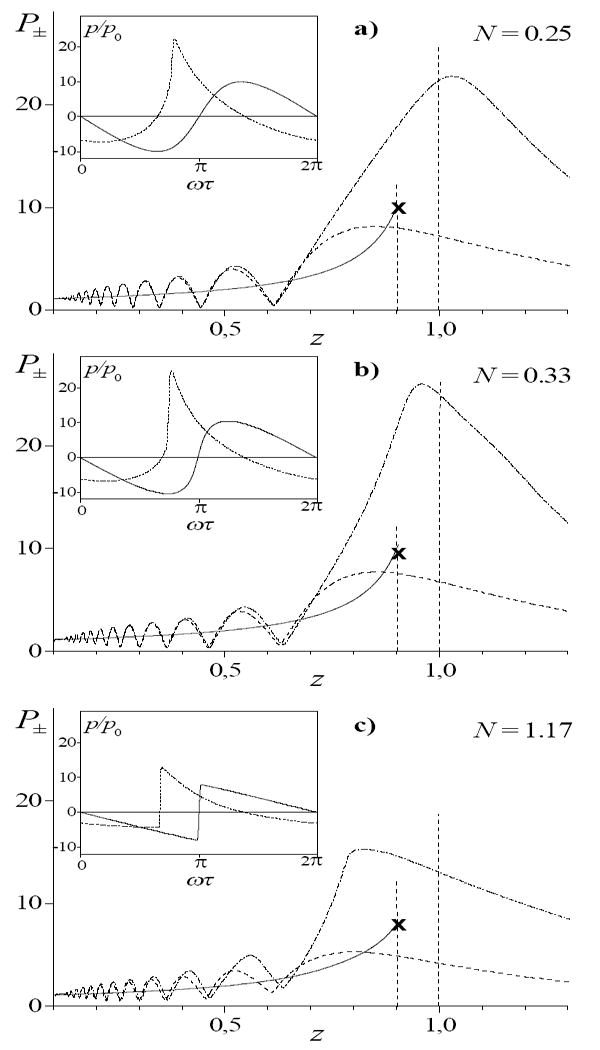
Distributions of the dimensionless peak pressures P+ and P− along beam axis (G = 10) for various values of nonlinear parameter N = 0.25 (a), 0.33 (b), and 1.17 (c). Solid lines correspond to the peak pressure in one-dimensional spherically convergent wave (P+ = P−); dashed lines – to the peak negative P− and dash-dotted line – to the peak positive P+ pressure in nonlinear beam. Shown in small frames are waveforms calculated in the geometrical focus for a beam and at the distance 1/G from the focus towards the source for one-dimensional spherically convergent wave.
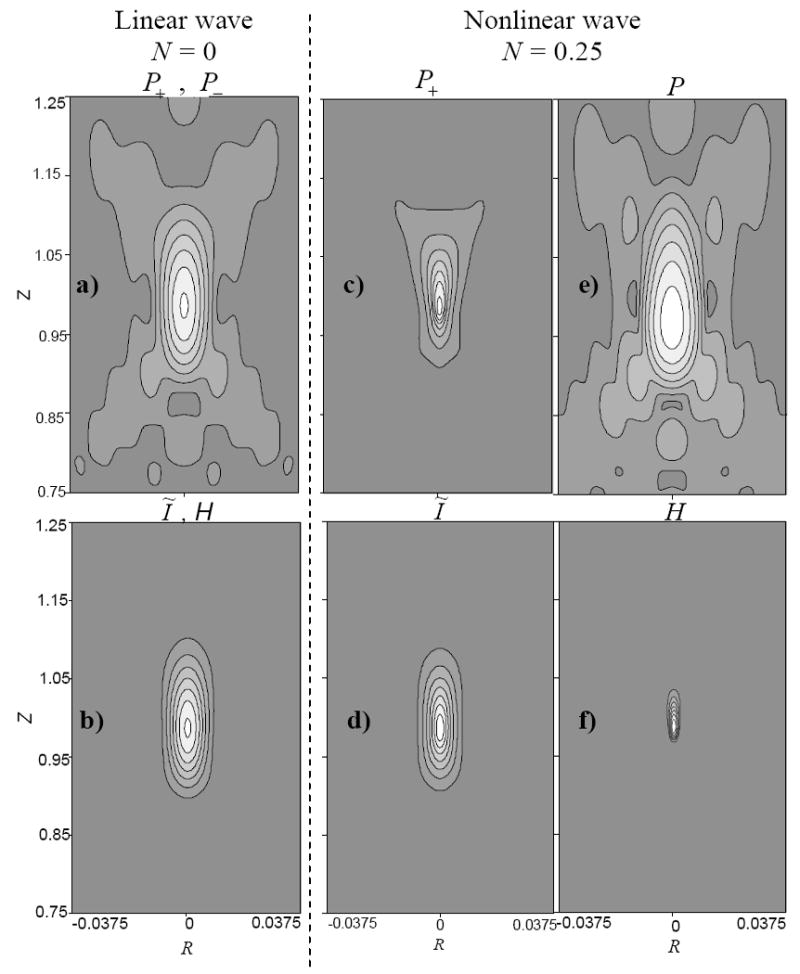
Spatial distributions in (z, R) coordinates of the peak positive P+ and negative P− pressures, intensity Ĩ, and heat deposition H for linear (N = 0, a-b) and nonlinear (N = 0.25, c-e) beams (G = 40).
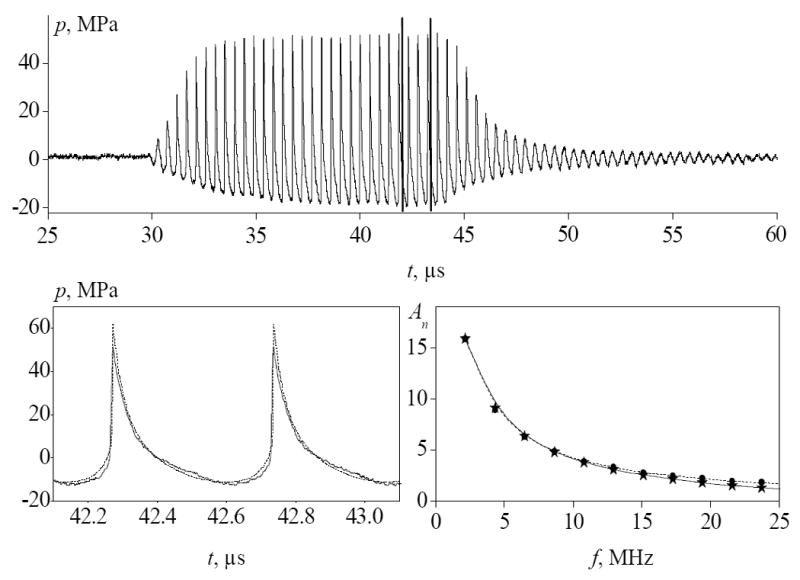
Comparison of measured data (solid lines) with the results of numerical modeling (dashed lines) for the pressure waveform at the focus: (a) - the measured signal; (b) - two periods in the wave profile between vertical lines on the graph of the measured signal, and (c) - the corresponding spectrum. Here An is the amplitude of the n-th harmonic of an initial wave, A1 = p0 at z = 0. Source parameters are: 22.5 mm radius, 44.4 mm focal length, 2 MHz frequency, and 0.4 MPa initial pressure, that correspond to the values of G = 48 and N = 0.25.
References
-
- Rudenko OV, Soluyan SI. Theoretical foundations of nonlinear acoustics. Plenum; New York: 1977. p. 268.
-
- Hill CR, Bamber JC, ter Haar GR. Physical Principles of Medical Ultrasonics. John Wiley&Sons; 2004. p. 528.
-
- Bailey MR, Khokhlova VA, Sapozhnikov OA, Kargl SG, Crum LA. Physical mechanisms of the therapeutic effect of ultrasound (a review) Acoustical Physics. 2003;49(4):369–388.
-
- Wu F, Wang ZB, Chen WZ, et al. Extracorporeal focused ultrasound surgery for treatment of human solid carcinomas: early Chinese clinical experience. Ultrasound in Med & Biol. 2004;30(2):245–260. - PubMed
-
- Khokhlova VA, Bailey MR, Crum LA. Acoustic nonlinearity in derating problem for HIFU sources. Proc. 4th International Symposium on Therapeutic Ultrasound; Kyoto, Japan. 2004. pp. 134–136.
Grants and funding
LinkOut - more resources
Full Text Sources
Other Literature Sources