


Inland Transport of Aerosolized Florida Red Tide Toxins
- PMID: 20161504
- PMCID: PMC2796838
- DOI: 10.1016/j.hal.2009.09.003
Inland Transport of Aerosolized Florida Red Tide Toxins
Abstract
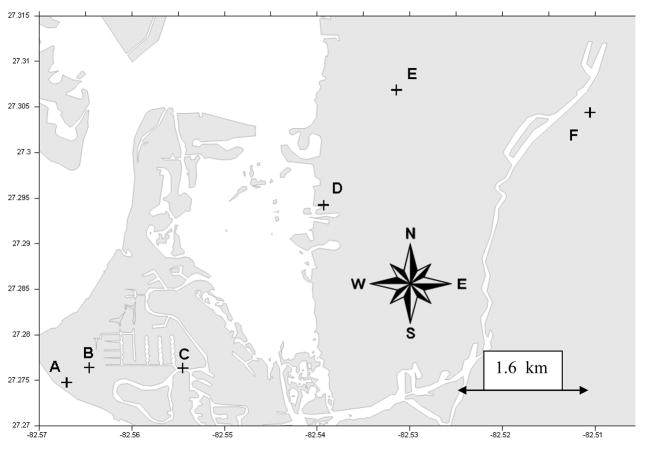
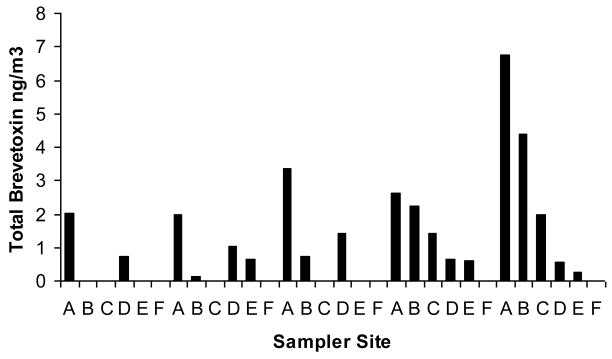
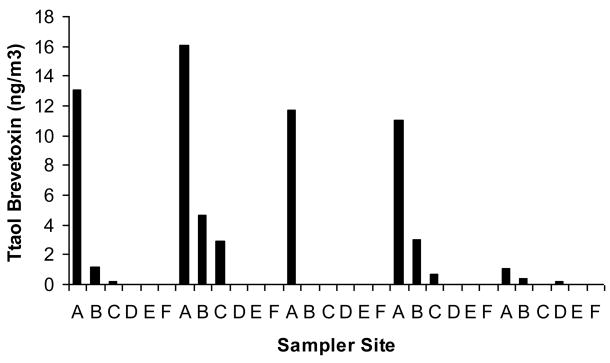
Florida red tides, an annual event off the west coast of Florida, are caused by the toxic dinoflagellate, Karenia brevis. K. brevis produces a suite of potent neurotoxins, brevetoxins, which kill fish, sea birds, and marine mammals, as well as sickening humans who consume contaminated shellfish. These toxins become part of the marine aerosol, and can also be inhaled by humans and other animals. Recent studies have demonstrated a significant increase in symptoms and decrease lung function in asthmatics after only one hour of beach exposure during an onshore Florida red tide bloom.This study constructed a transect line placing high volume air samplers to measure brevetoxins at sites beginning at the beach, moving approximately 6.4 km inland. One non-exposure and 2 exposure studies, each of 5 days duration, were conducted. No toxins were measured in the air during the non-exposure period. During the 2 exposure periods, the amount of brevetoxins varied considerably by site and by date. Nevertheless, brevetoxins were measured at least 4.2 kilometers from the beach and/or 1.6 km from the coastal shoreline. Therefore, populations sensitive to brevetoxins (such as asthmatics) need to know that leaving the beach may not discontinue their environmental exposure to brevetoxin aerosols.
Figures
References
-
- Baden DG. Marine food-borne dinoflagellate toxins. International Review Cytology. 1983;82:99–150. - PubMed
-
- Baden D, Fleming LE, Bean JA. Marine Toxins. Handbook of Clinical Neurology: Intoxications of the Nervous System Part H. In: DeWolf FA, editor. Natural Toxins and *Drugs. Elsevier Press; Amsterdam: 1995. pp. 141–175.
-
- Backer LC, Fleming LE, Rowan A, Cheng Y-S, Benson J, Pierce R, Zaias J, Bean J, Bossart G, Baden DG. Recreational Exposure to Aerosolized Brevetoxins During Florida Red Tide Events. Harmful Algae. 2003;2:19–28. - PubMed
-
- Fleming LE, Kirkpatrick B, Backer LC, Bean JA, Wanner A, Dalpra D, Tamer R, Zaias J, Cheng YS, Pierce R, Naar J, Abraham W, Clark R, Zhou Y, Henry MS, Johnson D, Van de Bogart G, Bossart GD, Harrington M, Baden DG. Initial Evaluation of the Effects of Aerosolized Florida Red Tide Toxins (Brevetoxins) in Persons with Asthma. Environ Health Persp. 2005;113(5):650–7. - PMC - PubMed
Grants and funding
LinkOut - more resources
Full Text Sources
