


Electron tunneling through sensitizer wires bound to proteins
- PMID: 20161508
- PMCID: PMC2797321
- DOI: 10.1016/j.ccr.2009.08.008
Electron tunneling through sensitizer wires bound to proteins
Abstract
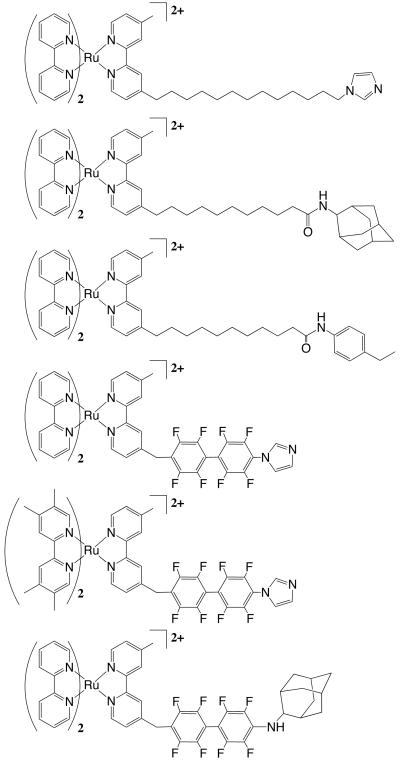
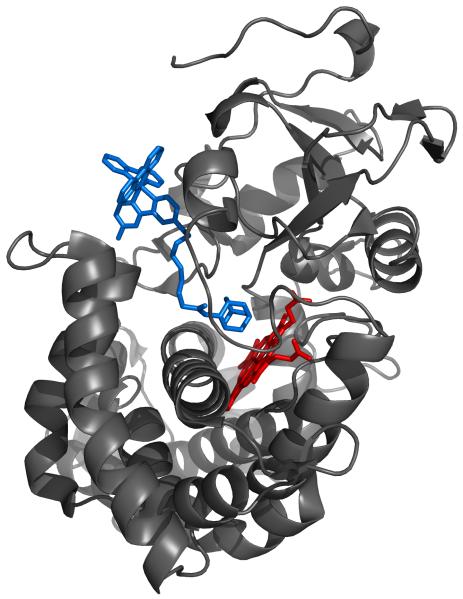
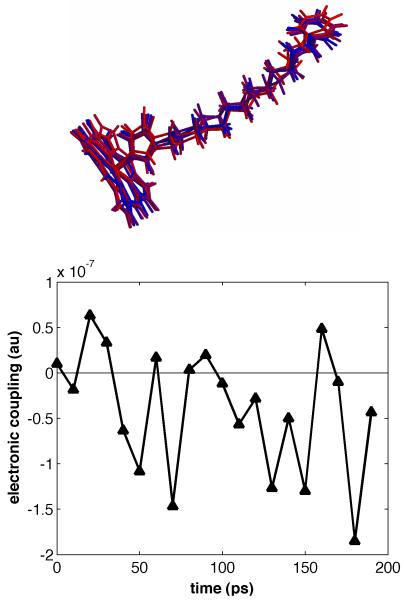
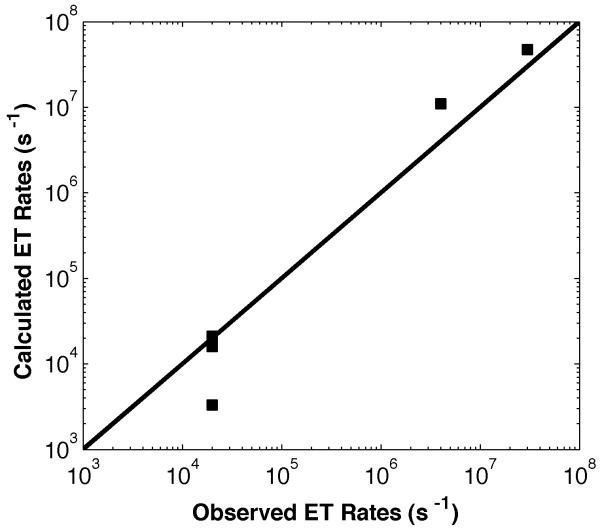
We report a quantitative theoretical analysis of long-range electron transfer through sensitizer wires bound in the active-site channel of cytochrome P450cam. Each sensitizer wire consists of a substrate group with high binding affinity for the enzyme active site connected to a ruthenium-diimine through a bridging aliphatic or aromatic chain. Experiments have revealed a dramatic dependence of electron transfer rates on the chemical composition of both the bridging group and the substrate. Using combined molecular dynamics simulations and electronic coupling calculations, we show that electron tunneling through perfluorinated aromatic bridges is promoted by enhanced superexchange coupling through virtual reduced states. In contrast, electron flow through aliphatic bridges occurs by hole-mediated superexchange. We have found that a small number of wire conformations with strong donor-acceptor couplings can account for the observed electron tunneling rates for sensitizer wires terminated with either ethylbenzene or adamantane. In these instances, the rate is dependent not only on electronic coupling of the donor and acceptor but also on the nuclear motion of the sensitizer wire, necessitating the calculation of average rates over the course of a molecular dynamics simulation. These calculations along with related recent findings have made it possible to analyze the results of many other sensitizer-wire experiments that in turn point to new directions in our attempts to observe reactive intermediates in the catalytic cycles of P450 and other heme enzymes.
Figures
References
-
- Wilker JJ, Dmochowski IJ, Dawson JH, Winkler JR, Gray HB. Angew. Chem. Int. Ed. 1999;38:90–92.
-
- Dmochowski IJ. Probing Cytochrome P450 with Sensitizer-linked Substrates. California Institute of Technology; 2000.
-
- Dunn AR, Hays AM, Goodin DB, Stout CD, Chiu R, Winkler JR, Gray HB. J. Am. Chem. Soc. 2002;124:10254–55. - PubMed
Grants and funding
LinkOut - more resources
Full Text Sources