


Transmitted drug resistance in nonsubtype B HIV-1 infection
- PMID: 20161523
- PMCID: PMC2800377
- DOI: 10.2217/hiv.09.30
Transmitted drug resistance in nonsubtype B HIV-1 infection
Abstract
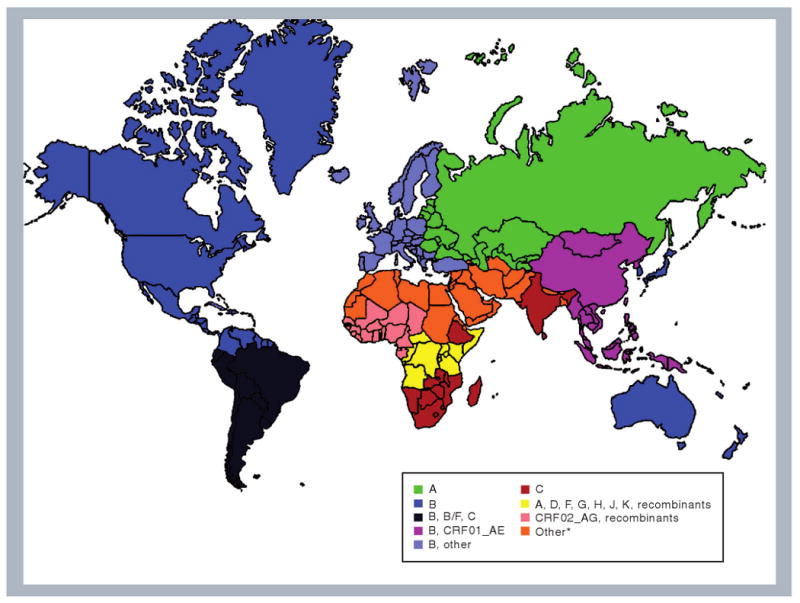
HIV-1 nonsubtype B variants account for the majority of HIV infections worldwide. Drug resistance in individuals who have never undergone antiretroviral therapy can lead to early failure and limited treatment options and, therefore, is an important concern. Evaluation of reported transmitted drug resistance (TDR) is challenging owing to varying definitions and study designs, and is further complicated by HIV-1 subtype diversity. In this article, we discuss the importance of various mutation lists for TDR definition, summarize TDR in nonsubtype B HIV-1 and highlight TDR reporting and interpreting challenges in the context of HIV-1 diversity. When examined carefully, TDR in HIV-1 non-B protease and reverse transcriptase is still relatively low in most regions. Whether it will increase with time and therapy access, as observed in subtype-B-predominant regions, remains to be determined.
Conflict of interest statement
The authors have no other relevant affiliations or financial involvement with any organization or entity with a financial interest in or financial conflict with the subject matter or materials discussed in the manuscript apart from those disclosed.
No writing assistance was utilized in the production of this manuscript.
Figures
References
Bibliography
-
- Clavel F, Hance AJ. HIV drug resistance. N Engl J Med. 2004;350:1023–1035. - PubMed
-
- Deeks SG. Treatment of antiretroviral-drug-resistant HIV-1 infection. Lancet. 2003;362:2002–2011. - PubMed
-
- Kozal MJ. Drug-resistant human immunodefiency virus. Clin Microbiol Infect. 2009;15(Suppl 1):69–73. - PubMed
-
- Daar ES. Emerging resistance profiles of newly approved antiretroviral drugs. Top HIV Med. 2008;16:110–116. - PubMed
Websites
-
- HIV Sequence Database. Breakpoints of circulating recombinant forms. [1 April 2009]. www.hiv.lanl.gov/content/sequence/HIV/CRFs/breakpoints.html.
-
- French National Agency for AIDS Research, v17. [1 April 2009]. www.hivfrenchresistance.org.
-
- Stanford Database. [1 April 2009]. http://hivdb.stanford.edu.
-
- Rega Institute mutation list v8.0.1. [1 April 2009]. www.rega.kuleuven.be/cev/
Grants and funding
LinkOut - more resources
Full Text Sources