


doi: 10.1586/eci.09.53.
Vitamin D, the immune system and asthma
Affiliations
- PMID: 20161622
- PMCID: PMC2812815
- DOI: 10.1586/eci.09.53
Item in Clipboard
Vitamin D, the immune system and asthma
Expert Rev Clin Immunol.
2009 Nov.
Abstract
The effects of vitamin D on bone metabolism and calcium homeostasis have long been recognized. Emerging evidence has implicated vitamin D as a critical regulator of immunity, playing a role in both the innate and cell-mediated immune systems. Vitamin D deficiency has been found to be associated with several immune-mediated diseases, susceptibility to infection and cancer. Recently, there has been increasing interest in the possible link between vitamin D and asthma. Further elucidation of the role of vitamin D in lung development and immune system function may hold profound implications for the prevention and treatment of asthma.
Figures
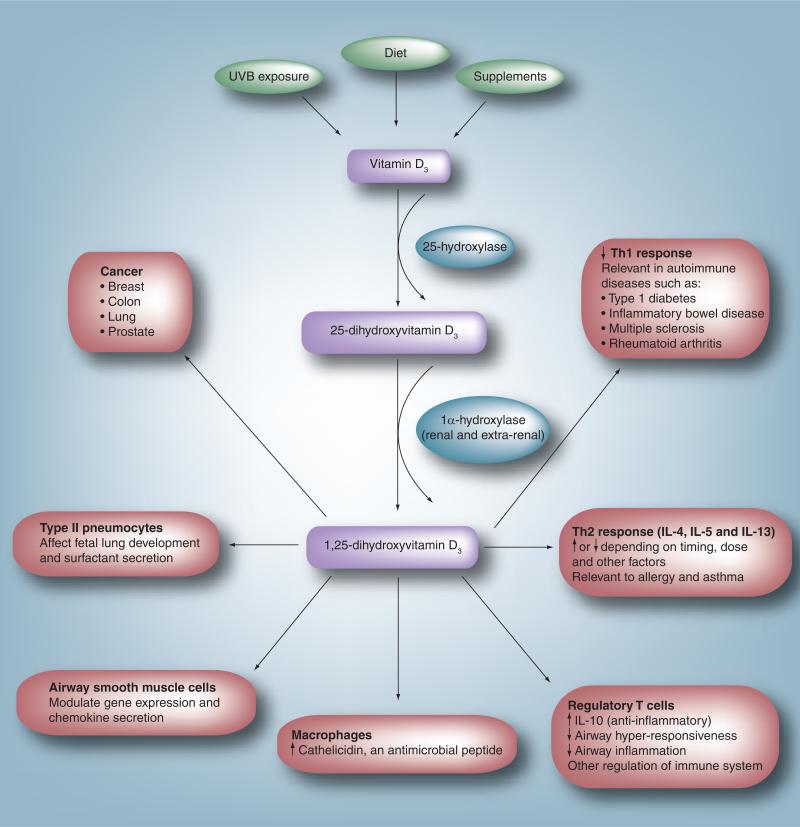
In humans, vitamin D is obtained through ultraviolet B exposure, diet and supplement intake. It is converted to 25-hydroxyvitamin D3 by the liver. Circulating 25-hydroxyvitamin D3 is converted to the active form, 1,25-dihydroxyvitamin D3, in a variety of sites including the kidney and cells of the immune system. Experimental evidence suggests an effect of 1,25-dihydroxyvitamin D3 on multiple different processes and cell types. In the immune system it leads to a decrease in the Th1 response, thought to be the mechanism involved in the association between low vitamin D levels and a variety of autoimmune diseases. It modulates the Th2 response affecting cytokines such as IL-4, IL-5 and IL-13. This is one possible link between vitamin D and allergy/asthma. It has been shown to upregulate T-regulatory cells, leading to an increase in the synthesis of the anti-inflammatory cytokine IL-10. In macrophages, vitamin D upregulates synthesis of the antimicrobial peptide cathelicidin, which may enhance the ability to fight infections. In airway smooth muscle cells, it has been shown to modulate chemokine release. Vitamin D may play a role in fetal lung development and in the differentiation of type II pneumocytes and surfactant secretion. Vitamin D has also been associated with a lower incidence of and mortality from a variety of cancers.
References
-
- Liu PT, Stenger S, Tang DH, Modlin RL. Cutting edge: vitamin D-mediated human antimicrobial activity against Mycobacterium tuberculosis is dependent on the induction of cathelicidin. J. Immunol. 2007;179(4):2060–2063. - PubMed
-
- Ginde AA, Mansbach JM, Camargo CA., Jr Association between serum 25-hydroxyvitamin D level and upper respiratory tract infection in the Third National Health and Nutrition Examination Survey. Arch. Intern. Med. 2009;169(4):384–390. [Recent study looking at Third National Health and Nutrition Examination Survey data showing an association between low 25-hydroxyvitamin D levels and recent upper respiratory tract infection. This association was stronger in patients with lung disease such as asthma or coronary obstructive pulmonary disease] - PMC - PubMed
-
- Karatekin G, Kaya A, Salihoglu O, Balci H, Nuhoglu A. Association of subclinical vitamin D deficiency in newborns with acute lower respiratory infection and their mothers. Eur. J. Clin. Nutr. 2007;63(4):473–477. - PubMed
-
- Laaksi I, Ruohola JP, Tuohimaa P, et al. An association of serum vitamin D concentrations < 40 nmol/l with acute respiratory tract infection in young Finnish men. Am. J. Clin. Nutr. 2007;86(3):714–717. - PubMed
-
- Wayse V, Yousafzai A, Mogale K, Filteau S. Association of subclinical vitamin D deficiency with severe acute lower respiratory infection in Indian children under 5 y. Eur. J. Clin. Nutr. 2004;58(4):563–567. - PubMed
Websites
-
- ClinicalTrials.gov. Randomized trial: Maternal Vitamin D Supplementation to Prevent Childhood Asthma (VDAART) http://clinicaltrials.gov/ct2/show/NCT00920621.
-
- ClinicalTrials.gov. Vitamin D for the Treatment of Severe Asthma http://clinicaltrials.gov/ct2/show/NCT00712205.
Grants and funding
LinkOut - more resources
Full Text Sources
