. 2009 Nov 6:3:41.
doi: 10.3389/neuro.08.041.2009. eCollection 2009.

Effect of Childhood Trauma on Adult Depression and Neuroendocrine Function: Sex-Specific Moderation by CRH Receptor 1 Gene

Affiliations

Effect of Childhood Trauma on Adult Depression and Neuroendocrine Function: Sex-Specific Moderation by CRH Receptor 1 Gene

Christine Heim et al. Front Behav Neurosci. .

Abstract

Variations of the corticotropin-releasing hormone receptor 1 (CRHR1) gene appear to moderate the development of depression after childhood trauma. Depression more frequently affects women than men. We examined sex differences in the effects of the CRHR1 gene on the relationship between childhood trauma and adult depression. We recruited 1,063 subjects from the waiting rooms of a public urban hospital. Childhood trauma exposure and symptoms of depression were assessed using dimensional rating scales. Subjects were genotyped for rs110402 within the CRHR1 gene. An independent sample of 78 subjects underwent clinical assessment, genotyping, and a dexamethasone/CRH test. The age range at recruitment was 18-77 years and 18-45, for the two studies respectively. In the hospital sample, the protective effect of the rs110402 A-allele against developing depression after childhood trauma was observed in men (N = 424), but not in women (N = 635). In the second sample, the rs110402 A-allele was associated with decreased cortisol response in the dexamethasone/CRH test only in men. In A-allele carriers with childhood trauma exposure women exhibited increased cortisol response compared men; there were no sex differences in A-allele carriers without trauma exposure. This effect may, however, not be related to gender differences per se, but to differences in the type of experienced abuse between men and women. CRHR x environment interactions in the hospital sample were observed with exposure to physical, but not sexual or emotional abuse. Physical abuse was the most common type of abuse in men in this cohort, while sexual abuse was most commonly suffered by women. Our results suggest that the CRHR1 gene may only moderate the effects of specific types of childhood trauma on depression. Gender differences in environmental exposures could thus be reflected in sex-specific CRHR1 x child abuse interactions.

Keywords: CRH receptor; HPA-axis; depression; dex-CRH test; endocrine; gene x environment interaction; genetics; polymorphism.


Figures
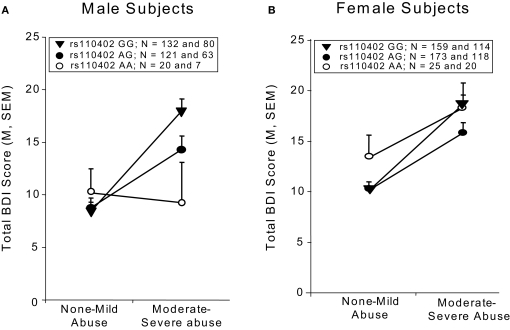
Figure 1
Figure 1
Interaction of CRHR1 rs110402 genotype and childhood abuse exposure on current depressive symptoms in men (N = 424) and women (N = 635). Graph depicts mean (SEM) total BDI scores in subjects grouped according to rs110402 allele status (GG, AG, AA) and exposure to none-mild versus moderate-severe childhood abuse. (A) In men, there was a significant main effect of childhood abuse exposure (F1, 423 = 8.20, p = 0.004) and a significant interaction effect of rs110402 by childhood abuse exposure (F2,423 = 3.50, p = 0.031) on BDI scores. (B) In women, there was a significant main effect of childhood abuse exposure on BDI score (F1,634 = 25.0, p < 0.0001), but no significant gene-environment interaction of rs110402 and childhood abuse exposure on BDI scores. The genotype distribution is given in the figure legend, with the first number representing the N in the non-mild abuse group and the second number the N in the moderate to severe abuse exposure group.
Figure 2
Figure 2
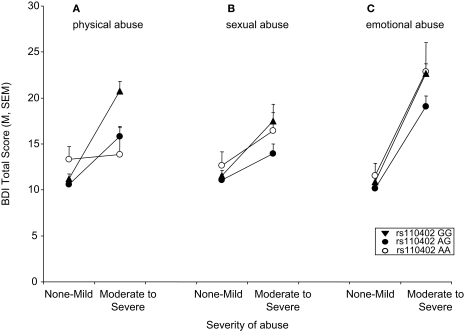
Interaction of CRHR1 rs110402 genotype and subtype of childhood abuse exposure on current depressive symptoms (N = 1058). (A) There was a significant interaction of moderate to severe physical abuse with rs110402 genotype (F2,1058 = 5.45, p = 0.004). The genotype distribution was as follows: AA = 58, AG = 372, GG = 402 for the none-mild childhood abuse exposure group and AA = 14, AG = 103, GG = 110 for the moderate-severe childhood abuse exposure group. (B) There was no significant interaction of moderate to severe sexual abuse with rs110402 genotype. The genotype distribution was as follows: AA = 57, AG = 364, GG = 366 for the none-mild childhood abuse exposure group and AA = 15, AG = 111, GG = 145 for the moderate-severe childhood abuse exposure group. (C) There was no significant interaction of moderate to severe emotional abuse with rs110402 genotype. The genotype distribution was as follows: AA = 60, AG = 390, GG = 409 for the none-mild childhood abuse exposure group and AA = 12, AG = 85, GG = 103 for the moderate-severe childhood abuse exposure group.
Figure 3
Figure 3
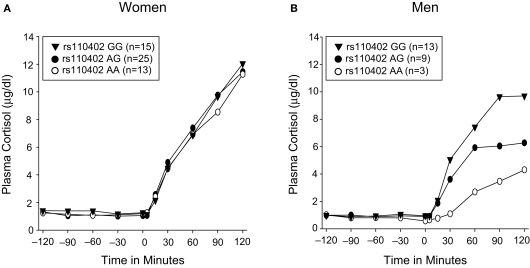
Effect of CRHR1 rs110402 on cortisol response in the dexamethasone/CRH test in women (N = 53) versus men (N = 25). Graph depicts mean plasma cortisol concentrations (μg/dl) in subjects grouped according to rs110402 allele status (GG, AG, AA). Subjects with 1 or 2 A alleles (AG or AA) were pooled for statistical analysis and compared with subjects carrying GG-alleles (see text). (A) In women, repeated measures ANOVA only revealed a significant main effect for the time factor (F10, 500 = 68.486, p < 0.001), indicating similar increases in cortisol concentrations in all groups. (B) In men, repeated measures ANOVA revealed a significant interaction of time by genotype (F10,230 = 2.225, p = 0.017), indicating decreased response in men carrying the A allele compared to men homozygous GG.
Figure 4
Figure 4
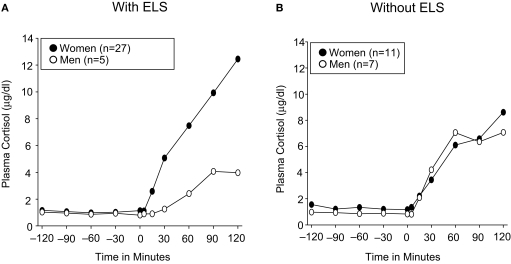
Effect of sex on cortisol response in dexamethasone/CRH test in carriers of the CRHR1 rs110402 A allele with (N = 32) and without (N = 18) histories of childhood trauma. Graph depicts mean plasma cortisol concentrations (μg/dl) in subjects grouped by sex. (A) In A allele carriers with moderate-severe childhood trauma exposure, repeated measures ANOVA revealed a significant interaction effect of time by genotype (F10,300 = 3.652, p < 0.001), indicating increased response in women compared to men. (B) In A allele carriers without moderate-severe childhood trauma exposure, repeated measures ANOVA only revealed a significant main effect of the time factor (F10,160 = 15.173, p < 0.001), indicating similar increases in cortisol concentrations in women and men.

References

    1. Beck A. T., Ward C. H., Mendelson M., Mock J., Erbaugh J. (1961). An inventory for measuring depression. Arch. Gen. Psychiatry 4, 561–571 - PubMed
    1. Bernstein D., Fink L. (1998). Childhood Trauma Questionnaire. A Retrospective Self-Report Questionnaire and Manual. San Antonio, The Psychological Corporation
    1. Bernstein D. P., Stein J. A., Newcomb M. D., Walker E., Pogge D., Ahluvalia T., Stokes J., Handelsman L., Medrano M., Desmond D., Zule W. (2003). Development and validation of a brief screening version of the Childhood Trauma Questionnaire. Child Abuse Negl. 27, 169–19010.1016/S0145-2134(02)00541-0 - DOI - PubMed
    1. Bifulco A., Brown G. W., Adler Z. (1991). Early sexual abuse and clinical depression in adult life. Br. J. Psychiatry 159, 115–12210.1192/bjp.159.1.115 - DOI - PubMed
    1. Binder E. B., Bradley R. G., Liu W., Epstein M. P., Deveau T. C., Mercer K. B., Tang Y., Gillespie C. F., Heim C. M., Nemeroff C. B., Schwartz A. C., Cubells J. F., Ressler K. J. (2008). Association of FKBP5 polymorphisms and childhood abuse with risk of posttraumatic stress disorder symptoms in adults. J. Am. Med. Assoc. 299, 1–1510.1001/jama.299.11.1291 - DOI - PMC - PubMed

LinkOut - more resources