. 2010 Feb 3:2:1.
doi: 10.3389/neuro.14.001.2010. eCollection 2010.

Persistent mitochondrial damage by nitric oxide and its derivatives: neuropathological implications

Affiliations

Persistent mitochondrial damage by nitric oxide and its derivatives: neuropathological implications

Juan P Bolaños et al. Front Neuroenergetics. .

Abstract

Approximately 15 years ago we reported that cytochrome c oxidase (CcO) was persistently inhibited as a consequence of endogenous induction and activation of nitric oxide ((*)NO) synthase-2 (NOS2) in astrocytes. Furthermore, the reactive nitrogen species implicated was peroxynitrite. In contrast to the reversible inhibition by (*)NO, which occurs rapidly, in competition with O(2), and has signaling regulatory implications, the irreversible CcO damage by peroxynitrite is progressive in nature and follows and/or is accompanied by damage to other key mitochondrial bioenergetic targets. In purified CcO it has been reported that the irreversible inhibition occurs through a mechanism involving damage of the heme a(3)-Cu(B) binuclear center leading to an increase in the K(m) for oxygen. Astrocyte survival, as a consequence of peroxynitrite exposure, is preserved due to their robust bioenergetic and antioxidant defense mechanisms. However, by releasing peroxynitrite to the neighboring neurons, whose antioxidant defense can, under certain conditions, be fragile, activated astrocytes trigger bioenergetic stress leading to neuronal cell death. Thus, such irreversible inhibition of CcO by peroxynitrite may be a plausible mechanism for the neuronal death associated with neurodegenerative diseases, in which the activation of astrocytes plays a crucial role.

Keywords: astrocytes; cytochrome c oxidase; neurodegeneration; neurons; nitric oxide; peroxynitrite.


Figures
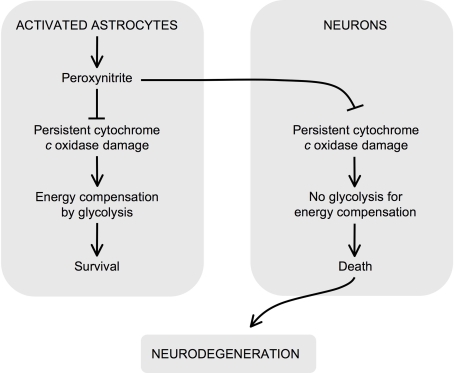
Figure 1
Figure 1
Role for irreversible inhibition of cytochrome c oxidase in neurodegeneration. Peroxynitrite can be formed in astrocytes upon activation. In astrocytes, peroxyntrite irreversibly damages cytochrome c oxidase, which causes mitochondrial dysfunction. However, these cells compensate the energy deficiency by activating glycolysis and survive. Peroxynitrite is a highly diffusible molecule, and hence it reaches neighboring neurons, where it irreversibly damages cytochrome c oxidase. In contrast to astrocytes, neurons cannot up-regulate the energy-compensating glycolysis and hence they die by bioenergetic crisis. Thus, the irreversible inhibition of cytochrome c oxidase by peroxynitrite has a critical negative effect on neuronal survival and may contribute to the propagation of neurodegeneration.

References

    1. Almeida A., Bolaños J. P., Medina J. M. (1999). Nitric oxide mediates glutamate-induced mitochondrial depolarization in rat cortical neurons. Brain Res. 816, 580–586 10.1016/S0006-8993(98)01240-2 - DOI - PubMed
    1. Almeida A., Moncada S., Bolaños J. P. (2004). Nitric oxide switches on glycolysis through the AMP protein kinase and 6-phosphofructo-2-kinase pathway. Nat. Cell Biol. 6, 45–51 10.1038/ncb1080 - DOI - PubMed
    1. Atamna H., Frey W. H., II (2007). Mechanisms of mitochondrial dysfunction and energy deficiency in Alzheimer's disease. Mitochondrion 7, 297–310 10.1016/j.mito.2007.06.001 - DOI - PubMed
    1. Bal-Price A., Matthias A., Brown G. C. (2002). Stimulation of the NADPH oxidase in activated rat microglia removes nitric oxide but induces peroxynitrite production. J. Neurochem. 80, 73–80 10.1046/j.0022-3042.2001.00675.x - DOI - PubMed
    1. Barker J. E., Bolaños J. P., Land J. M., Clark J. B., Heales S. J. R. (1996). Glutathione protects astrocytes from peroxynitrite-mediated mitochondrial damage: implications for neuronal/astrocytic trafficking and neurodegeneration. Dev. Neurosci. 18, 391–396 10.1159/000111432 - DOI - PubMed

LinkOut - more resources
