


Erratum to: Blood HbO2 and HbCO2 dissociation curves at varied O2, CO2, pH, 2,3-DPG and temperature levels
- PMID: 20162361
- PMCID: PMC2862600
- DOI: 10.1007/s10439-010-9948-y
Erratum to: Blood HbO2 and HbCO2 dissociation curves at varied O2, CO2, pH, 2,3-DPG and temperature levels
Abstract
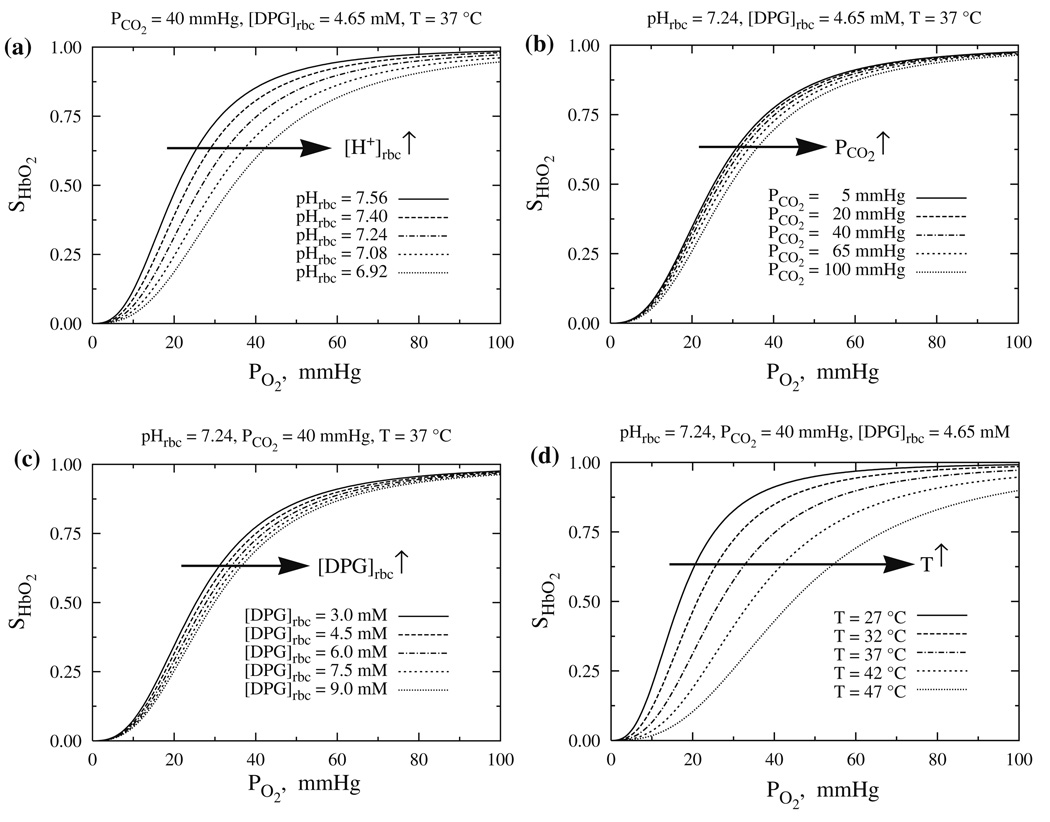
New mathematical model equations for O(2) and CO(2) saturations of hemoglobin (S(HbO)(2) and S(HbCO)(2) are developed here from the equilibrium binding of O(2) and CO(2) with hemoglobin inside RBCs. They are in the form of an invertible Hill-type equation with the apparent Hill coefficients KHbO(2) and KHbCO(2) in the expressions for SHbO(2) and SHbCO(2) dependent on the levels of O(2) and CO(2) partial pressures (P(O)(2) and P(CO)(2)), pH, 2,3-DPG concentration, and temperature in blood. The invertibility of these new equations allows PO(2) and PCO(2) to be computed efficiently from S(HbO)(2) and S(HbCO)(2) and vice versa. The oxyhemoglobin (HbO(2)) and carbamino-hemoglobin (HbCO(2)) dissociation curves computed from these equations are in good agreement with the published experimental and theoretical curves in the literature. The model solutions describe that, at standard physiological conditions, the hemoglobin is about 97.2% saturated by O(2) and the amino group of hemoglobin is about 13.1% saturated by CO(2). The O(2) and CO(2) content in whole blood are also calculated here from the gas solubilities, hematocrits, and the new formulas for S(HbO)(2) and S(HbCO)(2). Because of the mathematical simplicity and invertibility, these new formulas can be conveniently used in the modeling of simultaneous transport and exchange of O(2) and CO(2) in the alveoli-blood and blood-tissue exchange systems.
Figures




Corrected and republished from
-
Blood HbO2 and HbCO2 dissociation curves at varied O2, CO2, pH, 2,3-DPG and temperature levels.Ann Biomed Eng. 2004 Dec;32(12):1676-93. doi: 10.1007/s10439-004-7821-6. Ann Biomed Eng. 2004. Corrected and republished in: Ann Biomed Eng. 2010 Apr;38(4):1683-701. doi: 10.1007/s10439-010-9948-y. PMID: 15682524 Corrected and republished.
References
-
- Adair GS. The hemoglobin system. VI. The oxygen dissociation curve of hemoglobin. J. Biol. Chem. 1925;63:529–545.
-
- Antonini E, Brunori M. Hemoglobin and Myoglobin in Their Reactions with Ligands. Amsterdam: North Holland; 1971. p. 436.
-
- Austin WH, Lacombe E, Rand PW, Chatterjee M. Solubility of carbon dioxide in serum from 15 to 38°C. J. Appl. Physiol. 1963;18:301–304. - PubMed
-
- Bauer C, Klocke RA, Kamp D, Forster RE. Effect of 2,3-diphosphoglycerate and H+ on the reaction of O2 and hemoglobin. Am. J. Physiol. 1973;224:838–847. - PubMed
-
- Baumann R, Bartels H, Bauer C. Handbook of Physiology, Sect 3: The Respiratory System. Vol IV. Gas Exchange. Bethesda, Maryland: American Physiological Society; 1987. Blood oxygen transport; pp. 147–172.
Publication types
MeSH terms
Substances
Grants and funding
LinkOut - more resources
Full Text Sources
Other Literature Sources
Molecular Biology Databases
