. 2010 Mar;62(3):173-84.
doi: 10.1007/s00251-010-0425-4. Epub 2010 Feb 17.

Immunoglobulin heavy chain diversity in Pteropid bats: evidence for a diverse and highly specific antigen binding repertoire

Affiliations

Immunoglobulin heavy chain diversity in Pteropid bats: evidence for a diverse and highly specific antigen binding repertoire

Michelle L Baker et al. Immunogenetics. 2010 Mar.

Abstract

Bats are the natural host reservoir for range of emerging and re-emerging viruses, many of which cause significant morbidity and mortality in other mammals, yet appear to result in no clinical consequences for bats. The ability of bats to coexist with a variety of viruses presents an interesting immunological problem that has not been examined in any detail but which could provide significant insights into the evolution of antiviral mechanisms in mammals. Towards a better understanding of the bat immune system, we analysed the expressed heavy chain variable (VH) regions of antibodies from the black flying fox, Pteropus alecto. The germline repertoire of the closely related Pteropid bat, Pteropus vampyrus, whose genome has been sequenced was also examined for comparative purposes. Representative VH genes were found in all three mammalian VH clans (I, II and III) in both the expressed P. alecto VH repertoire and the germline P. vampyrus VH repertoire. Evidence for the use of multiple heavy chain diversity (DH) and joining (JH) segments for the generation of diverse VDJ rearrangements was also present in the expressed antibody repertoire of P. alecto. The long period of co-evolutionary history of bats with viruses may have resulted in a variety of highly specific VH segments being hardwired into the genomes of bats and may have implications for their ability to successfully cope with a diversity of viral antigens.


Figures
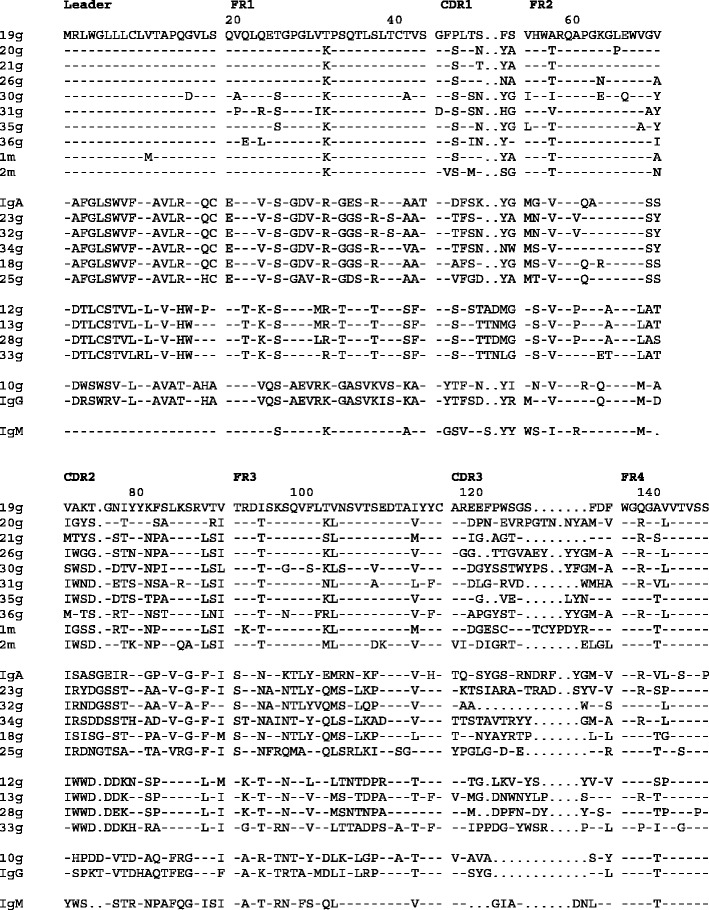
Fig. 1
Fig. 1
Alignment of deduced amino acid sequences of 23 P. alecto VHs. The designation following the clone number refers to isolation by RACE-PCR using Cμ (m) or Cγ (g) specific primers. IgM, IgG and IgA clones refer to VH regions obtained from full-length clones. Sequences are aligned based on sequence similarity in the VH region. Dashes indicate similarity and dots indicate gaps
Fig. 2
Fig. 2
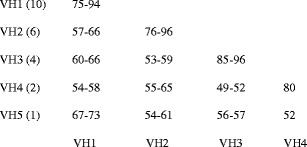
Range of per cent nucleotide identity between 23 P. alecto VH sequences based on an alignment of the region corresponding to FR1 to FR3 inclusive of CDRs. Numbers in parentheses indicate number of clones isolated from each family
Fig. 3
Fig. 3
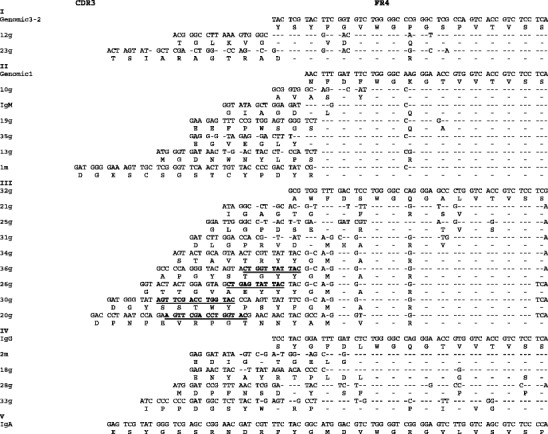
Nucleotide and amino acid translation from CD3 to FR4 of 23 different P. alecto VH sequences and two germline JH segments (germline3-2 and germline1). Roman numerals indicate the five different groups of JH segments. Regions of homology within the CDR3 region of different clones are shown underlined in bold. Dashes indicate similarity
Fig. 4
Fig. 4
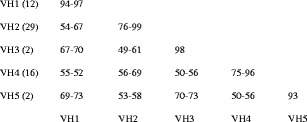
Range of per cent nucleotide identity between 61 P. vampyrus VH sequences based on an alignment of the region corresponding to FR1 to FR3 inclusive of CDRs. Numbers in parentheses indicate number of sequences identified from each family
Fig. 5
Fig. 5
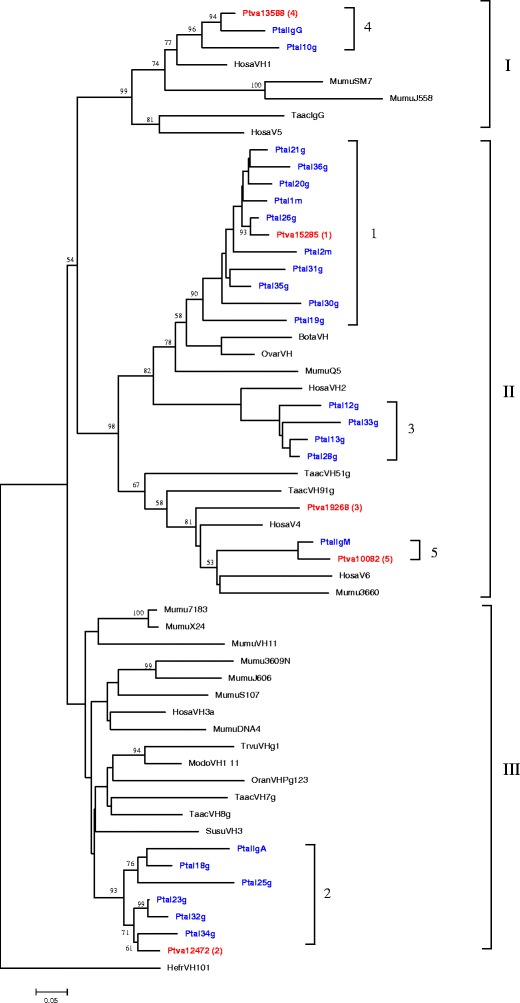
Phylogenetic tree based on alignments of VH sequences from P. alecto, P. vampyrus and representatives of other mammals and one non-mammal. All P. alecto sequences are shown in blue and P. vampyrus sequences are shown red in the tree. The tree was constructed using the NJ method (Saitou and Nei 1987). The numbers on the branch nodes indicate bootstrap values based on 1,000 replicates. Roman numerals on the right indicate the three VH clans (Tutter and Riblet 1989). Numbers within the three clans indicate the P. alecto VH family identified by pairwise analysis (Fig. 2). Species names are: B. taurus (Bota), H. sapiens (Hosa), H. fransciscii (Hefr), M. domestica (Modo), M. musculus (Mumu), O. aries (Ovar), O. anatinus (Oran), P. alecto (Ptal), P. vampyrus (Ptva) S. scrofa (Susc), T. vulpecula (Trvu), T. aculeatus (Taac). Numbers after the P. vampyrus sequences correspond to scaffolds in the P. vampyrus whole genome assembly, and numbers in parentheses indicate the five P. alecto families identified by pairwise analysis (Fig. 2)

References

    1. Altschul SF, Gish W, Miller W, Myers EM, Lipman DJ. Basic local alignment search tool. J Mol Evol. 1990;215:403–410. - PubMed
    1. Baker ML, Belov K, Miller RD. Unusually similar patterns of antibody V segment diversity in distantly related marsupials. J Immunol. 2005;174:5665–5671. - PubMed
    1. Berens SJ, Wylie DE, Lopez OJ. Use of a single VH family and long CDR3s in the variable region of cattle Ig heavy chains. Int Immunol. 1997;9:189–199. doi: 10.1093/intimm/9.1.189. - DOI - PubMed
    1. Birtalan S, Zhang Y, Fellouse FA, Shao L, Schaefer G, Sidhu SS. The intrinsic contributions of tyrosine, serine, glycine and arginine to the affinity and specificity of antibodies. J Mol Biol. 2008;377:1518–1528. doi: 10.1016/j.jmb.2008.01.093. - DOI - PubMed
    1. Bossart KN, Tachedjian M, McEachern JA, Crameri G, Zhu Z, Dimitrov DS, Broder CC, Wang LF. Functional studies of host-specific ephrin-B ligands as Henipavirus receptors. Virology. 2008;72:357–371. doi: 10.1016/j.virol.2007.11.011. - DOI - PubMed

Publication types

MeSH terms

LinkOut - more resources