


Evaluation of chromogenic media for detection of methicillin-resistant Staphylococcus aureus
- PMID: 20164268
- PMCID: PMC2849574
- DOI: 10.1128/JCM.01745-09
Evaluation of chromogenic media for detection of methicillin-resistant Staphylococcus aureus
Abstract
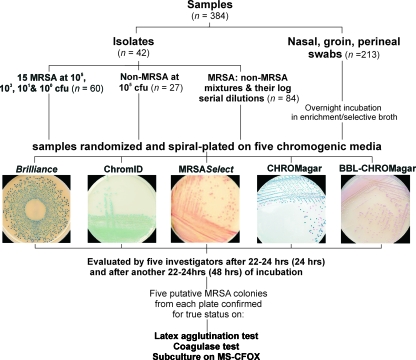
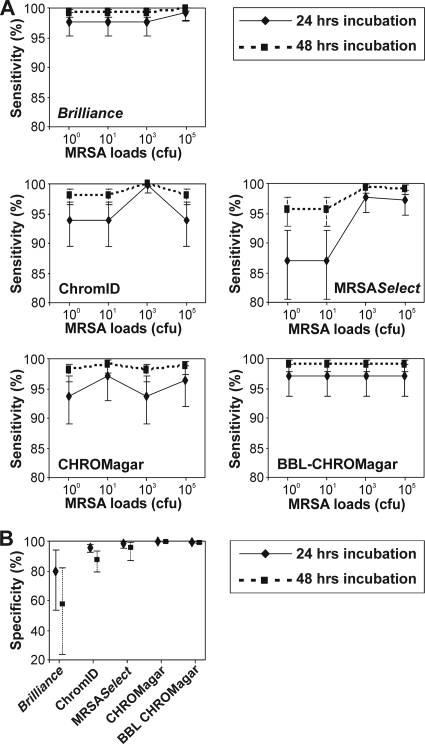
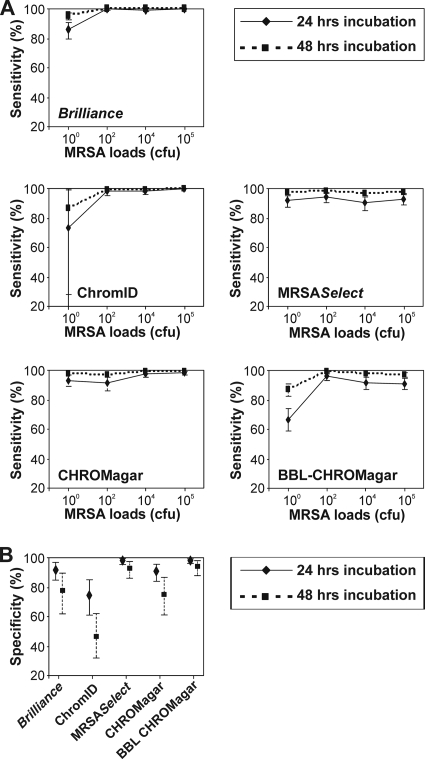
Rapid laboratory diagnosis is critical for treating, managing, and preventing methicillin-resistant Staphylococcus aureus (MRSA) infections. We evaluated and compared the potential for MRSA detection of five chromogenic media, Brilliance MRSA agar (Oxoid), ChromID (bioMérieux), MRSASelect (Bio-Rad), CHROMagar (CHROMagar Microbiology), and BBL-CHROMagar (BD Diagnostics). Media were tested with log serial dilutions (10(0) to 10(6) CFU) of pure isolates of MRSA (n = 60), non-MRSA (n = 27), and defined mixtures thereof simulating clinical samples (n = 84). Further evaluations were done on pre-enriched nasal and groin screening swabs (n = 213) from 165 hospitalized patients. Randomized samples were spiral plated on each medium and independently scored by five investigators for characteristic colonies at 24 and 48 h of incubation. Confirmatory testing of up to five putative MRSA colonies recovered from each medium was done. The cumulative average sensitivity with isolates, mixtures, and clinical samples was the highest for Brilliance MRSA agar (97%) and similar for the other four media (>or=92%). The cumulative average specificity was the highest for BBL-CHROMagar (99%), followed by MRSASelect (98%), CHROMagar (97%), ChromID (89%), and Brilliance MRSA agar (86%). All of the media detected MRSA at 10 and 1 CFU, although at these low loads, few MRSA samples harboring SCCmec type III or IV were misinterpreted as non-MRSA by investigators. False-positive results were mainly due to methicillin-resistant S. epidermidis. For an arbitrary MRSA prevalence of 5% and based on patient sample evaluations, the positive predictive values for BBL-CHROMagar and CHROMagar ( approximately 84%) were the highest. The negative predictive values of all of the media were >or=92% for MRSA prevalences ranging from 5% to 30%. In conclusion, BBL-CHROMagar and CHROMagar gave the best overall results for detection of MRSA, irrespective of the sample concentration, investigator, or incubation period.
Figures
References
-
- Aires De Sousa, M., I. Santos Sanchez, M. L. Ferro, and H. de Lencastre. 2000. Epidemiological study of staphylococcal colonization and cross-infection in two West African hospitals. Microb. Drug Resist. 6:133-141. - PubMed
-
- Becker, K., I. Pagnier, B. Schuhen, F. Wenzelburger, A. W. Friedrich, F. Kipp, G. Peters, and C. von Eiff. 2006. Does nasal cocolonization by methicillin-resistant coagulase-negative staphylococci and methicillin-susceptible Staphylococcus aureus strains occur frequently enough to represent a risk of false-positive methicillin-resistant S. aureus determinations by molecular methods? J. Clin. Microbiol. 44:229-231. - PMC - PubMed
-
- Cherkaoui, A., G. Renzi, P. Francois, and J. Schrenzel. 2007. Comparison of four chromogenic media for culture-based screening of meticillin-resistant Staphylococcus aureus. J. Med. Microbiol. 56:500-503. - PubMed
-
- Clinical and Laboratory Standards Institute. 2005. Performance standards for antimicrobial susceptibility testing. Fifteenth informational supplement, M100-S15. Clinical and Laboratory Standards Institute, Wayne, PA.
Publication types
MeSH terms
Substances
LinkOut - more resources
Full Text Sources
Medical
