


Risk of complication and revision total hip arthroplasty among Medicare patients with different bearing surfaces
- PMID: 20165935
- PMCID: PMC2914292
- DOI: 10.1007/s11999-010-1262-3
Risk of complication and revision total hip arthroplasty among Medicare patients with different bearing surfaces
Abstract
Background: To address the long-term problems of bearing surface wear and osteolysis associated with conventional metal-polyethylene (M-PE) total hip arthroplasty (THA), metal-metal (M-M), and ceramic-ceramic (C-C) bearings have been introduced. These bearing surfaces are associated with unique risks and benefits and higher costs. However the relative risks of these three bearings in an older population is unknown.
Questions/purposes: We compared the short-term risk of complication and revision THA among Medicare patients having a primary THA with metal-polyethylene (M-PE), metal-metal (M-M), and ceramic-ceramic (C-C) bearings.
Methods: We used the 2005 to 2007 100% Medicare inpatient claim files to perform a matched cohort analysis in three separate cohorts of THA patients (M-PE, M-M, and C-C) who were matched by age, gender, and US census region. Multivariate Cox proportional-hazards models were constructed to compare complication and revision THA risk among cohorts, adjusting for medical comorbidities, race, socioeconomic status, and hospital factors.
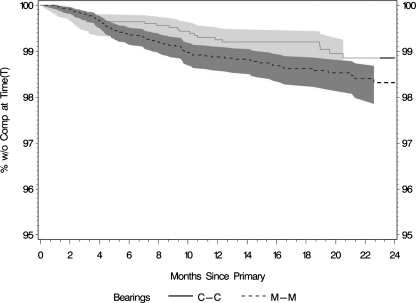
Results: After adjusting for patient and hospital factors, M-M bearings were associated with a higher risk of periprosthetic joint infection (hazard ratio, 3.03; confidence interval, 1.02-9.09) when compared with C-C bearings (0.59% versus 0.32%, respectively). There were no other differences among bearing cohorts in the adjusted risk of revision THA or any other complication.
Conclusions: The risk of short-term complication (including dislocation) and revision THA were similar among appropriately matched Medicare THA patients regardless of bearing surface. Hard-on-hard THA bearings are of questionable value in Medicare patients, given the higher cost associated with their use and uncertain long-term benefits in older patients.
Level of evidence: Level II, prognostic study. See Guidelines for Authors for a complete description of levels of evidence.
Figures
References
-
- Agency for Healthcare Research and Quality. HCUP Databases. Healthcare Cost and Utilization Project (HCUP). 2007. Available at: http://hcupnet.ahrq.gov/. Accessed January 9, 2009.
-
- Australian Orthopaedic Association National Joint Replacement Registry Web site. Hip and Knee Arthroplasty. Annual Report 2009. Available at: http://www.dmac.adelaide.edu.au/aoanjrr/publications.jsp. Accessed January 9, 2009.
-
- Berry DJ, Harmsen WS, Cabanela ME, Morrey BF. Twenty-five-year survivorship of two thousand consecutive primary Charnley total hip replacements: factors affecting survivorship of acetabular and femoral components. J Bone Joint Surg Am. 2002;84:171–177. - PubMed
-
- Berry DJ, von Knoch M, Schleck CD, Harmsen WS. The cumulative long-term risk of dislocation after primary Charnley total hip arthroplasty. J Bone Joint Surg Am. 2004;86:9–14. - PubMed
