


Cesarean delivery for the prevention of anal incontinence
- PMID: 20166087
- PMCID: PMC6481416
- DOI: 10.1002/14651858.CD006756.pub2
Cesarean delivery for the prevention of anal incontinence
Abstract
Background: Caesarean delivery (CD) is a common form of delivery of a baby, rising in frequency. One reason for its performance is to preserve maternal pelvic floor function, part of which is anal continence.
Objectives: To assess the ability of CD in comparison to vaginal delivery (VD) to preserve anal continence in a systematic review
Search strategy: Search terms include: "Caesarean section, Cesarean delivery, vaginal delivery, incontinence and randomised". PubMed, EMBASE and the Cochrane Central Register of Controlled Trials (Central) were searched from their inception through July, 2009.
Selection criteria: Both randomised and non-randomised studies that allowed comparisons of post partum anal continence (both fecal and flatus) in women who had had babies delivered by either CD or VD were included.
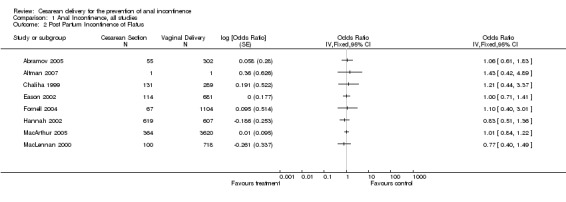
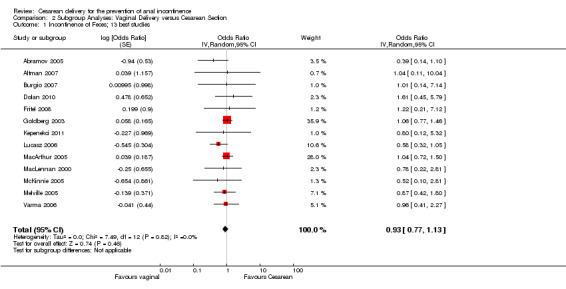
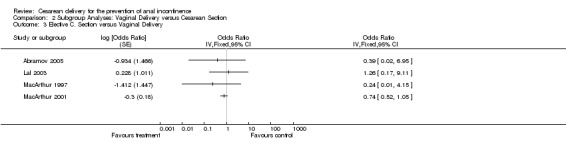
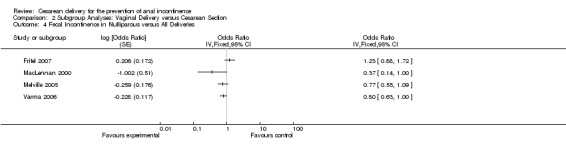
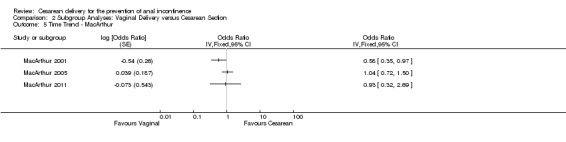
Data collection and analysis: Mode of delivery, and when possible mode of all previous deliveries prior to the index pregnancy were extracted, as well as assessment of continence post partum of both faeces and flatus. In Non-RCTs, available adjusted odds ratios were the primary end point sought. Incontinence of flatus is reported as a separate outcome. Summary odds ratios are not presented as no study was analysed as a randomised controlled trial. Numbers needed to treat (NNT) are presented, that is, the number of CDs needed to be performed to prevent a single case of fecal or flatus incontinence, for each individual study. Quality criteria were developed, selecting studies that allowed maternal age adjustment, studies that allowed a sufficient time after the birth of the baby for continence assessment and studies in which mode of delivery of prior pregnancies was known. Subgroup analyses were done selecting studies meeting all quality criteria and in comparisons of elective versus emergency CD, elective CD versus VD and nulliparous women versus those delivered by VD or CD, in each case again, not calculating a summary risk statistic.
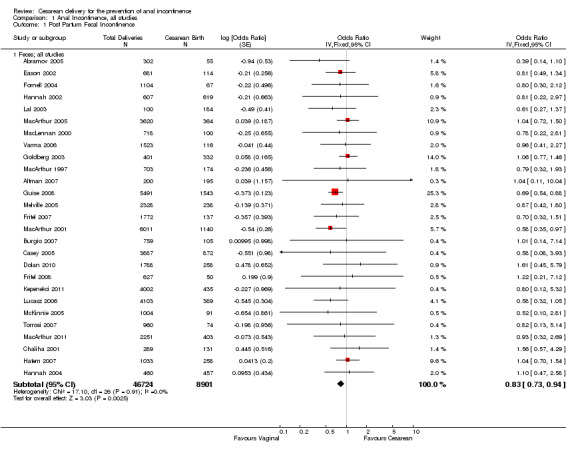
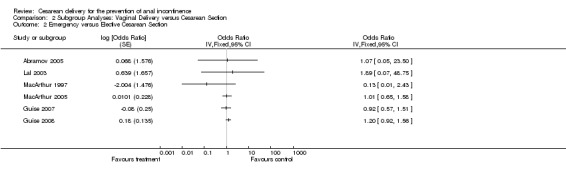
Main results: Twentyone reports have been found eligible for inclusion in the review, encompassing 31,698 women having had 6,028 CDs and 25,170 VDs as the index event prior to anal continence assessment . Only one report randomised women (with breech presentation) to CD or VD, but because of extensive crossing over, 52.1%, after randomisation, it was analysed along with the other 20 studies as treated, i.e. as a non-randomised trial. Only one of these reports demonstrated a significant benefit of CD in the preservation of anal continence, a report in which incontinence incidence was extremely high, 39% in CD and 48% in VD, questioning, relative to other reports, the timing and nature of continence assessment. The greater the quality of the report, the closer its Odds ratio approached 1.0. There was no difference in continence preservation in women have emergency versus elective CD.
Authors' conclusions: Without demonstrable benefit, preservation of anal continence should not be used as a criterion for choosing elective primary CD. The strength of this conclusion would be greatly strengthened if there were studies that randomised women with average risk pregnancies to CD versus VD.
Conflict of interest statement
None known
Figures
Update of
References
References to studies included in this review
Abramov 2005 {published data only}
-
- Abramov Y, Sand PK, Botros SM, Goldberg RP, et al. Risk factors for female anal incontinence: new insight through the Evanston‐Northwestern twin sisters study. Obstet. & Gynecol. 2005;106:726‐32. - PubMed
Altman 2007 {published data only}
-
- Altman D, Ekstrom A, Frosgren C, Nordenstam J, Zetterstrom J. Symptoms of anal and urinary incontinence following cesarean section or spontaneous vaginal delivery. Am J Obstet. Gynecol. 2007;197:512.e1‐e7. - PubMed
Borello‐France 2006 {published data only}
-
- Borello‐France D, Burgioo KL, Richter HE, Zycziinski H, et al. Fecal and urinary incontinence in primiparous women. Obstet Gynecol 2006;108(4):863‐72. - PubMed
Burgio 2007 {published data only}
-
- Burgio KL, Borello‐France D, Richter HE, Fitzgerals MP, et al. Risk factors for fecal and urinary incontinence after childbirth: the childbirth and pelvic symptoms study.. Am J Gastro 2007;102:1998‐2004. - PubMed
Casey 2005 {published data only}
-
- Casey BM, Schaffer JI, Bloom SL, Heartwell SF, et al. Obstetric antecedents for postpartum pelvic floor dysfunction. Am J Obstet Gynecol 2005;192:1655‐62. - PubMed
Chaliha 1999 {published data only}
-
- Chaliha C, Kalia V, Stanton SL, Monga A, Sultan AH. Antenatal prediction of postpartum urinary and fecal incontinence. Obstet. & Gynecol. 1999;94:689‐94. - PubMed
Chaliha 2001 {published data only}
-
- Chaliha C, Sultan AH, Bland JM, Monga A, Stanton SL. Anal function: effect of pregnancy and delivery. Am J Obstet. & Gynecol 2001;185:427‐32. - PubMed
Dolan 2010 {published data only}
-
- Dolan LM, Hilton P. Obstetric risk factors and pelvic floor dysfunction 20 years after first delivery. Int Urogynecol J 2010;21(5):535‐44. - PubMed
Eason 2002 {published data only}
Fornell 2004 {published data only}
-
- Fornell EU, Wingren G, Kjoelhede P. Factors associated with pelvic floor dysfunction with emphasis on urinary and fecal incontinence and genital prolapse: an epidemiologic study. Acta Obstet Gynecol Scand. 2004;83:383‐9. - PubMed
Fritel 2007 {published data only}
-
- Fritel X, Ringa V, Varnous N, Zins M, Breart G. Mode of delivery and fecal incontinence at midlife. Obstet. & Gynecol. 2007;110:31‐38. - PubMed
Fritel 2008 {published data only}
Goldberg 2003 {published data only}
-
- Goldberg RP, Kwon C, Gandhi S, Atkuru LV, et al. Prevalence of anal incontinence among mothers of multiples and analysis of risk factors. Am J Obstet. Gynecol. 2003;189:1627‐31. - PubMed
Guise 2007 {published data only}
-
- Guise J‐M, Morris C, Osterweil P, Li H, Rosenberg D, Greenlick M. Incidence of fecal incontinence after childbirth. Obstet. & Gynecol. 2007;109:281‐288. - PubMed
Guise 2008 {published data only}
-
- Guise J‐M, Boyles SH, Osterwel P, Li H, Eden KB, Mori M. Does cesarean protect against fecal incontinence in primiparous women?. Int. J. Urogynecol. 2008;20:61‐67. - PubMed
Hannah 2002 {published data only}
-
- Hannah ME, Hannah WJ, Hodnett ED, et al. Outcomes at 3 months after planned Cesarean vs. planned vaginal delivery for breech presentation at term. JAMA 2002;287:1822‐31. - PubMed
Hannah 2004 {published data only}
-
- Hannah ME, Whyte H, Hannah WJ, Hewson S, Amankwah K, Cheng M, Gafni A, et al. Maternal outcomes at 2 years after planned cesarean section versus planned vaginal birth for breech presentation at term: the international randomised term breech trial.. Am J Obstet. Gynecol. 2004;191:917‐27. - PubMed
Hatem 2007 {published data only}
-
- Hatem M, Pasquier JC, Fraser W, Lepire E. Factors associated with postpartum urinary/anal incontinence in primiparious women in Quebec. J Obstet. Gynecol. 2007;29:232‐239. - PubMed
Kepenekci 2011 {published data only}
-
- Kepenekci I, Keskinkilic B, Akinsu F, Cakir P, Elhan AH, Erkek AB, Kuzu MA. Prevalence of pelvic floor disorders in the female population and the impact of age, mode of delivery and parity. Dis. Colon & Rectum 2011;54:85‐94. - PubMed
Lal 2003 {published data only}
-
- Lal M, Mann CH, Callender R, Radley S. Does Cesarean delivery prevent anal incontinence?. Obstet. & Gynecol. 2003;101:305‐12. - PubMed
Lucasz 2006 {published data only}
-
- Lucasz ES, Lawrence JM, Contreras R, Nager CW, Luber KM. Parity, mode of delivery and pelvic floor disorders.. Obstet Gynecol 2006;107:1253‐60. - PubMed
MacArthur 1997 {published data only}
-
- MacArthur C, Bick DE, Keithley MRB. Fecal incontinence after childbirth. Br J Obstet. & Gynecol. 1997;104:46‐50. - PubMed
MacArthur 2001 {published data only}
-
- MacArthur C, Glazener CMA, Wilson PD, Herbison GP. Obstetric practice and faecal incontinence three months after delivery.. Br J Obstet Gynecol 2001;108:678‐83. - PubMed
MacArthur 2005 {published data only}
-
- MacArthur C, Glazener CMA, Lancashire R, Herbison P, et al. Faecal incontinence and mode of first and subsequent delivery: a six‐year longitudinal study. Br J Obstet & Gynecol. 2005;112:1075‐82. - PubMed
MacArthur 2011 {published data only}
-
- MacArthur C, Glazener C, Lancashire R, Herbison P, Wilsond D. Exclusive caesarean section delivery and subsequent urinary and faecal incontinence: A 12‐year longitudinal study.. BJOG: An International Journal of Obstetrics and Gynaecology 2011;118(8):1001‐7. - PubMed
MacLennan 2000 {published data only}
-
- MacLennan AH, Taylor AW, Wilson DH, Wilson D. The prevalence of pelvic floor disorders and their relationship to gender, age, parity and mode of delivery. J Obstet Gynecol. 2000;107:1460‐1470. - PubMed
McKinnie 2005 {published data only}
-
- McKinnie V, Swift S, Wang W, Woodman P, O'Boyle A, Kahn M, Valley M, Bland D, Shaffer J. The effect of pregnancy and mode of delivery on the prevalence of urinary and fecal incontinence. Am J Obstet Gynec 2005:512‐8. - PubMed
Melville 2005 {published data only}
-
- Melville JL, Fan M‐Y, Newton K, Fenner D. Fecal incontinence in US women: a population‐based study. Obstet. & Gynecol. 2005;193:2071‐2076. - PubMed
Torrosi 2007 {published data only}
-
- Torrisi G, Sampugnaro E.G, Pappalardo E.M, D'Urso E, Vecchio M, Mazza A. Postpartum urinary stress incontinence: Analysis of the associated risk factors and neurophysiological tests.. Minerva Ginecologica 2007;59(5):491‐498. - PubMed
Varma 2006 {published data only}
Williams 2007 {published data only}
-
- Williams A, Herron‐Marx S, Knibb R. The prevalence of enduring postnatal perineal morbidity and its relationship to type of birth and birth risk factors. .. Journal of Clinical Nursing 16(3), 549‐561. 2007 2007;16(3):549‐61. - PubMed
References to studies excluded from this review
Bharucha 2006 {published data only}
-
- Bharucha AE, Zinsmeister AR, Locke GR, Seide BM, et al. Risk factors for fecal incontinence: a population based study in women. Am J Gastroent. 2006;101:1305‐1312. - PubMed
Bharucha 2010 {published data only}
Eogan 2011 {published data only}
-
- Eogan M, O'Brien C, Daly L, Behan M, O'Connell P.R, O'Herlihy C. The dual influences of age and obstetric history on fecal continence in parous women.. International Journal of Gynecology and Obstetrics 2011;112(2):93‐7. - PubMed
Fynes 1998 {published data only}
-
- Fynes M, Donnelly V.S, O'Connell P.R, O'Herlihy C. Cesarean delivery and anal sphincter injury.. Obstetrics and Gynecology 1998;92(41):496‐500. - PubMed
Grau 2010 {published data only}
-
- Grau J, Lacima G, Roura P, Rovira R, Estopina N, Cayuela E, Espuna M. 12 months follow‐up of post‐partum anal incontinence.. Progresos de Obstetricia y Ginecologia 2010;53(1):18‐23.
Groutz 1999 {published data only}
-
- Groutz A, Fait G, Lessing JB, et al. Incidence and obstetric risk factors of postpartum anal incontinence. Scan J Gastronet. 1999;34:15‐18. - PubMed
Hall 2003 {published data only}
-
- Hall W, McCracken K, Osterweil P, Guise J‐M. Frequency and predictors for postpartum fecal incontinence. AmJ Obstet. Gyencol. 2003;188:1205‐7. - PubMed
Lewicki‐Gaupp 2008 {published data only}
-
- Lewicky‐Gaupp C, Cao D.‐C, Culbertson S. Urinary and Anal Incontinence in African American Teenaged Gravidas during Pregnancy and the Puerperium.. Journal of Pediatric and Adolescent Gynecology 2008;21(1):21‐6. - PubMed
Okonkwo 2002 {published data only}
-
- Okonkwo J, Obionu C.N, Okonkwo C.V, Obiechina N.J.A. Anal incontinence among IGBO (Nigerian) women.. International Journal of Clinical Practice 2002;56(3):178‐180. - PubMed
Perry 2002 {published data only}
Pinta 2004 {published data only}
-
- Pinta TM, Kylanpaa M‐L, Teramo KA, Luukkonen PS. Sphincter rupture and anal incontinence after first vaginal delivery. Acta Obstet. Gynecol Scand 2004;83:917‐22. - PubMed
Roman 2004 {published data only}
-
- Roman H, Robillard P.‐Y, Payet E, Amrani R, Verspyck E, Marpeau L, Barau G. Factors associated with fecal incontinence after childbirth: Prospective study in 525 women.. Journal de Gynecologie Obstetrique et Biologie de la Reproduction 33(6 I), 497‐505. 2004. 2004;33(61):497‐505. - PubMed
Solans‐Domenech 2010 {published data only}
-
- Solans‐Domenech M, Sanchez E, Espuna‐Pons M. Urinary and anal incontinence during pregnancy and postpartum: Incidence, severity, and risk factors. .. Obstetrics and Gynecology 2010;115(3):618‐28. - PubMed
Sultan 1993 {published data only}
-
- Sultan AH, Kamm MA, Hudson CN, Thomas JM, Bartam CI. Anal sphincter disruption during vaginal delivery. N Eng J Med 1993;329:1905‐11. - PubMed
Thompson 2002 {published data only}
-
- Thompson J.F, Roberts C.L, Currie M, Ellwood D.A. Prevalence and persistence of health problems after childbirth: Associations with parity and method of birth.. Birth 2002;29(2):83‐94. - PubMed
References to studies awaiting assessment
Geissbuehler 2009 {published data only}
-
- Geissbuehler V and Raschle M.W. International Urogynecology Journal and Pelvic Floor Dysfunction Conference: 34th Annual Meeting of the International Urogynecological Association, IUGA Lago di Como Italy. Conference Start: 20090616 Conference End: 20090620. Conference Publication:(var.pagings). Urinary stress incontinence, fecal incontinence and dyspareunia one year after first delivery. Vaginal delivery is compared with cesarean section.. Urinary stress incontinence, fecal incontinence and dyspareunia one year after first delivery. Vaginal delivery is compared with cesarean section. 2009;1:50‐1.
Additional references
Abramowitz 2000
-
- Abramatowitz I, Sobhani I, Ganansia R. Are sphincter defects the cause of anal incontinence after vaginal delivery? Results of a prospective survey. Dis. Colon & Rectum 2000;43:590‐6. - PubMed
Amu 1998
-
- Amu O, Rajendran S, Bolaji II. Should doctors perform an elective Cesarean section on request? Maternal choice alone should not determine method of delivery. BMJ 1998;317:463‐5. - PubMed
Behague 2002
Declercq 2005
Devine 1999
-
- Devine JB, Ostergard DR, Noblett KL. Long term complications of the second stage of labor. Contemp Obstet Gyencol 1999;x:119‐26.
Faridi 2002
-
- Faridi FA, Willis S, Schelzig P, Siggelkow W, Schumpelick V, Rath W. Anal sphincter injury during vaginal delivery ‐ an argument for Cesarean section on request?. Perinat. Med 2002;30:379‐87. - PubMed
Farrell 2002
Goffeng 1998
-
- Goffeng AR, Andersch B, Andersson M, Berndtsson I, Hulten L, Oreslan T. Objective methods cannot predict anal incontinence after primary repair of extensive anal tears. Acta Obstet Gynecol Scand 1998;77:439‐43. - PubMed
Grady 2008
-
- Grady. After Caesareans, some see higher insurance cost. New York Times 2008, issue June 1.
Greene 2004
-
- Greene MF. Vaginal birth after Cesarean revisited. N Eng J Med 2004;351:2647‐8. - PubMed
Guise 2004
Guttierz 2005
-
- Guttierz AB, Madoff RD, Lowry AC, Parker SC, Buie WD, Baxter NN. Long term results of anterior sphincteroplasty. Dis Colon & Rectum 2004;47:727‐32. - PubMed
Halverson 2002
-
- Halverson AN, Hull TL. Lon‐term outcome of overlapping anal sphincter repair. Dis Colon & Rectum 2002;45:345‐8. - PubMed
Henderson 2001
-
- Henderson J, McClandlish R, Kumiega L, Petrou S. Systematic review of economic aspects of alternative modes of delivery. Br J Obstet Gynecol 2001;108:149‐57. - PubMed
Higgins 2008
-
- Higgins JPT, Green S (editors). Cochrane Handbook for Systematic Reviews of Interventions Version 5.0.0 [Updated February 2008]. www.cochrane‐handbook.org The Cochrane Collaboration, 2008.
Howard 1999
-
- Howard RJ. Pregnant Women should have choices. BMJ 9 January, 1999; 318:122. - PubMed
Hsu 2008
-
- Hsu KH, Liao PJ, Hwang CJ. Factors affecting Taiwanese women's choice of Cesarean section. Soc Sci Med 2008;66(1):201‐9. - PubMed
Idama 1999
-
- Idama TO, Lindow SW. Safest option is still to aim for vaginal delivery. Br Med J 1999;318:121. - PubMed
Jacobsen 2004
-
- Jacobsen AF, Drolsum AM, Klow NE. Deep vein thrombosis after elective Cesarean section. Thrombosis res. 2004;113:283‐8. - PubMed
Karoui 2000
-
- Karoui S, Leroi AM, Koning E, Menar JF, Michot F, Dens P. Results of sphincteroplasty in 86 patients with anal incontinence. Dis Colon & Rectum 2000;43:813‐20. - PubMed
Kotaska 2004
Landon 2004
-
- Landon MB, Hauth JC, Leveno KJ. Maternal and perinatal outcomes associated with a trial of labor after prior Cesarean delivery. N Eng J Med 2004;351:2581‐9. - PubMed
Lavender 2005
Liu 2005
-
- Liu S, Heaman M, Joseph KS, Liston RM. Risk of maternal postpartum readmission associated with mode for delivery. Obstet Gynecol 2005;105:836‐42. - PubMed
Lockwood 2004
-
- Lockwood CJ. Cesarean delivery: is it time to embrace elective procedures?. Contemp. Ob/Gyn 2004;12:8‐10.
Makoha 2004
-
- Makoha FW, Felimban HM, Fatthuddien MA, Roomi F, Ghabra T. Multiple cesarean section morbidity. Int J Obstet Gyencol 2004;87:227‐32. - PubMed
Malouf 2000
-
- Malouf AJ, Norton CS, Engel AF, Nicholls RJ, Kamm MA. Long‐term results of overlapping anterior anal sphincter repair for obstetrical trauma. Lancet 2000;355:260‐5. - PubMed
Minkoff 2003
-
- Minkoff H, Chervenak FA. Elective primary Cesarean delivery. N Eng J Med 2003;348:946‐50. - PubMed
Mollison 2005
-
- Mollison J, Porter M, Cambell D, Bhattacharya S. Primary mode of delivery and subsequent pregnancy. Br J Obstet Gynecol 2005;112:1061‐5. - PubMed
Morales 2007
-
- Morales KJ, Gordon MC, Bates Jr GW. Postcesarean delivery adhesions associated with delayed delivery of infant.. Am J Obstet Gynecol 2007;196:461, e1‐e6. - PubMed
Murray 2000
Nelson 1998
-
- Nelson RL, Furner S, Jesudason V. Fecal incontinence in Wisconsin Nursong Homes: Prevalence and Associations. Diseases of the Colon & Rectum 1998;41:1226‐1229. - PubMed
Nelson 2004
-
- Nelson RL. Epidemiology of fecal incontinence. Gastroenterol. 2004;126:s3‐7. - PubMed
Nelson2006
-
- Nelson RL, Westercamp M, Furner SE. A systematic review of the efficacy of Cesarean section in the preservation of anal continence. Dis. Colon & Rectum 2006;49:1‐9. - PubMed
NIH 2006
-
- NIH Consensus Conference. Cesarean Delivery on Maternal Request. NIH consensus and state of the science statements; http://consensus.nih.gov/2006/CesareanStatement_Final053106.pdf 2006;23(1):1‐29. - PubMed
Nygaard 2003
-
- Nygaard IE, Cruickshank FA. Should all women be offered elective Cesarean section. Obstet Gynecol. 2003;102:217‐9. - PubMed
Oberwalder 2003
-
- Oberwalder M, Connor J, Wexner SD. Meta‐analysis to determine the incidence of obstetric anal sphincter damage. Br J Surg 2003;90:1333‐37. - PubMed
Paterson‐Brown 1998
PCRG 2008
Pinta 2003
-
- Pinta T, Kyaanpaa ML, Salmi T, Jaarvinen HJ, Luukkonen P. Delayed sphincter repair for obstetric ruptures: analysis of failure. Colorectal Dis 2003;5:73‐8. - PubMed
Potter 2001
Press 2007
-
- Press JZ, Klein MC, Kaczoroski J, Liston RM, Dadelszen P. Does Cesarean section reduce postpartum urinary incontinence? A systematic review.. Birth 2007;34(3):228‐237. - PubMed
Roduit 2009
-
- Roduit C, Scholtens S, Jongste JC, Wijga AH, Gerritsen J, Postma DS, et al. Asthma at 8 years of age in children born by caesarean section. Thorax 2009;64(2):107‐13. - PubMed
Rose 2009
-
- Rose D. Caesarean deliveries go up, despite dangers. The Times (London) 2009, issue 1 May:23.
Rothbart 2000
-
- Rothbart J, Bemelman WA, Meijerink WJ. Long term results of anterior anal sphincter repair for fecal incontinence due to obstetric injury. Dig. Surg 2000;17:390‐4. - PubMed
Shorten 2007
-
- Shorten A. Maternal and neonatal effects of caesarean section; More accurate estimates of benefits and harms are needed to support informed childbirth choices. Br Med J 17 November 2007;335:1003‐4.
Tilbrook 2009
Tita 2009
Turner 2008
-
- Turner CE, Young JM, Solomon MJ, Ludlow, Bennes C, Phipps H. Willingness of pregnant women and clinicians to participate in a hypothetical randomized controlled trial comparing vaginal delivery and elective caesarean section. Aust New Zeal J Obstet Gynecol 2008;48:542‐6. - PubMed
Vaizey 2004
-
- Vaizey CJ, Norton C, Thornton MJ, Nicholls RJ, Kamm MA. Long term results of repeat anterior anal sphincter repair. Dis Colon & Rectum 2004;47:858‐63. - PubMed
van Roosmalen 1999
-
- Roosmalen J. Unnecessary caesarean sections should be avoided. BMJ 1999;318:121. - PubMed
Villar 2007
Zetterstrom 1999
-
- Zetterstrom J, Lopez A, Anzen B, Dolk A, Norman M, Mellgren A. Anal incontinence after vaginal delivery: a prospective study in primiparous women. Obstete Gynecol 1999;106:324‐30. - PubMed
References to other published versions of this review
Nelson 2006
-
- Nelson RL, Westercamp M, Furner SE. A systematic review of cesarean section and the prevention of anal incontinence. Diseases of Colon & Rectum 2006;49:1587‐95. - PubMed
Publication types
MeSH terms
LinkOut - more resources
Full Text Sources
Medical
