. 2010 Feb 18:7:6.
doi: 10.1186/1742-4682-7-6.

Degeneracy: a link between evolvability, robustness and complexity in biological systems

Affiliations

Degeneracy: a link between evolvability, robustness and complexity in biological systems

James M Whitacre. Theor Biol Med Model. .

Abstract

A full accounting of biological robustness remains elusive; both in terms of the mechanisms by which robustness is achieved and the forces that have caused robustness to grow over evolutionary time. Although its importance to topics such as ecosystem services and resilience is well recognized, the broader relationship between robustness and evolution is only starting to be fully appreciated. A renewed interest in this relationship has been prompted by evidence that mutational robustness can play a positive role in the discovery of adaptive innovations (evolvability) and evidence of an intimate relationship between robustness and complexity in biology.This paper offers a new perspective on the mechanics of evolution and the origins of complexity, robustness, and evolvability. Here we explore the hypothesis that degeneracy, a partial overlap in the functioning of multi-functional components, plays a central role in the evolution and robustness of complex forms. In support of this hypothesis, we present evidence that degeneracy is a fundamental source of robustness, it is intimately tied to multi-scaled complexity, and it establishes conditions that are necessary for system evolvability.


Figures
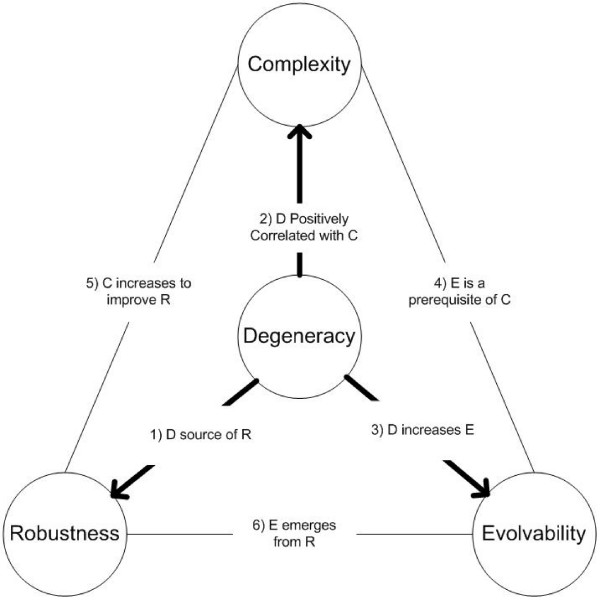
Figure 1
Figure 1
high level illustration of the relationships between degeneracy, complexity, robustness, and evolvability. The numbers in column one of Table 1 correspond with the abbreviated descriptions shown here. This diagram is reproduced with permission from [3].
Figure 2
Figure 2
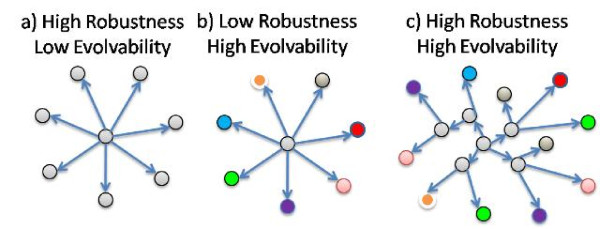
The conflicting properties of robustness and evolvability and their proposed resolution. A system (central node) is exposed to changing conditions (peripheral nodes). Robustness of a function requires minimal variation in the function (panel a) while the discovery of new functions requires the testing of a large number of functional variants (panel b). The existence of a neutral network may allow for both requirements to be met (panel c). In the context of a fitness landscape, movement along edges of each graph would reflect changes in genotype while changes in color would reflect changes in phenotype.
Figure 3
Figure 3
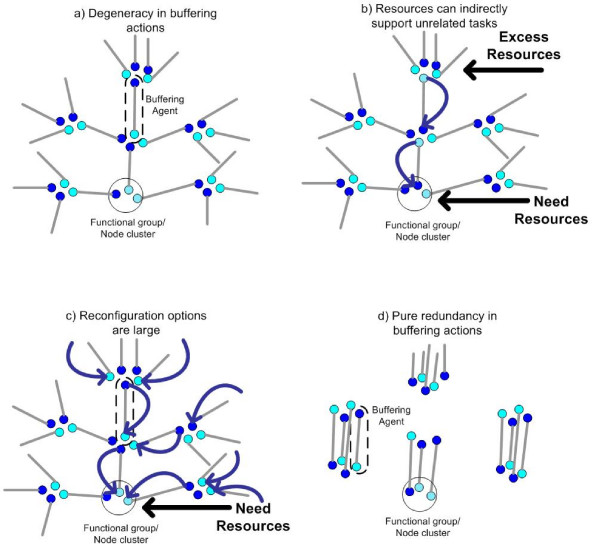
Illustration of how distributed robustness can be achieved in degenerate systems (panels a-c) and why it is not possible in purely redundant systems (panel d). Nodes describe tasks, dark nodes are active tasks. In principle, agents can perform two distinct tasks but are able to perform only one task at a time. Panels a and d are reproduced with permission from [3].

References

    1. Kirschner M, Gerhart J. Evolvability. 0027-8424. 1998;95:8420–8427. - PMC - PubMed
    1. Edelman GM, Gally JA. Degeneracy and complexity in biological systems. 0027-8424. 2001;98:13763–13768. - PMC - PubMed
    1. Whitacre JM, Bender A. Degeneracy: a design principle for achieving robustness and evolvability. Journal of Theoretical Biology. 2009. - PubMed
    1. Wagner A. Robustness and evolvability: a paradox resolved. 0962-8452. 2008;275:91–100. - PMC - PubMed
    1. Ancel LW, Fontana W. Plasticity, evolvability, and modularity in RNA. Journal of Experimental Zoology. 2000;288:242–283. doi: 10.1002/1097-010X(20001015)288:3<242::AID-JEZ5>3.0.CO;2-O. - DOI - PubMed

Publication types

LinkOut - more resources