


Neuroprotection by caffeine: time course and role of its metabolites in the MPTP model of Parkinson's disease
- PMID: 20167258
- PMCID: PMC2849921
- DOI: 10.1016/j.neuroscience.2010.02.020
Neuroprotection by caffeine: time course and role of its metabolites in the MPTP model of Parkinson's disease
Abstract
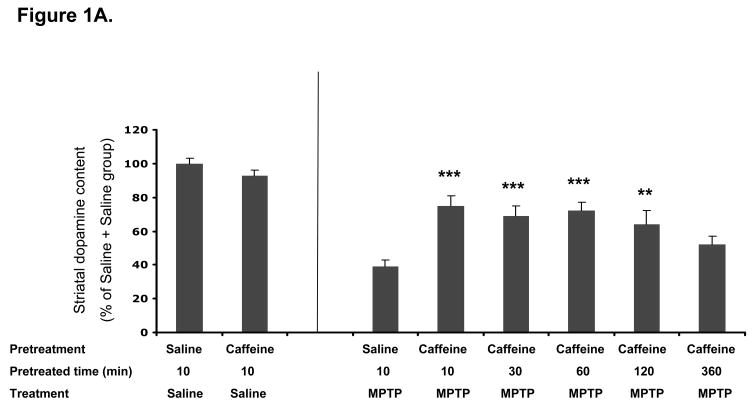
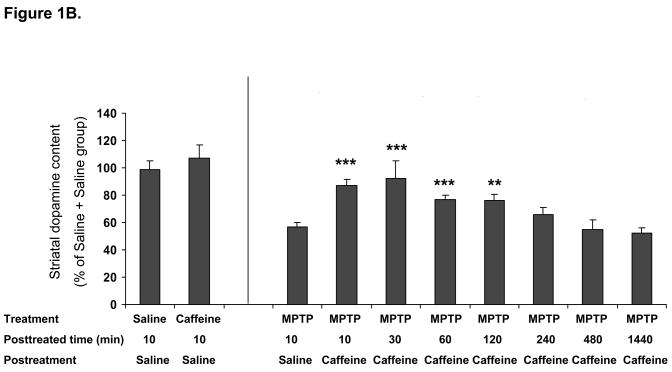
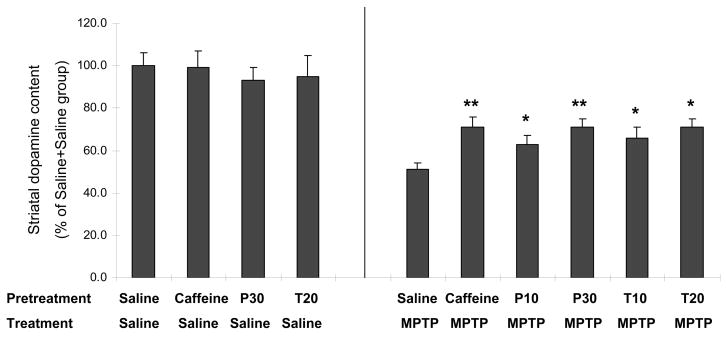
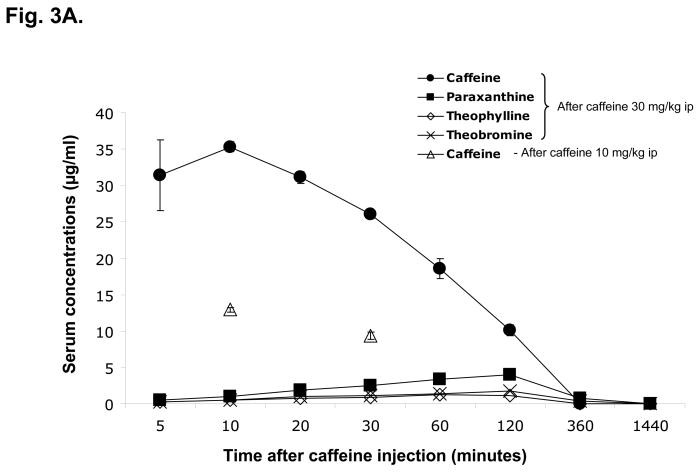
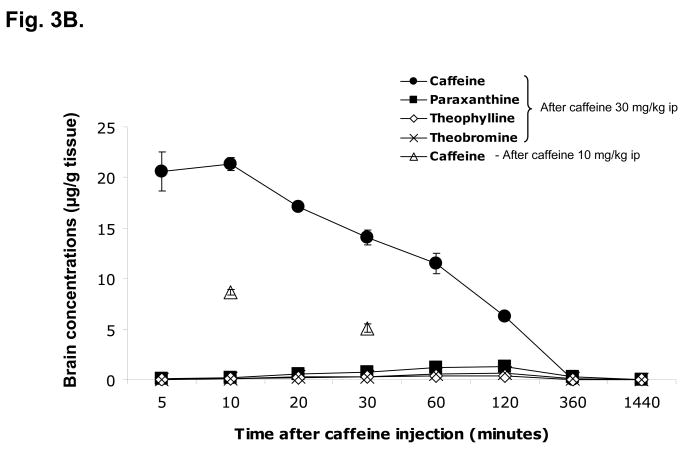
Epidemiological studies have raised the possibility of caffeine serving as a neuroprotective agent in Parkinson's disease (PD). This possibility has gained support from findings that dopaminergic neuron toxicity induced by 1-methyl-4-phenyl-1,2,3,6-tetrahydropyridine (MPTP) or other neurotoxins is attenuated by co-administration of caffeine in mice. Here we examined the time window of caffeine's neuroprotection as well as the effects of caffeine's metabolites (theophylline and paraxanthine) in the MPTP mouse model of PD. In the first experiment, caffeine pre-treatment (30 mg/kg ip) significantly attenuated MPTP-induced striatal dopamine depletion when it was given 10 min, 30 min, 1 h, or 2 h but not 6 h before MPTP (40 mg/kg ip) treatment. Meanwhile, caffeine post-treatment also significantly attenuated striatal dopamine loss when it was given 10 min, 30 min, 1 h or 2 h but not 4 h, 8 h or 24 h after MPTP injection. In the second experiment, both theophylline (10 or 20 mg/kg) and paraxanthine (10 or 30 mg/kg) administration (10 min before MPTP) significantly attenuated MPTP-induced dopamine depletion in mice, as did caffeine (10 mg/kg) treatment. Thus the metabolites of caffeine also provide neuroprotective effects in this mouse model of PD. The data suggest that if caffeine protects against putative toxin-induced dopaminergic neuron injury in humans, then precise temporal pairing between caffeine and toxin exposures may not be critical because the duration of neuroprotection by caffeine may be extended by protective effects of its major metabolites.
(c) 2010 IBRO. Published by Elsevier Ltd. All rights reserved.
Figures
References
-
- Aguiar LM, Nobre HV, Jr, Macêdo DS, Oliveira AA, Freitas RM, Vasconcelos SM, Cunha GM, Sousa FC, Viana GS. Neuroprotective effects of caffeine in the model of 6-hydroxydopamine lesion in rats. Pharmacol Biochem Behav. 2006;84:415–419. - PubMed
-
- Arnaud MJ. The pharmacology of caffeine. Prog Drug Res. 1987;31:273–313. - PubMed
-
- Ascherio A, Zhang SM, Hernan MA, Kawachi I, Colditz GA, Speizer FE, Willett WC. Prospective study of caffeine consumption and risk of Parkinson’s disease in men and women. Ann Neurol. 2001;50:56–63. - PubMed
-
- Benedetti MD, Bower JH, Maqraganore DM, McDonnell SK, Peterson BJ, Ahlskog JE, Schaid DJ, Rocca WA. Smoking, alcohol, and coffee consumption preceding Parkinson’s disease: a case-control study. Neurology. 2000;55:1350–1358. - PubMed
-
- Benowitz NL, Jacob P, III, Mayan H, Denaro C. Sympathomimetic effects of paraxanthine and caffeine in humans. Clin Pharmacol Ther. 1995;58:684–691. - PubMed
Publication types
MeSH terms
Substances
Grants and funding
LinkOut - more resources
Full Text Sources
Other Literature Sources
Medical
