


Review
doi: 10.1016/j.bcmd.2010.01.009.
Epub 2010 Feb 18.
Hematologically important mutations: the autosomal recessive forms of chronic granulomatous disease (second update)
Affiliations
- PMID: 20167518
- PMCID: PMC4568122
- DOI: 10.1016/j.bcmd.2010.01.009
Item in Clipboard
Review
Hematologically important mutations: the autosomal recessive forms of chronic granulomatous disease (second update)
Blood Cells Mol Dis.
.
Abstract
Chronic granulomatous Disease (CGD) is an immunodeficiency disorder affecting about 1 in 250,000 individuals. The disease is caused by mutations in the genes encoding the components of the leukocyte NADPH oxidase. This enzyme produces superoxide, which is essential in the process of intracellular pathogen killing by phagocytic leukocytes. Four of the five genes involved in CGD are autosomal; these are CYBA, encoding p22-phox, NCF2, encoding p67-phox, NCF1, encoding p47-phox, and NCF4, encoding p40-phox. This article lists all mutations identified in these genes in the autosomal forms of CGD. Moreover, polymorphisms in these genes are also given, which should facilitate the recognition of future disease-causing mutations.
Figures
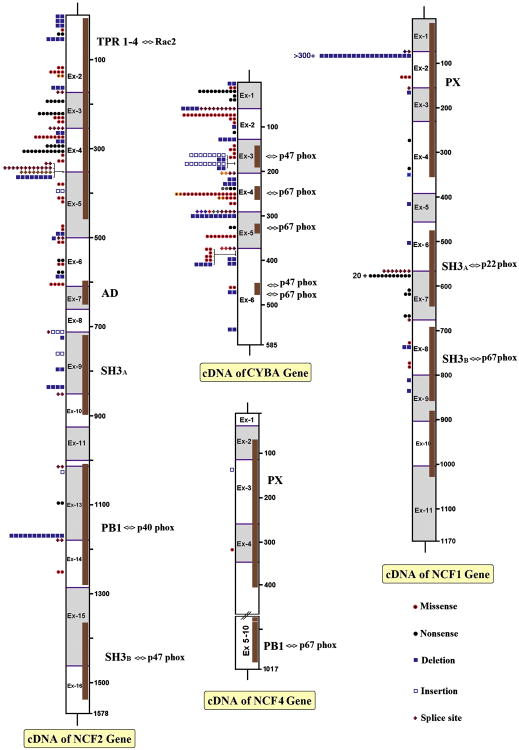
For each cDNA, the exon positions and the corresponding protein domains have been depicted. For some of the protein domains, their interaction with other proteins has been indicated. The PX domains interact with phosphatidyl-inositol-phosphates. The type of mutations (explained in the right hand corner), their position and number of mutated alleles are indicated. Splice site mutations are given at the exon borders.
References
-
- Iwata M, Nunoi H, Yamazaki H, Nakano T, Niwa H, Tsuruta S, Ohga S, Ohmi S, Kanegasaki S, Matsuda I. Homologous dinucleotide (GT or TG) deletion in Japanese patients with chronic granulomatous disease with p47-phox deficiency. Biochem Biophys Res Commun. 1994;199:1372–1377. - PubMed
Publication types
MeSH terms
Substances
Grants and funding
LinkOut - more resources
Full Text Sources
Medical
Molecular Biology Databases
