


Role of the adaptive immune system in hypertension
- PMID: 20167535
- PMCID: PMC2843787
- DOI: 10.1016/j.coph.2010.01.006
Role of the adaptive immune system in hypertension
Abstract
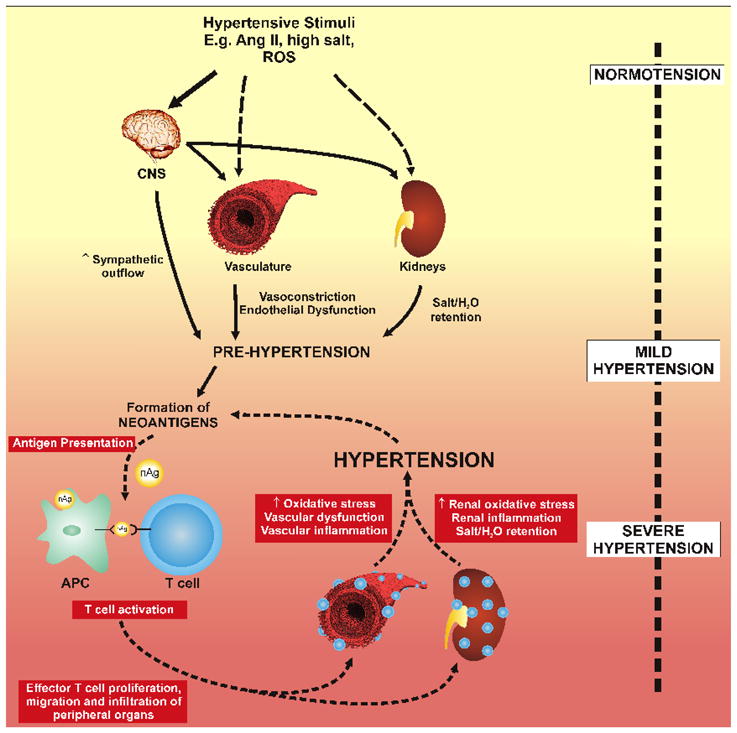
Recent studies have shown that both innate and adaptive immunity contribute to hypertension. Inflammatory cells, including macrophages and T cells accumulate in the vessel wall, particularly in the perivascular fat, and in the kidney of hypertensive animals. Mice lacking lymphocytes are resistant to the development of hypertension, and adoptive transfer of T cells restores hypertensive responses to angiotensin II and DOCA-salt challenge. Immune modulating agents have variable, but often-beneficial effects in ameliorating end-organ damage and blood pressure elevation in experimental hypertension. The mechanisms by which hypertension stimulates an immune response remain unclear, but might involve the formation of neoantigens that activate adaptive immunity. Identification of these neoantigens and understanding how they form might prove useful in the prevention and treatment of this widespread and devastating disease.
Copyright 2010 Elsevier Ltd. All rights reserved.
Figures
References
-
- Rosenfeld ME, Khoo JC, Miller E, Parthasarathy S, Palinski W, Witztum JL. Macrophage-derived foam cells freshly isolated from rabbit atherosclerotic lesions degrade modified lipoproteins, promote oxidation of low-density lipoproteins, and contain oxidation-specific lipid-protein adducts. J Clin Invest. 1991;87:90–99. - PMC - PubMed
-
- Hansson GK. Inflammation, atherosclerosis, and coronary artery disease. N Engl J Med. 2005;352:1685–1695. - PubMed
-
- Bobryshev YV, Lord RS. S-100 positive cells in human arterial intima and in atherosclerotic lesions. Cardiovasc Res. 1995;29:689–696. - PubMed
-
- Ozmen J, Bobryshev YV, Lord RS, Ashwell KW. Identification of dendritic cells in aortic atherosclerotic lesions in rats with diet-induced hypercholesterolaemia. Histol Histopathol. 2002;17:223–237. - PubMed
Publication types
MeSH terms
Substances
Grants and funding
LinkOut - more resources
Full Text Sources
Medical
