


Exercise and the metabolic syndrome with weight regain
- PMID: 20167668
- PMCID: PMC2904200
- DOI: 10.1152/japplphysiol.01361.2009
Exercise and the metabolic syndrome with weight regain
Abstract
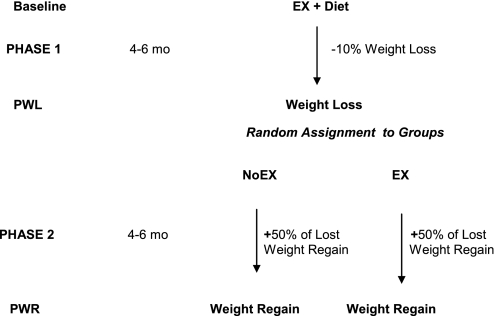
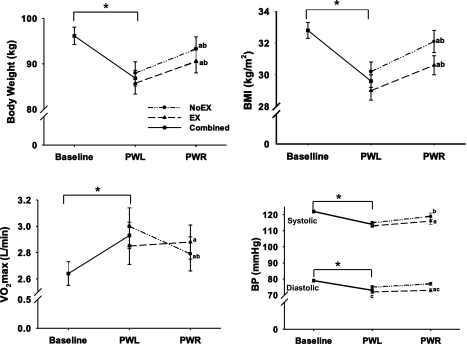
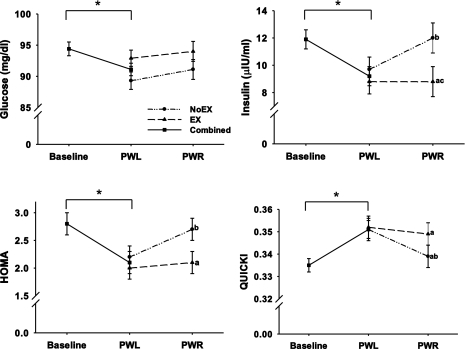
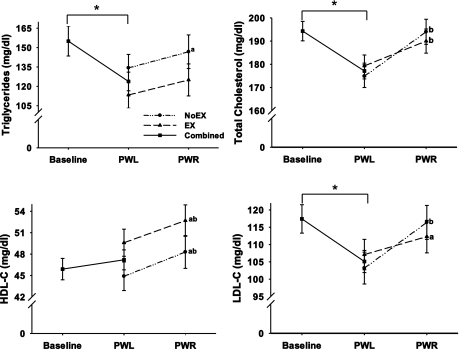
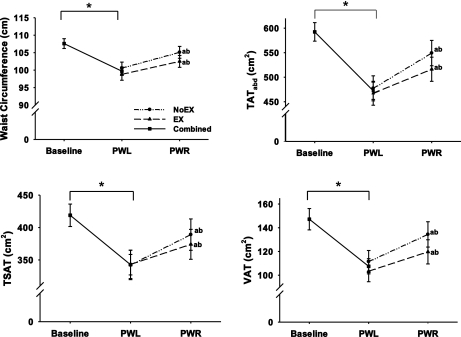
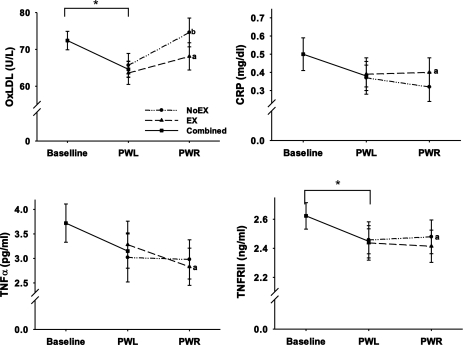
Weight loss improves metabolic syndrome (MetS) factors, but risk may return with weight regain. This study was designed to determine if exercise training can maintain improvements in MetS risk factors during weight regain. In a randomized control trial,102 overweight or obese (body mass index 25.0-39.9 kg/m(2)) men and women (age 21-52 yr), with characteristics of the MetS, lost 10% of body weight with supervised walking/jogging at 60% of maximal oxygen consumption (Vo(2 max)) (-400 kcal/session), 5 days/wk, and caloric restriction (-600 kcal/day) over a 4- to 6-mo period. After weight loss, 77 remaining subjects underwent programmed weight regain (+50% of lost weight) for 4-6 mo with random assignment to two groups: no exercise (NoEX) or continued supervised exercise (EX). Blood pressure, regional fat, glucose homeostasis, lipids, and inflammatory markers were assessed at baseline, post-weight loss, and post-weight regain. Groups were compared by two-way repeated-measures ANOVA on the 67 subjects. After weight loss (9.7 +/- 0.2% of body weight), significant (P < 0.05) improvements were observed in almost all parameters assessed. Following weight regain (54.4 +/- 1.6% of lost weight), the NoEX group exhibited deterioration in most metabolic markers, while the EX group maintained improvements in Vo(2 max), blood pressures, glucose homeostasis, high- and low-density lipoprotein cholesterol (HDL-C and LDL-C), oxidized LDL, and other markers of inflammation, but did not maintain improvements in triglyceride and cholesterol concentrations or abdominal fat. Results of this design of controlled human weight regain suggest that aerobic exercise can counter the detrimental effects of partial weight regain on many markers of disease risk.
Figures
Comment in
-
An exercise outpost in weight regain territory.J Appl Physiol (1985). 2010 Jul;109(1):1-2. doi: 10.1152/japplphysiol.00364.2010. Epub 2010 Apr 15. J Appl Physiol (1985). 2010. PMID: 20395547 No abstract available.
References
-
- American College of Sports Medicine ACSM's Guidelines for Exercise Testing and Prescription ( 8th ed.). Philadelphia, PA: Lippincott, Williams, and Wilkins, 2009
-
- Barlow CE, Kohl HW, 3rd, Gibbons LW, Blair SN. Physical fitness, mortality and obesity. Int J Obes Relat Metab Disord 19, Suppl 4: S41– S44, 1995 - PubMed
-
- Boule NG, Haddad E, Kenny GP, Wells GA, Sigal RJ. Effects of exercise on glycemic control and body mass in type 2 diabetes mellitus: a meta-analysis of controlled clinical trials. JAMA 286: 1218– 1227, 2001 - PubMed
-
- Brooks GA, Butte NF, Rand WM, Flatt JP, Caballero B, Brooks GA, Butte NF, Rand WM, Flatt JP, Caballero B. Chronicle of the Institute of Medicine physical activity recommendation: how a physical activity recommendation came to be among dietary recommendations. Am J Clin Nutr 79: 921S– 930S, 2004 - PubMed
-
- Dengel DR, Hagberg JM, Pratley RE, Rogus EM, Goldberg AP. Improvements in blood pressure, glucose metabolism, and lipoprotein lipids after aerobic exercise plus weight loss in obese, hypertensive middle-aged men. Metabolism 47: 1075– 1082, 1998 - PubMed
Publication types
MeSH terms
Substances
Grants and funding
LinkOut - more resources
Full Text Sources
Other Literature Sources
Medical
