New-onset diabetes mellitus after kidney transplantation in Denmark
- PMID: 20167685
- PMCID: PMC2849691
- DOI: 10.2215/CJN.05360709
New-onset diabetes mellitus after kidney transplantation in Denmark
Abstract
Background and objectives: This study aimed to investigate the development of new-onset diabetes mellitus (NODM) in a prospective study of 97 nondiabetic uremic patients.
Design, setting, participants, & measurements: Included were 57 kidney recipients (Tx group, age 39 +/- 13 years) and 40 uremic patients remaining on the waiting list for kidney transplantation (uremic controls, age 47 +/- 11 years). All were examined at baseline before possible transplantation and after 12 months. The prevalence of diabetes, prediabetes, insulin sensitivity index (ISI), and insulin secretion index (Isecr) were estimated using an oral glucose tolerance test with measurements of plasma glucose and plasma insulin.
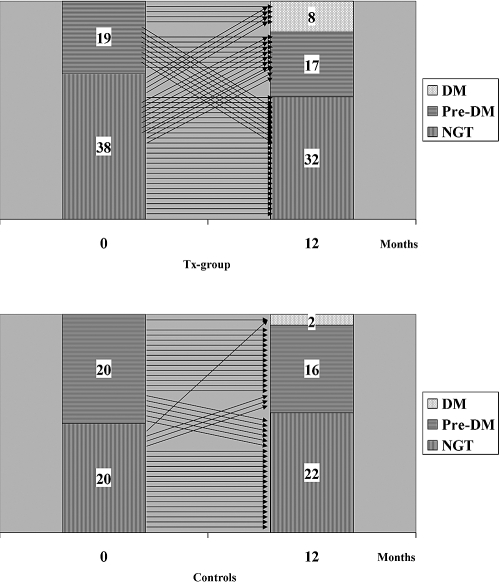
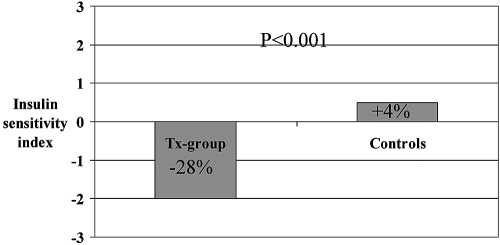
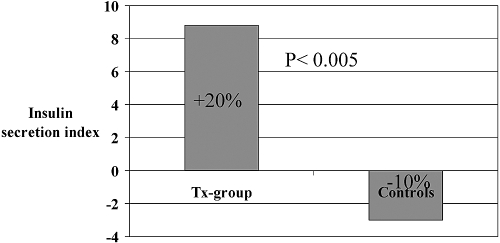
Results: One year after transplantation NODM was present in 14% (8 of 57) compared with 5% (2 of 40) in the uremic control group (P = 0.01). ISI in the Tx group deteriorated from 6.8 +/- 3.9 before transplantation to 4.9 +/- 2.8 at 12 months after transplantation (P = 0.005), and a slight increase in Isecr from 37 +/- 19 to 46 +/- 22 (P = 0.02) was seen. No significant changes occurred in the uremic controls (ISI was 7.9 +/- 5 and 8.5 +/- 5, and Isecr was 31 +/- 17 and 28 +/- 15). Using multivariate ordinal logistic regression, pre-Tx ISI and age predicted NODM (odds ratios: 0.82, P = 0.01 and 1.06, P = 0.02, respectively).
Conclusions: One year after kidney transplantation, NODM was present in 14% of patients. This was mainly caused by an increase in insulin resistance and was observed despite improvement in insulin secretion.
Figures
Comment in
-
Transplant-associated hyperglycemia: shedding light on the mechanisms.Clin J Am Soc Nephrol. 2010 Apr;5(4):560-2. doi: 10.2215/CJN.01430210. Epub 2010 Mar 25. Clin J Am Soc Nephrol. 2010. PMID: 20338965 No abstract available.
References
-
- Boudreaux JP, McHugh L, Canafax DM, Ascher N, Sutherland DE, Payne W, Simmons RL, Najarian JS, Fryd DS: The impact of cyclosporine and combination immunosuppression on the incidence of posttransplant diabetes in renal allograft recipients. Transplantation 44: 376–381, 1987 - PubMed
-
- Montori VM, Basu A, Erwin PJ, Velosa JA, Gabriel SE, Kudva YC: Posttransplantation diabetes: A systematic review of the literature. Diabetes Care 25: 583–592, 2002 - PubMed
-
- Gross CR, Limwattananon C, Matthees B, Zehrer JL, Savik K: Impact of transplantation on quality of life in patients with diabetes and renal dysfunction. Transplantation 70: 1736–1746, 2000 - PubMed
-
- Hjelmesaeth J, Hartmann A, Leivestad T, Holdaas H, Sagedal S, Olstad M, Jenssen T: The impact of early-diagnosed new-onset post-transplantation diabetes mellitus on survival and major cardiac events. Kidney Int 69: 588–595, 2006 - PubMed
-
- Kasiske BL, Snyder JJ, Gilbertson D, Matas AJ: Diabetes mellitus after kidney transplantation in the United States. Am J Transplant 3: 178–185, 2003 - PubMed
Publication types
MeSH terms
Substances
LinkOut - more resources
Full Text Sources
Medical