


Identification of pathogens by mass spectrometry
- PMID: 20167691
- PMCID: PMC7108202
- DOI: 10.1373/clinchem.2009.138867
Identification of pathogens by mass spectrometry
Abstract
Background: Mass spectrometry (MS) is a suitable technology for microorganism identification and characterization.
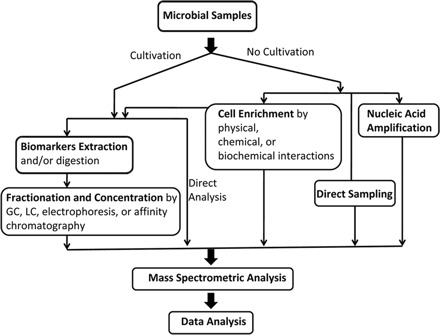
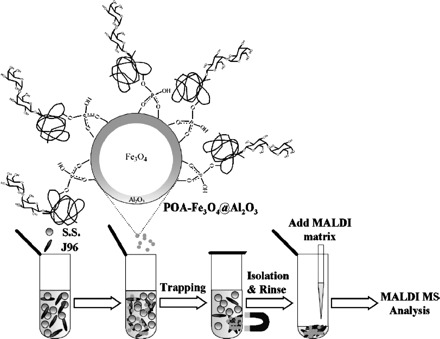
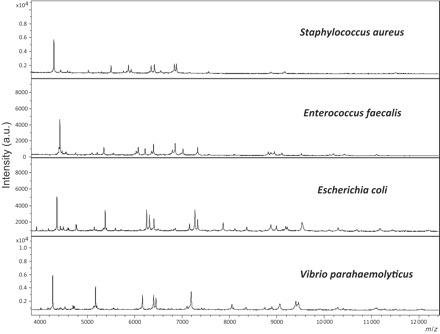
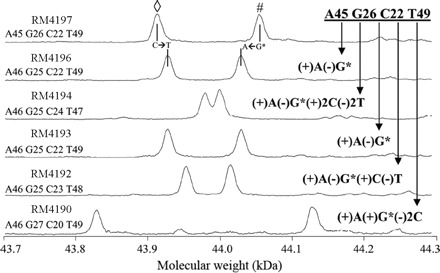
Content: This review summarizes the MS-based methods currently used for the analyses of pathogens. Direct analysis of whole pathogenic microbial cells using MS without sample fractionation reveals specific biomarkers for taxonomy and provides rapid and high-throughput capabilities. MS coupled with various chromatography- and affinity-based techniques simplifies the complexity of the signals of the microbial biomarkers and provides more accurate results. Affinity-based methods, including those employing nanotechnology, can be used to concentrate traces of target microorganisms from sample solutions and, thereby, improve detection limits. Approaches combining amplification of nucleic acid targets from pathogens with MS-based detection are alternatives to biomarker analyses. Many data analysis methods, including multivariate analysis and bioinformatics approaches, have been developed for microbial identification. The review concludes with some current clinical applications of MS in the identification and typing of infectious microorganisms, as well as some perspectives.
Summary: Advances in instrumentation (separation and mass analysis), ionization techniques, and biological methodologies will all enhance the capabilities of MS for the analysis of pathogens.
Figures
References
-
- Demirev PA, Fenselau C. Mass spectrometry for rapid characterization of microorganisms. Annu Rev Anal Chem 2008;1:3.1-3.23. - PubMed
-
- Gu H, Ho P-L, Tsang KWT, Wang L, Xu B. Using biofunctional magnetic nanoparticles to capture vancomycin-resistant Enterococci and other gram-positive bacteria at ultralow concentration. J Am Chem Soc 2003;125:15702-15703. - PubMed
-
- Liu JC, Tsai PJ, Lee YC, Chen YC. Affinity capture of uropathogenic Escherichia coli using pigeon ovalbumin-bound Fe3O4@Al2O3 magnetic nanoparticles. Anal Chem 2008;80:5425-5432. - PubMed
-
- Afonso C, Fenselau C. Use of bioactive glass slides for matrix-assisted laser desorption/ionization analysis: application to microorganisms. Anal Chem 2003;75:694-697. - PubMed
Publication types
MeSH terms
LinkOut - more resources
Full Text Sources
Other Literature Sources
