


Scale-up and coverage of Avahan: a large-scale HIV-prevention programme among female sex workers and men who have sex with men in four Indian states
- PMID: 20167737
- PMCID: PMC3252619
- DOI: 10.1136/sti.2009.039115
Scale-up and coverage of Avahan: a large-scale HIV-prevention programme among female sex workers and men who have sex with men in four Indian states
Abstract
Objective: Documenting the implementation of a public health programme as per its design is critical to interpretation of results from survey-led outcome and impact evaluation activities, the authors describe the scale-up and coverage of large-scale HIV-prevention services provided to female sex workers (FSWs) and high-risk men who have sex with men (HR-MSM) during the first 5 years of the Avahan programme in India.
Methods: Implementing NGO partner-generated denominator estimates from 70 districts were used to estimate the programme's intended coverage. Routine programme-monitoring data until December 2008 were used to describe the service and commodity availability, service utilisation to generate internal estimates of coverage. Coverage was validated in few districts using data from a cross-sectional survey.
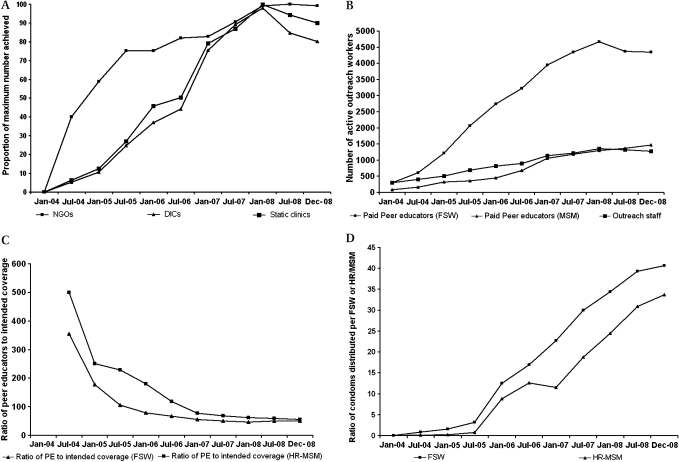
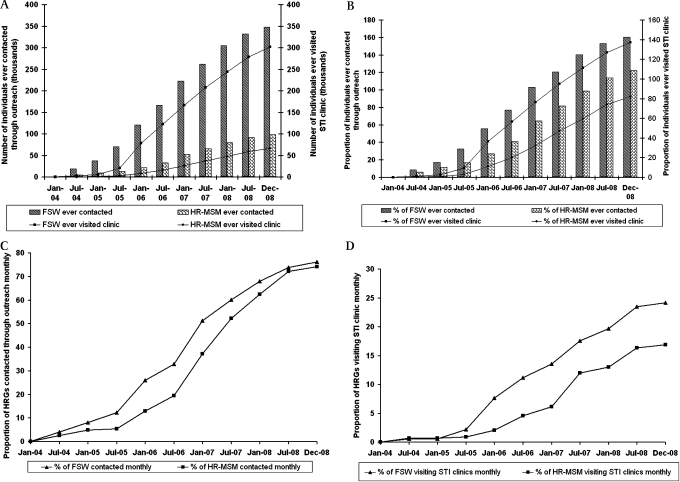
Results: In December 2008, the estimated denominators for intended services were about 217,000 FSWs and 80,000 HR-MSM. By January 2007, 79% of eventual total clinics and 75% drop-in centres were established, and 83% of eventual peer educators were active. By month 48, sufficient condoms to cover all estimated FSW commercial sex acts were distributed free. By month 60, 75% of the estimated denominator intended to be covered was met monthly. 86% of FSWs and 67% of HR-MSM ever contacted had used sexually transmitted infections services at least once. Cross-sectional survey generated coverage results suggest that programme-monitoring data provide a proxy to coverage of services.
Conclusion: Avahan's monitoring data show that Avahan achieved infrastructure scale by year 3 and high contact coverage through peers and with commodities by year 5 of implementation as per the design.
Conflict of interest statement
Figures
References
-
- Bertozzi S, Laga M, Bautista-Arredondo S, et al. Making HIV prevention programs work. Lancet 2008;372:831–44 - PubMed
-
- Pandey A, Reddy DC, Ghys PD, et al. Improved estimates of India's HIV burden in 2006. Indian J Med Res 2009;129:50–8 - PubMed
-
- Moses S, Blanchard J, Kang H, et al. AIDS in South Asia: understanding and responding to a heterogeneous epidemic. Washington, DC: World Bank, 2006. http://siteresources.worldbank.org/SOUTHASIAEXT/Resources/Publications/4...
-
- Chandrasekaran P, Dallabetta G, Loo V, et al. Containing HIV/AIDS in India: the unfinished agenda. Lancet Infect Dis 2006;6:508–21 - PubMed
-
- Bill and Melinda Gates Foundation New Delhi Avahan—the India AIDS initiative: the business of HIV prevention at scale. New Delhi, India: 2008. http://www.gatesfoundation.org/avahan/Documents/Avahan_HIVPrevention.pdf
Publication types
MeSH terms
LinkOut - more resources
Full Text Sources
Medical
Miscellaneous
