Effectiveness of an HIV/STD risk-reduction intervention for adolescents when implemented by community-based organizations: a cluster-randomized controlled trial
- PMID: 20167903
- PMCID: PMC2836337
- DOI: 10.2105/AJPH.2008.140657
Effectiveness of an HIV/STD risk-reduction intervention for adolescents when implemented by community-based organizations: a cluster-randomized controlled trial
Abstract
Objectives: We evaluated the effectiveness of an HIV/STD risk-reduction intervention when implemented by community-based organizations (CBOs).
Methods: In a cluster-randomized controlled trial, 86 CBOs that served African American adolescents aged 13 to 18 years were randomized to implement either an HIV/STD risk-reduction intervention whose efficacy has been demonstrated or a health-promotion control intervention. CBOs agreed to implement 6 intervention groups, a random half of which completed 3-, 6-, and 12-month follow-up assessments. The primary outcome was consistent condom use in the 3 months prior to each follow-up assessment, averaged over the follow-up assessments.
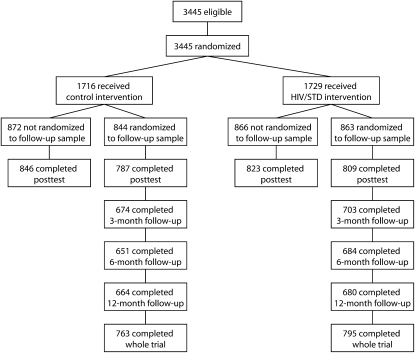
Results: Participants were 1707 adolescents, 863 in HIV/STD-intervention CBOs and 844 in control-intervention CBOs. HIV/STD-intervention participants were more likely to report consistent condom use (odds ratio [OR] = 1.39; 95% confidence interval [CI] = 1.06, 1.84) than were control-intervention participants. HIV/STD-intervention participants also reported a greater proportion of condom-protected intercourse (beta = 0.06; 95% CI = 0.00, 0.12) than did the control group.
Conclusions: This is the first large, randomized intervention trial to demonstrate that CBOs can successfully implement an HIV/STD risk-reduction intervention whose efficacy has been established.
Figures
References
-
- Joint United Nations Programme on HIV/AIDS AIDS Epidemic Update: 2003 Geneva, Switzerland: Joint United Nations Programme on HIV/AIDS and World Health Organization; 2003
-
- Joint United Nations Programme on HIV/AIDS 2004 Report on the Global AIDS Epidemic Geneva, Switzerland: Joint United Nations Programme on HIV/AIDS and World Health Organization; 2004
-
- Weinstock H, Berman S, Cates W., Jr Sexually transmitted diseases among American youth: incidence and prevalence estimates, 2000. Perspect Sex Reprod Health 2004;36(1):6–10 - PubMed
-
- Jemmott JB, III, Jemmott LS, Fong GT. Abstinence and safer sex HIV risk-reduction interventions for African American adolescents: a randomized controlled trial. JAMA 1998;279(19):1529–1536 - PubMed
Publication types
MeSH terms
Grants and funding
LinkOut - more resources
Full Text Sources
Medical
Research Materials