Effect of control strategies on prevalence, incidence and re-infection of clonorchiasis in endemic areas of China
- PMID: 20169061
- PMCID: PMC2821909
- DOI: 10.1371/journal.pntd.0000601
Effect of control strategies on prevalence, incidence and re-infection of clonorchiasis in endemic areas of China
Abstract
Background: A pilot clonorchiasis control project was implemented to evaluate the efficacies of various chemotherapy strategies on prevalence, incidence and re-infection in Heilongjiang Province, China.
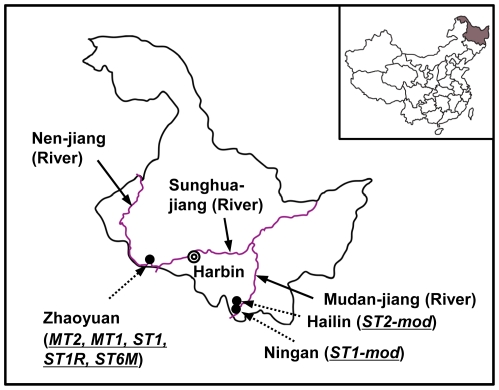
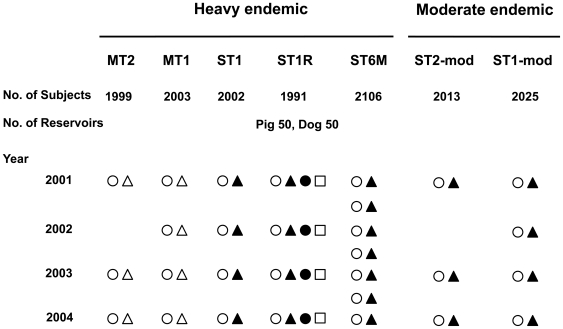
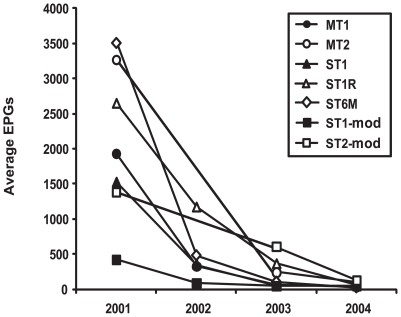
Methods and findings: Seven intervention groups (14,139 residents, about 2000 in each group) in heavily or moderately endemic areas were subjected to repeated praziquantel administration from 2001 to 2004. In the selective chemotherapy groups, residents were examined for fecal eggs, and those who tested positive were treated with three doses of 25 mg/kg praziquantel at 5-hour-intervals in one day. However, all residents were treated in the mass chemotherapy groups. In heavily endemic areas, two mass treatments of all residents in 2001 and 2003 reduced the prevalence from 69.5% to 18.8%, while four annual mass treatments reduced the prevalence from 48.0% in 2001 to 8.4% in 2004. Selective annual treatments for egg-positive subjects reduced the egg-positive rates from 54.9% in 2001 to 15.0% in 2004 or from 73.2% in 2001 to 12.3% in 2004. Selective treatments every 6 months significantly reduced the prevalence from 59.5% in 2001 to 7.5% in 2004. All of the repeated treatments reduced EPG (eggs per gram of feces) significantly. The annual mass treatment and selective treatment every 6 months produced lower prevalence and re-infection rates and higher egg reduction rate than annual selective treatments did. In the moderate endemic areas, egg positive rates were 24.8% and 29.7% in 2001 but were 1.9% and 1.3% after 2 or 3 selective treatments. The prevalence, incidence, re-infection rates in a moderately endemic area were significantly lower than those of heavy endemic areas.
Conclusions: Repeated mass treatment or selective treatment with praziquantel every 6 to 12 months is highly effective for clonorchiasis control in heavily endemic areas. In contrast, one or two selective treatments with health education is effective in moderately endemic areas.
Conflict of interest statement
The authors have declared that no competing interests exist.
Figures
References
-
- Lun ZR, Gasser RB, Lai DH, Li AX, Zhu XQ, et al. Clonorchiasis: a key foodborne zoonosis in China. Lancet Infect Dis. 2005;5:31–41. - PubMed
-
- Rim HJ. Clonorchiasis: an update. J Helminthol. 2005;79:269–281. - PubMed
-
- Hong ST. Clonorchis sinensis. In: Miliotis MD, Bier JW, editors. International Handbook of Foodborne Pathogens. New York, Basel: Marcel Dekker, Inc; 2003. pp. 581–592.
-
- Choi D, Lim JH, Lee KT, Lee JK, Choi SH, et al. Cholangiocarcinoma and Clonorchis sinensis infection: a case-control study in Korea. J Hepatol. 2006;44:1066–1073. - PubMed
Publication types
MeSH terms
Substances
LinkOut - more resources
Full Text Sources