. 2010 Sep;15(5):605-17.
doi: 10.1007/s12192-010-0173-2. Epub 2010 Feb 19.

The early-onset torsion dystonia-associated protein, torsinA, displays molecular chaperone activity in vitro

Affiliations

The early-onset torsion dystonia-associated protein, torsinA, displays molecular chaperone activity in vitro

Alexander J Burdette et al. Cell Stress Chaperones. 2010 Sep.

Abstract

TorsinA is a member of the AAA+ ATPase family of proteins and, notably, is the only known ATPase localized to the ER lumen. It has been suggested to act as a molecular chaperone, while a mutant form associated with early-onset torsion dystonia, a dominantly inherited movement disorder, appears to result in a net loss of function in vivo. Thus far, no studies have examined the chaperone activity of torsinA in vitro. Here we expressed and purified both wild-type (WT) and mutant torsinA fusion proteins in bacteria and examined their ability to function as molecular chaperones by monitoring suppression of luciferase and citrate synthase (CS) aggregation. We also assessed their ability to hold proteins in an intermediate state for refolding. As measured by light scattering and SDS-PAGE, both WT and mutant torsinA effectively, and similarly, suppressed protein aggregation compared to controls. This function was not further enhanced by the presence of ATP. Further, we found that while neither form of torsinA could protect CS from heat-induced inactivation, they were both able to reactivate luciferase when ATP and rabbit reticulocyte lysate were added. This suggests that torsinA holds luciferase in an intermediate state, which can then be refolded in the presence of other chaperones. These data provide conclusive evidence that torsinA acts as a molecular chaperone in vitro and suggests that early-onset torsion dystonia is likely not a consequence of a loss in torsinA chaperone activity but might be an outcome of insufficient torsinA localization at the ER to manage protein folding or trafficking.


Figures
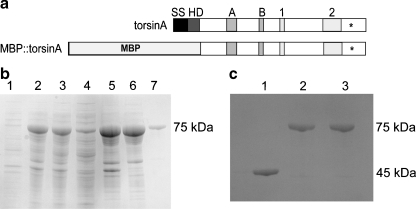
Fig. 1
Fig. 1
Purification of WT torsinA and torsinA (ΔE) fusions. a Structural organization of torsinA before and after cloning modifications. Domains are indicated by abbreviations as follows: SS (signal sequence), HD (hydrophobic domain), A (Walker A domain), B (Walker B domain—also the location of the E171Q hydrolysis mutant), 1 (sensor 1 domain), 2 (sensor 2 domain); asterisks indicate location of ΔE 302/303 mutation. The SS and HD domains were removed from torsinA and replaced with the MBP for purification purposes. b Uninduced E. coli (lane 1), induced E. coli (lane 2), supernatant from 25,000×g spin (lane 3), supernatant from 222,000×g spin (lane 4), membrane fraction from 222,000×g spin (lane 5), aqueous fraction from Triton X-114 separation (lane 6), purified torsinA (lane 7) (75 kDa). c MBP (45 kDa) from the pDEST17 vector purified by amylose resin column (lane 1). WT torsinA (lane 2) and torsinA (ΔE) fusions (lane 3) (75 kDa) from MBP vector were purified by amylose resin column chromatography and analyzed by gel electrophoresis with Coomassie staining
Fig. 2
Fig. 2
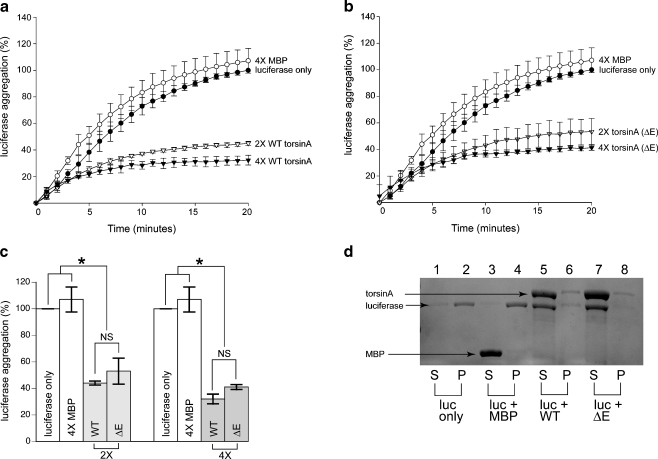
WT torsinA and torsinA (ΔE) inhibit heat-induced aggregation of luciferase. Luciferase (0.1 μM) was incubated at 42°C for 20 min either alone (filled circles), in the presence of MBP (0.4 μM, open circles), WT torsinA (0.2 μM, open triangles; 0.4 μM, filled triangles) in a, or torsinA (ΔE) (0.2 μM, open triangles; 0.4 μM, filled triangles) in b. Aggregation was determined by light scattering at 370 nm. c There was no significant difference in the aggregation of luciferase between WT torsinA and torsinA (ΔE). Comparative analysis among torsinA constructs, MBP, and luciferase at 20-min time points. For all time points, data are representative of three trials and were calculated as a percentage of the maximum aggregation of luciferase after 20 min for each trial and are expressed as the mean ± the standard deviation. d Suppression of luciferase aggregation monitored by SDS-PAGE and Coomassie staining. Lanes 1, 3, 5, and 7 represent the soluble fractions. Lanes 2, 4, 6, and 8 represent the insoluble fractions. Lanes 1 and 2 are 0.8 μM of luciferase only. Lanes 3 and 4 are 4.8 μM of MBP and 0.8 μM of luciferase. Lanes 5 and 6 are 4.8 μM of WT torsinA and 0.8 μM of luciferase. Lanes 7 and 8 are 0.8 μM luciferase and 4.8 μM torsinA (∆E)
Fig. 3
Fig. 3
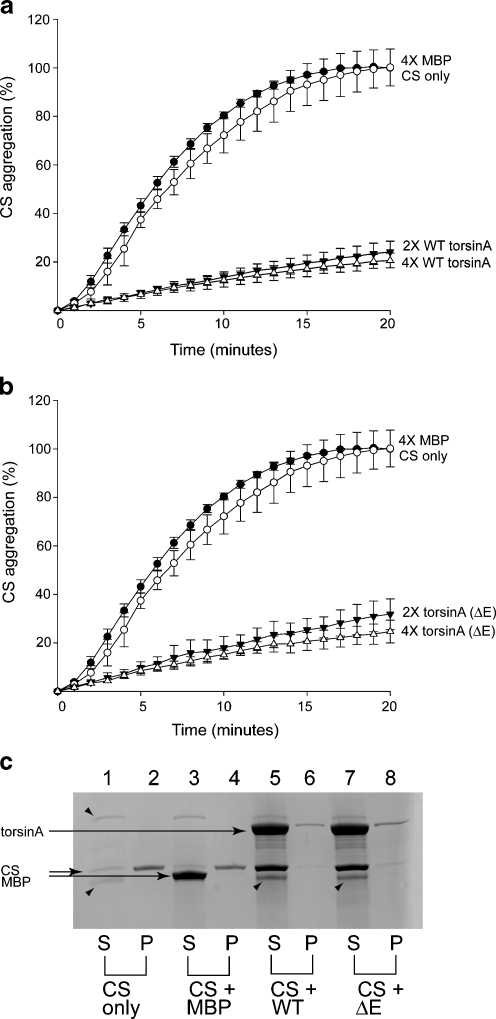
WT torsinA and torsinA (ΔE) inhibit heat-induced aggregation of citrate synthase (CS). CS (0.15 μM) was incubated at 44°C for 20 min either alone (open circles), in the presence of MBP (0.6 μM, filled circles), WT torsinA (0.3 μM, filled triangles; 0.6 μM, open triangles) in a, or torsinA (ΔE) (0.3 mM, filled triangles; 0.6 mM, open triangles) in b. Aggregation was determined by light scattering at 370 nm. Data are representative of three trials and were calculated as a percentage of the maximum aggregation of CS after 20 min for each trial and are expressed as the mean ± standard deviation. c Suppression of CS aggregation monitored by SDS-PAGE and Coomassie staining. Lanes 1, 3, 5, and 7 represent the soluble fractions. Lanes 2, 4, 6, and 8 represent the insoluble fractions. Lanes 1 and 2 are 1.6 μM of CS only. Lanes 3 and 4 are 6.4 μM of MBP and 1.6 μM of CS. Lanes 5 and 6 are 6.4 μM of WT torsinA and 1.6 μM of CS. Lanes 7 and 8 are 1.6 μM CS and 6.4 μM torsinA (∆E). Arrowheads represent slight contaminants and/or degradation products present in CS preparation from Roche
Fig. 4
Fig. 4
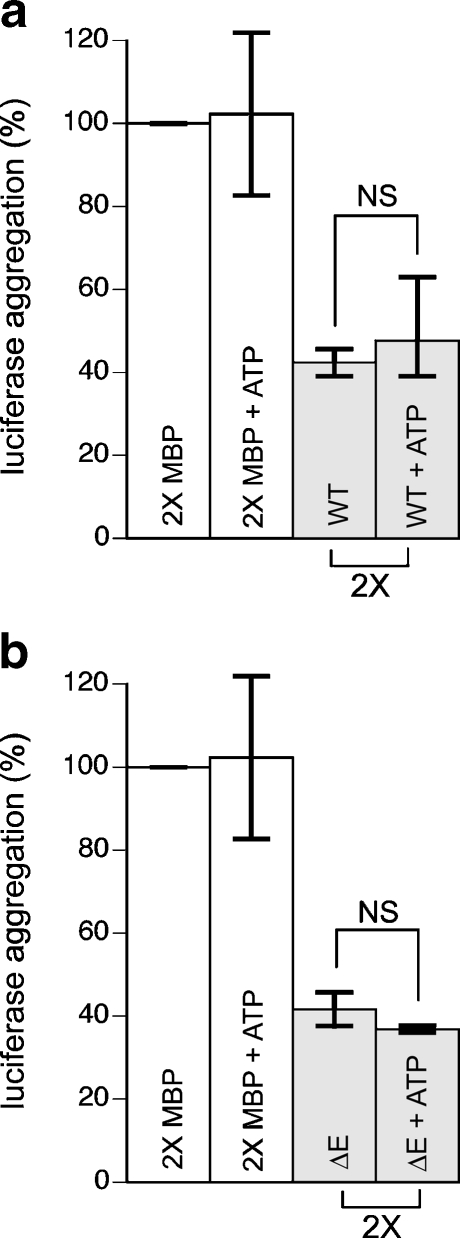
ATP does not influence the prevention of luciferase aggregation by WT torsinA or torsinA (∆E). Luciferase (0.1 μM) was heated at 42°C for 20 min in the presence and absence of 3 mM ATP with 0.2 μM MBP or 0.2 μM WT torsinA in a or 0.2 μM torsinA (∆E) in b. Aggregation was determined by light scattering at 370 nm. Data are representative of two trials and were calculated as a percentage of the maximum aggregation of luciferase after 20 min for each trial and are expressed as the mean ± standard deviation
Fig. 5
Fig. 5
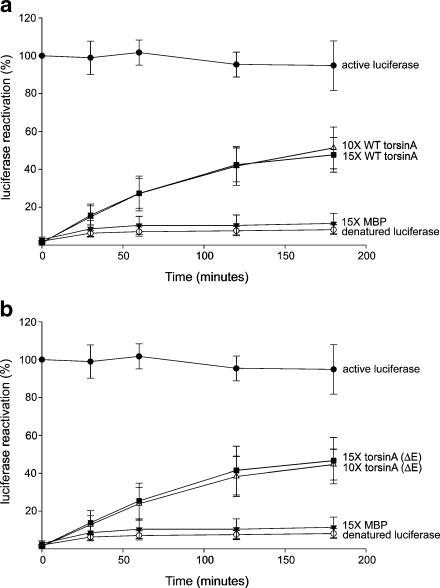
Luciferase can be refolded in the presence of either WT torsinA or torsinA (ΔE). Active luciferase (0.17 μM, filled circles) was measured after incubation at 25°C for the indicated times. All other measurements were made after incubation at 42°C for 15 min. Luciferase (0.17 μM) was incubated either alone (open circles), or in the presence of 15× MBP (2.5 μM; filled triangles). In a, luciferase was incubated with WT torsinA (1.7 and 2.5 μM), and in b, luciferase was incubated with torsinA (ΔE) (1.7 and 2.5 μM). The refolding step was performed at 30°C for 120 min in RRL supplemented with ATP, and luciferase activity was determined at the time points indicated. Data are representative of three trials and are presented as percentage of luciferase activity after 15 min of incubation at 42°C. Data are expressed as mean ± standard deviation
Fig. 6
Fig. 6
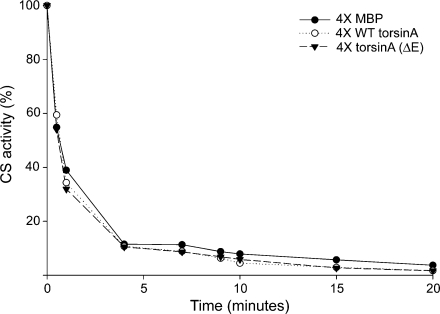
WT torsinA and torsinA (ΔE) do not affect the rate of heat-induced inactivation of CS. CS (0.15 μM) was incubated for 30 min at 43°C in the presence of 0.6 μM MBP (filled circles), 0.6 μM WT torsinA (open circles), or 0.6 µM torsinA (ΔE) (filled triangles), and CS activity was measured at various time points. The enzymatic activity of CS was expressed as a percentage of initial CS activity

References

    1. Abdulle R, Mohindra A, Fernando P, Heikkila JJ. Xenopus small heat shock proteins, Hsp30C and Hsp30D, maintain heat- and chemically denatured luciferase in a folding-competent state. Cell Stress Chaperones. 2002;7(1):6–16. doi: 10.1379/1466-1268(2002)007<0006:XSHSPH>2.0.CO;2. - DOI - PMC - PubMed
    1. Alexandrov A, Dutta K, Pascal SM. MBP fusion protein with a viral protease cleavage site: one-step cleavage/purification of insoluble proteins. Biotechniques. 2001;30(6):1194–1198. - PubMed
    1. Augood SJ, Martin DM, Ozelius LJ, Breakefield XO, Penney JB, Jr, Standaert DG. Distribution of the mRNAs encoding TorsinA and TorsinB in the normal adult human brain. Ann Neurol. 1999;46(5):761–769. doi: 10.1002/1531-8249(199911)46:5<761::AID-ANA12>3.0.CO;2-Z. - DOI - PubMed
    1. Balcioglu A, Kim MO, Sharma N, Cha JH, Breakefield XO, Standaert DG. Dopamine release is impaired in a mouse model of DYT1 dystonia. J Neurochem. 2007;102(3):783–788. doi: 10.1111/j.1471-4159.2007.04590.x. - DOI - PubMed
    1. Ben-Zvi AP, Goloubinoff P. Review: mechanisms of disaggregation and refolding of stable protein aggregates by molecular chaperones. J Struct Biol. 2001;135(2):84–93. doi: 10.1006/jsbi.2001.4352. - DOI - PubMed

Publication types

MeSH terms