. 2010 May;151(4):473-9.
doi: 10.1016/j.cbpc.2010.02.005. Epub 2010 Feb 16.

Levels of plasma ceruloplasmin protein are markedly lower following dietary copper deficiency in rodents

Affiliations

Levels of plasma ceruloplasmin protein are markedly lower following dietary copper deficiency in rodents

Margaret Broderius et al. Comp Biochem Physiol C Toxicol Pharmacol. 2010 May.

Abstract

Ceruloplasmin (Cp) is a multicopper oxidase and the most abundant copper binding protein in vertebrate plasma. Loss of function mutations in humans or experimental deletion in mice result in iron overload consistent with a putative ferroxidase function. Prior work suggested plasma may contain multiple ferroxidases. Studies were conducted in Holtzman rats (Rattusnorvegicus), albino mice (Mus musculus), Cp-/- mice, and adult humans (Homo sapiens) to investigate the copper-iron interaction. Dietary copper-deficient (CuD) rats and mice were produced using a modified AIN-76A diet. Results confirmed that o-dianisidine is a better substrate than paraphenylene diamine (PPD) for assessing diamine oxidase activity of Cp. Plasma from CuD rat dams and pups, and CuD and Cp-/- mice contained no detectable Cp diamine oxidase activity. Importantly, no ferroxidase activity was detectable for CuD rats, mice, or Cp-/- mice compared to robust activity for copper-adequate (CuA) rodent controls using western membrane assay. Immunoblot protocols detected major reductions (60-90%) in Cp protein in plasma of CuD rodents but no alteration in liver mRNA levels by qRT-PCR. Data are consistent with apo-Cp being less stable than holo-Cp. Further research is needed to explain normal plasma iron in CuD mice. Reduction in Cp is a sensitive biomarker for copper deficiency.


Figures

Fig. 1
Fig. 1
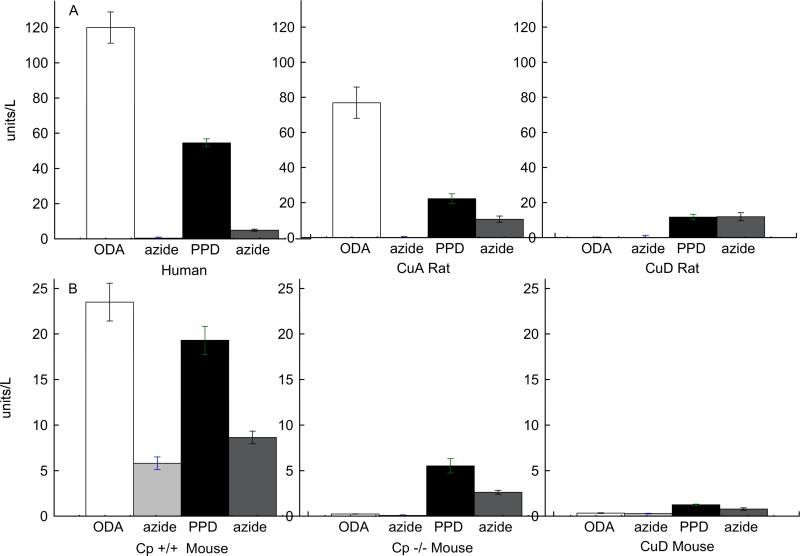
Impact of diet and azide on plasma diamine oxidase activity. A. Normal human and CuA and CuD rat plasma was assayed for Cp activity with either o-dianisidine (ODA) or paraphenylene diamine (PPD) as substrate with or without azide. B. Mouse plasma from wild-type (Cp +/+) and null (Cp -/-) mice and CuD mice was assayed for Cp activity with either ODA or PPD with or without azide. Activity (unit = μmol/min) was determined on a minimum of 4 samples of each group and all data was repeated. Bars represent mean ± SEM. Note the scale difference in A compared to B.
Fig. 2
Fig. 2
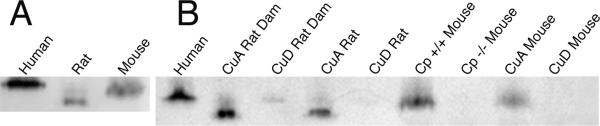
Ferroxidase activity of plasma. Plasma, 5 μL, from normal human or CuA rat or mouse (panel A) or from other treatment groups (B) was subjected to non-denaturing electrophoresis and transfer to PVDF membranes as assayed for membrane ferroxidase activity. Mobility of the Cp in rat is different from human or mouse. Ferroxidase activity in CuD rat, CuD mouse, and Cp -/- mouse plasma was not detected.
Fig. 3
Fig. 3
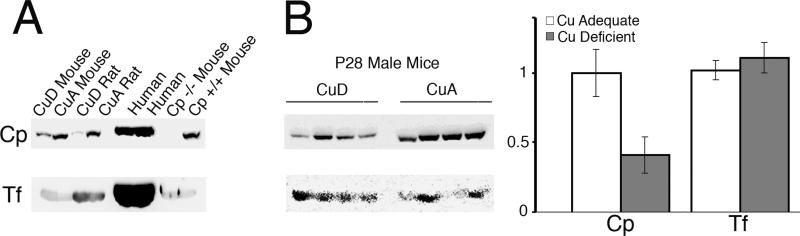
A. Characterization of the goat anti-human Cp antibody against human, mouse, and rat plasma. Plasma, 1 μL, was subjected to denaturing SDS PAGE, 8% gel, and probed for Cp. The blot was stripped and reprobed for transferrin (Tf). A single band, MW 135 kDa, was detected in human, CuA rat and mouse and Cp +/+ mouse. No Cp band was detected in the plasma from Cp -/- mice but a robust band for Tf was present. B. Abundance of Cp and Tf in mouse plasma following copper deficiency. Each lane contained 1 μL plasma from CuA or CuD mice. A 60% reduction in Cp abundance was detected in CuD mouse samples, P < 0.05, whereas Tf levels were comparable.
Fig. 4
Fig. 4
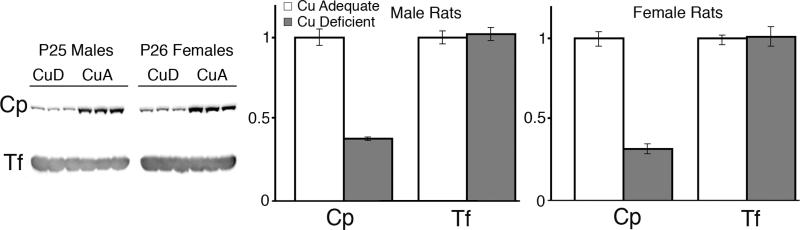
Abundance of Cp and Tf in rat pup plasma following copper deficiency. Each lane contained 1 μL plasma from CuA or CuD male or female rat pups. A 70% reduction in Cp abundance was detected in CuD rat samples, P < 0.05, whereas Tf levels were comparable.
Fig. 5
Fig. 5
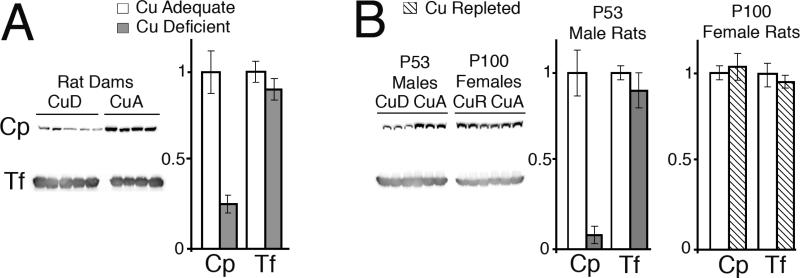
A. Abundance of Cp and Tf in rat dam plasma following copper deficiency. Each lane contained 1 μL plasma from CuA or CuD rat dams. A 75% reduction in Cp abundance was detected in CuD rat samples, P < 0.05, whereas Tf levels were comparable. B. Abundance of Cp and Tf in adult male rat plasma following copper deficiency and adult female rat plasma following copper repletion (CuR). Each lane contained 1 μL plasma. A 90% reduction in Cp abundance was detected in CuD male rat samples, P < 0.05, whereas Tf levels were comparable. Cp abundance was not different between CuA and CuR female rats, P > 0.05.

References

    1. Chen H, Huang G, Su T, Gao H, Attieh ZK, McKie AT, Anderson GJ, Vulpe CD. Decreased hephaestin activity in the intestine of copper-deficient mice causes systemic iron deficiency. J. Nutr. 2006;136:1236–1241. - PubMed
    1. Cherukuri S, Tripoulas NA, Nurko S, Fox PL. Anemia and impaired stress-induced erythropoiesis in aceruloplasminemic mice. Blood Cells Mol. Dis. 2004;33:346–355. - PubMed
    1. Fox PL. The copper-iron chronicles: the story of an intimate relationship. Biometals. 2003;16:9–40. - PubMed
    1. Frieden E, Hsieh HS. Ceruloplasmin: the copper transport protein with essential oxidase activity. Adv Enzymol Rel Areas Mol Biol. 1976;44:187–236. - PubMed
    1. Gitlin JD, Schroeder JJ, Lee-Ambrose LM, Cousins RJ. Mechanisms of caeruloplasmin biosynthesis in normal and copper- deficient rats. Biochem. J. 1992;282:835–839. - PMC - PubMed

Publication types

MeSH terms

LinkOut - more resources