


African-American women have a higher risk for developing peripartum cardiomyopathy
- PMID: 20170791
- PMCID: PMC3814012
- DOI: 10.1016/j.jacc.2009.09.043
African-American women have a higher risk for developing peripartum cardiomyopathy
Abstract
Objectives: The purpose of this study was to assess whether African-American women are at increased risk of having peripartum cardiomyopathy.
Background: Peripartum cardiomyopathy is a heart disease of unknown cause that affects young women, often with devastating consequences. The frequency of peripartum cardiomyopathy varies markedly between African and non-African regions.
Methods: A case-control study was performed at a regional center that provides medical care to a racially heterogeneous population. For each case, 3 healthy control patients were randomly selected who delivered babies within the same month.
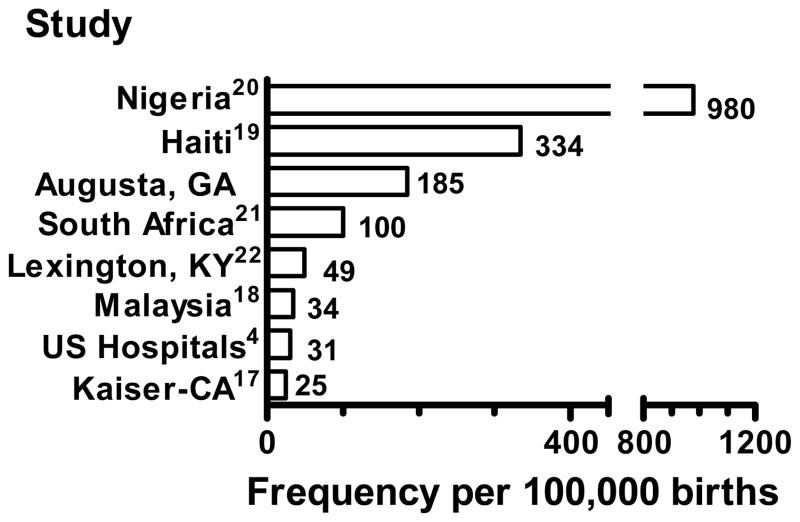
Results: African-American women had a 15.7-fold higher relative risk of peripartum cardiomyopathy than non-African Americans (odds ratio [OR]: 15.7, 95% confidence interval [CI]: 3.5 to 70.6). Other significant univariate risk factors were hypertension (OR: 10.8, 95% CI: 2.6 to 44.4), being unmarried (OR: 4.2, 95% CI: 1.4 to 12.3), and having had >2 previous pregnancies (OR: 2.9, 95% CI: 1.1 to 7.4). African-American ethnicity remained a significant risk factor for peripartum cardiomyopathy when other risk factors were considered in multivariable (OR: 31.5, 95% CI: 3.6 to 277.6) and stratified analyses (OR: 12.9 to 29.1, p < 0.001). Although the frequency of peripartum cardiomyopathy (185 of 100,000 deliveries) at this center was higher than in previous U.S. reports, it was comparable to the frequency in countries with more women of African descent (100 to 980 of 100,000). Analysis of other U.S. studies confirmed that the frequency of peripartum cardiomyopathy was significantly higher among African-American women.
Conclusions: African-American women have significantly higher odds of having peripartum cardiomyopathy that could not be explained by several other factors. Further research will be necessary to determine the potential environmental and/or genetic factors associated with African descent that confer this risk.
Conflict of interest statement
Disclosures: The authors have no conflicts of interest.
Figures
References
-
- Pearson GD, Veille JC, Rahimtoola S, et al. Peripartum cardiomyopathy: National Heart, Lung, and Blood Institute and Office of Rare Diseases (National Institutes of Health) workshop recommendations and review. Jama. 2000;283(9):1183–8. - PubMed
-
- Sliwa K, Fett J, Elkayam U. Peripartum cardiomyopathy. Lancet. 2006;368(9536):687–93. - PubMed
-
- Elkayam U, Akhter MW, Singh H, et al. Pregnancy-associated cardiomyopathy: clinical characteristics and a comparison between early and late presentation. Circulation. 2005;111(16):2050–5. - PubMed
-
- Mielniczuk LM, Williams K, Davis DR, et al. Frequency of peripartum cardiomyopathy. Am J Cardiol. 2006;97(12):1765–8. - PubMed
Publication types
MeSH terms
Grants and funding
LinkOut - more resources
Full Text Sources
Medical
