. 2010 Jun 15;48(12):1570-6.
doi: 10.1016/j.freeradbiomed.2010.02.016. Epub 2010 Feb 18.

Increased levels of 4-hydroxynonenal and acrolein in the brain in preclinical Alzheimer disease

Affiliations

Increased levels of 4-hydroxynonenal and acrolein in the brain in preclinical Alzheimer disease

M A Bradley et al. Free Radic Biol Med. .

Abstract

Previous studies demonstrate increased levels of 4-hydroxynonenal (HNE) and acrolein in vulnerable brain regions of subjects with mild cognitive impairment and late-stage Alzheimer disease (LAD). Recently preclinical AD (PCAD) subjects, who demonstrate normal antemortem neuropsychological test scores but abundant AD pathology at autopsy, have become the focus of increased study. Levels of extractable HNE and acrolein were quantified by gas chromatography-mass spectrometry with negative chemical ionization, and protein-bound HNE and acrolein were quantified by dot-blot immunohistochemistry in the hippocampus/parahippocampal gyrus (HPG), superior and middle temporal gyri (SMTG), and cerebellum (CER) of 10 PCAD and 10 age-matched normal control (NC) subjects. Results of the analyses show a significant (P<0.05) increase in levels of extractable acrolein in the HPG of PCAD subjects compared to age-matched NC subjects and a significant decrease in extractable acrolein in PCAD CER. Significant increases in protein-bound HNE in HPG and a significant decrease in CER of PCAD subjects compared to NC subjects were observed. No significant alterations were observed in either extractable or protein-bound HNE or acrolein in the SMTG of PCAD subjects. Additionally, no significant differences in levels of protein carbonyls were observed in the HPG, SMTG, or CER of PCAD subjects compared to NC subjects.


Figures

Figure 1
Figure 1
Antibody specificity of HNE and acrolein. (A) HNE modified BSA loaded in triplicate in Row 1 and HNE modified BSA loaded in triplicate in Row 2 incubated with anti-HNE pre-incubated with HNE. (B) HNE modified BSA loaded in triplicate in Row 1 and HNE modified BSA loaded in triplicate in Row 2 incubated with anti-HNE. (C) Acrolein modified BSA loaded in triplicate in Row 1 and HNE modified BSA loaded in triplicate in Row 2 incubated with anti-acrolein pre-incubated with acrolein. (D) Acrolein modified BSA loaded in triplicate in Row 1 and HNE modified BSA loaded in triplicate in Row 2 incubated with anti-acrolein antibody.
Figure 2
Figure 2
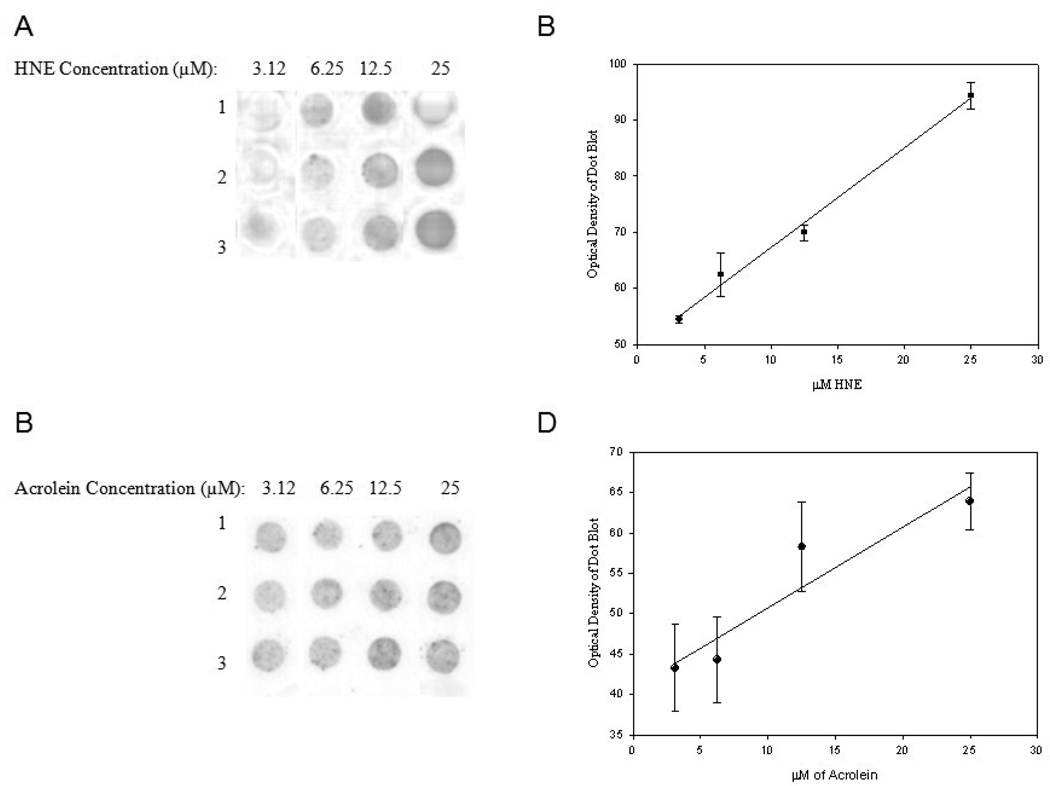
HNE and acrolein immunochemical staining of protein samples incubated with increasing concentrations of HNE or acrolein. Each modified BSA sample was loaded in triplicate. (A) Representative dot blots of HNE modified BSA with increasing HNE concentrations (3.125, 6.25, 12.5, and 25 µM). (B) Calibration curve of HNE concentration vs. immunochemical response (r = 0.99, P ≤ 0.05). (C) Representative dot blots of acrolein modified BSA with increasing acrolein concentrations 3.125, 6.25, 12.5, and 25 µM). (D) Calibration curve of acrolein concentration vs. immunochemical response (r = 0.94, P ≤ 0.05).
Figure 3
Figure 3
Levels of extractable acolein expressed as the median and range (nmol/mg of protein) in hippocampus/parahippocampal gyrus (HPG), superior and middle temporal gyri (SMTG), and cerebellum (CER) of preclinical Alzheimer’s disease (PCAD) and NC subjects. There was a significant (P < 0.05) increase in extractable acrolein in the HPG of PCAD subjects compared to NC subjects. There was a significant (P < 0.05) decrease in acrolein in the CER of PCAD subjects compared to NC subjects.
Figure 4
Figure 4
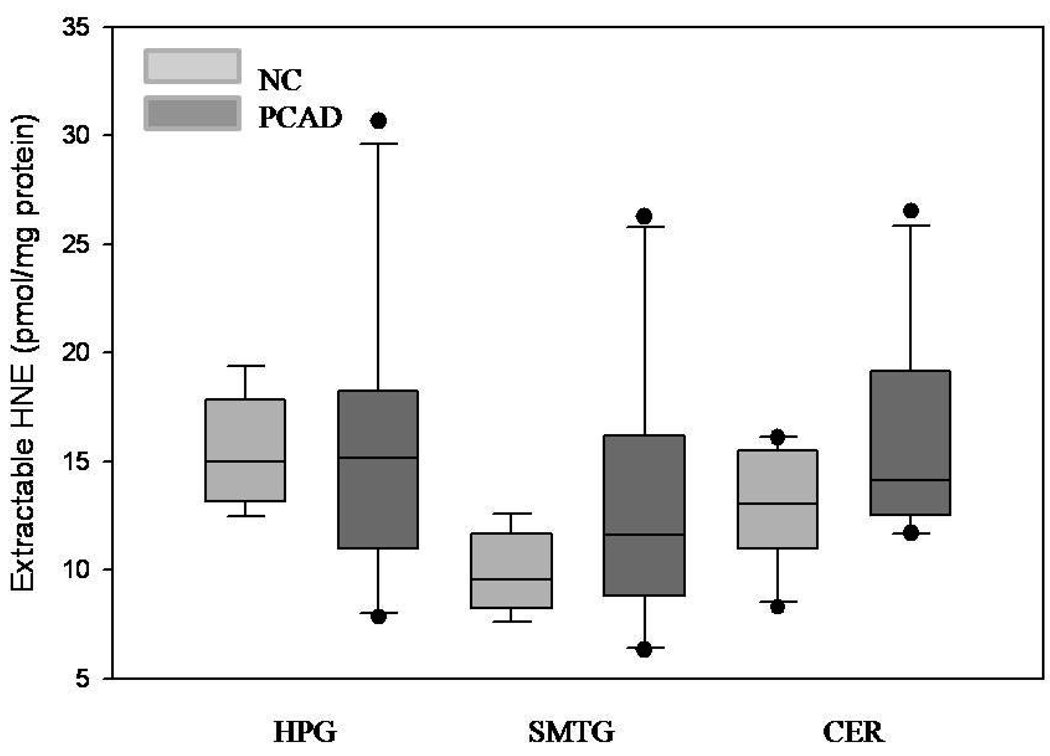
Levels of extractable HNE expressed as the median and range (pmol/mg of protein) in hippocampus/parahippocampal gyrus (HPG), superior and middle temporal gyri (SMTG), and cerebellum (CER) of preclinical Alzheimer’s disease (PCAD) and NC subjects. There were no significant differences in levels of extractable HNE in any brain region studied.
Figure 5
Figure 5
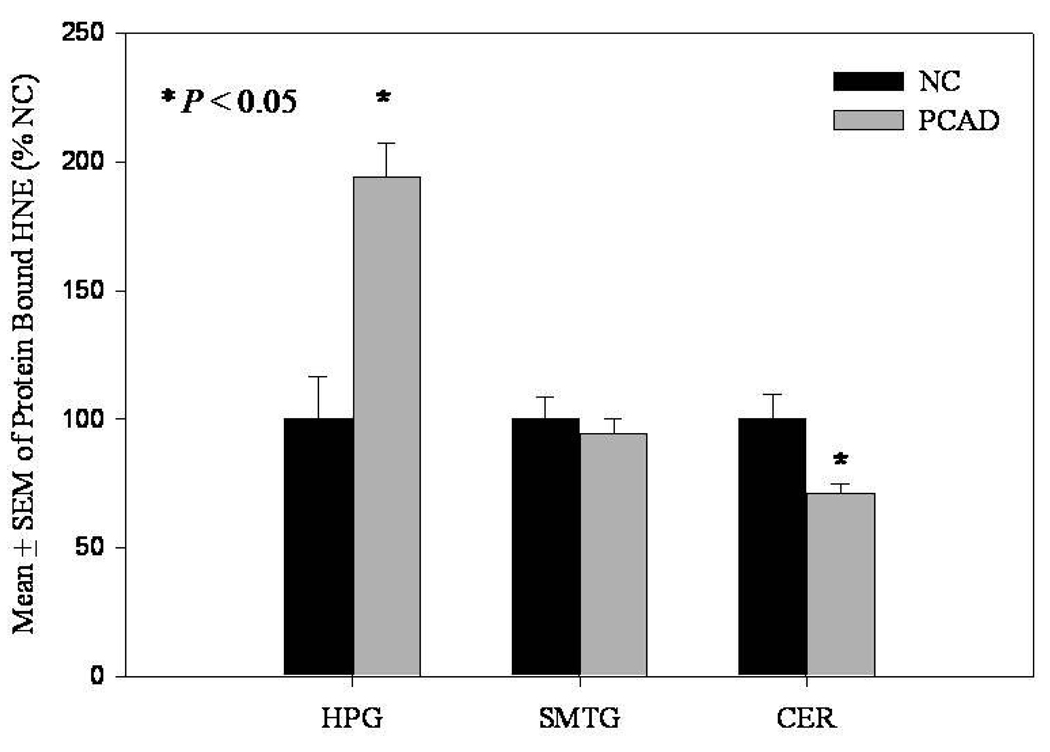
Levels of protein-bound HNE expressed as mean ± SEM (% of normal control [NC]) in hippocampus/parahippocampal gyrus (HPG), superior and middle temporal gyri (SMTG), and cerebellum (CER) of preclinical Alzheimer’s disease (PCAD) and NC subjects. There was a significant (P < 0.05) increase in protein bound HNE in the HPG of PCAD subjects compared to NC subjects. There was a significant (P < 0.05) decrease in protein bound HNE in the CER of PCAD subjects compared to NC subjects.
Figure 6
Figure 6
Levels of protein-bound acrolein expressed as mean ± SEM (% of normal control [NC]) in hippocampus/parahippocampal gyrus (HPG), superior and middle temporal gyri (SMTG), and cerebellum (CER) of preclinical Alzheimer’s disease (PCAD) and NC subjects. There were no significant differences between PCAD and NC subjects for any brain region studied.
Figure 7
Figure 7
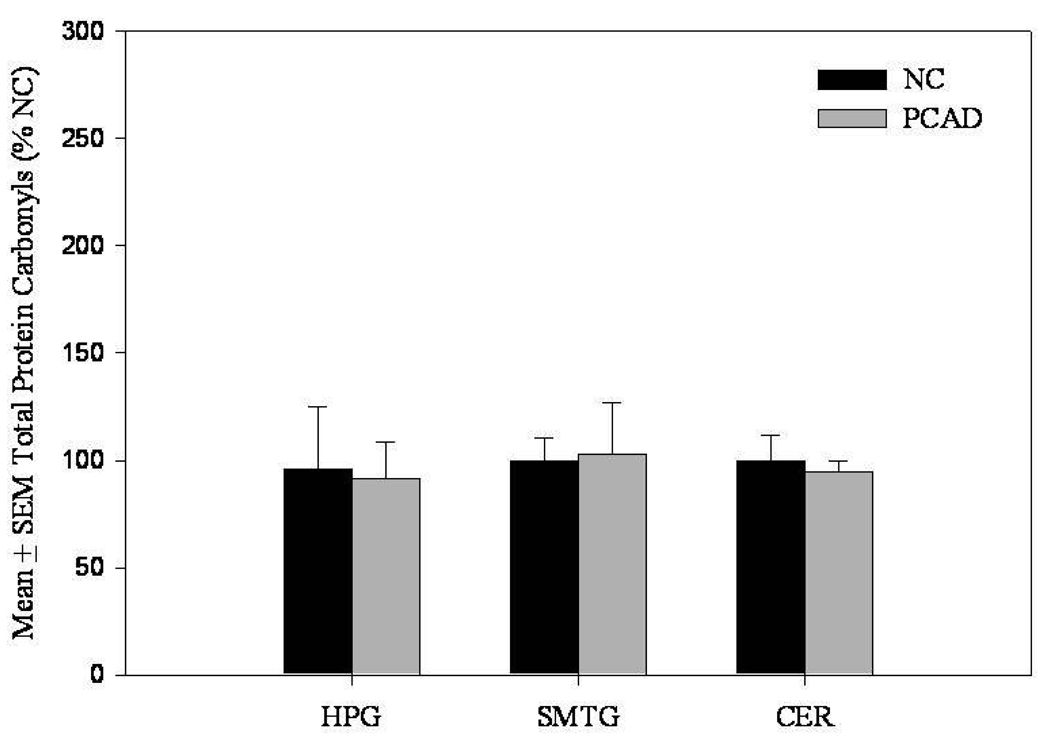
Protein carbonyl content expressed as mean ± SEM (% of normal control [NC]) in hippocampus/parahippocampal gyrus (HPG), superior and middle temporal gyri (SMTG), and cerebellum (CER) of PCAD and NC subjects. There were no significant differences for any brain region studied.

References

    1. Mecocci P, MacGarvey U, Beal MF. Oxidative damage to mitochondrial DNA is increased in Alzheimer's disease. American Neurological Association. 1994;36:747–751. - PubMed
    1. Gabbit SP, Lovell MA, Markesbery WR. Increased Nuclear DNA Oxidation in the Brain in Alzheimer's Disease. Journal of Neurochemistry. 1998;71:2034–2040. - PubMed
    1. Nunomura A, Perry G, Pappolla MA, Wade R, Hirai K, Chiba S, Smith MA. RNA oxidation is a prominent feature of vulnerable neurons in Alzherimer's disease. The Journal of Neuroscience. 1999;19:1959–1964. - PMC - PubMed
    1. Shan X, Tashiro H, Lin CG. The identification and characterization of oxidized RNAs in Alzheimer's disease. The Journal of Neuroscience. 2003;23:4913–2921. - PMC - PubMed
    1. Lovell MA, Xie C, Markesbery WR. Decrease base excision repair and increased helicase activity in Alzheimer's disease brain. Brain Research. 2000;855:166–123. - PubMed

Publication types