


Review
doi: 10.1016/j.idc.2009.10.014.
Legionnaires' disease: clinical differentiation from typical and other atypical pneumonias
Affiliations
- PMID: 20171547
- PMCID: PMC7127122
- DOI: 10.1016/j.idc.2009.10.014
Item in Clipboard
Review
Legionnaires' disease: clinical differentiation from typical and other atypical pneumonias
Infect Dis Clin North Am.
2010 Mar.
Abstract
This article describes the clinical differentiation of legionnaires' disease from typical and other atypical pneumonias, with reference to the history, microbiology, epidemiology, clinical presentation (including radiologic manifestations, clinical extrapulmonary features, nonspecific laboratory findings, clinical syndromic diagnosis, and differential diagnosis), therapy, complications, and prognosis of the disease.
Copyright 2010 Elsevier Inc. All rights reserved.
Figures
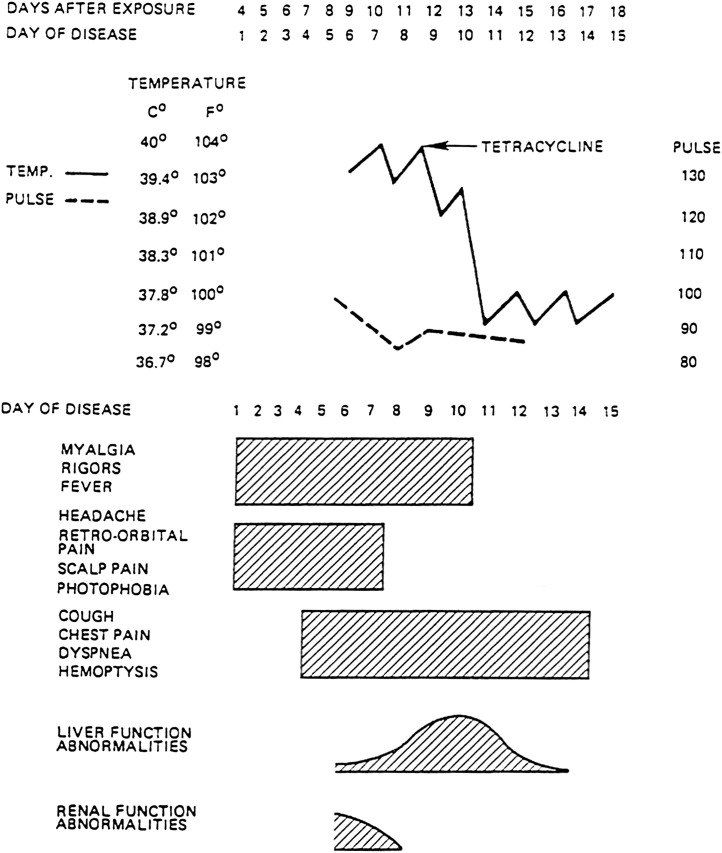
Relative bradycardia, an early clinical clue, from an early case of Legionnaires' disease. (Reprinted from Lattimer GL, Ormsbee RA. Legionnaires' disease. New York: Marcel Dekker; 1981; with permission.)

Clinical approach to community-acquired pneumonias: the importance of the zoonotic contact history and relative bradycardia.

Typical fever response (5–7 days) of legionnaires' disease to anti-Legionella antibiotic therapy with doxycycline (note lack of fever response to β-lactam therapy). (Reprinted from Cotton LM, Strampfer MJ, Cunha BA. Legionella and Mycoplasma pneumonia. A community hospital experience. Clin Chest Med 1987;8:441–53; with permission.)

Typical time course of early transient hypophosphatemia with legionnaires' disease. From Cunha BA. Hypophosphatemia: diagnostic significance in legionnaires' disease. Am J Med 2006;119:5–6.

Serial ESRs in a patient with Legionella CAP. (From Cunha BA, Mickail N, Syed U, et al. The rapid clinical diagnosis of Legionnaires' disease during the “herald wave” of the swine influenza (H1N1) pandemic: the Legionnaires' disease triad. Heart Lung 2010;39; in press; with permission.)

Serial CRP levels in a patient with Legionella CAP. (From Cunha BA, Mickail N, Syed U, et al. The rapid clinical diagnosis of Legionnaires' disease during the “herald wave” of the swine influenza (H1N1) pandemic: the Legionnaires' disease triad. Heart Lung 2010;39; in press; with permission.)
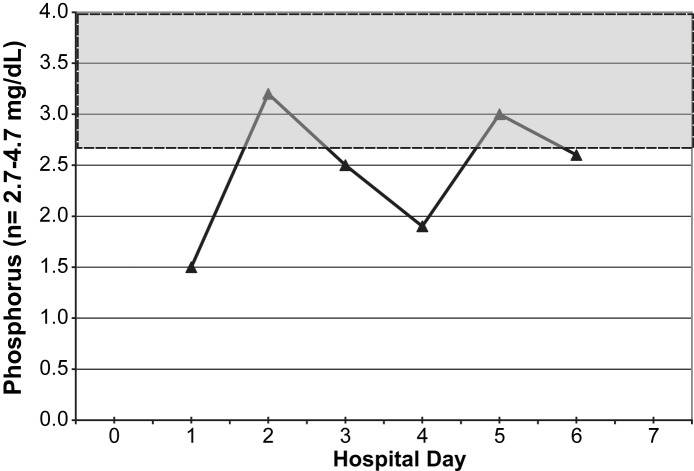
Serial serum phosphorus levels in a patient with Legionella CAP. (From Cunha BA, Mickail N, Syed U, et al. The rapid clinical diagnosis of Legionnaires' disease during the “herald wave” of the swine influenza (H1N1) pandemic: the Legionnaires' disease triad. Heart Lung 2010;39; in press; with permission.)

Serial serum transaminase levels in a patient with Legionella CAP. (From Cunha BA, Mickail N, Syed U, et al. The rapid clinical diagnosis of Legionnaires' disease during the “herald wave” of the swine influenza (H1N1) pandemic: the Legionnaires' disease triad. Heart Lung 2010;39; in press; with permission.)

Serial CPK levels in a patient with Legionella CAP. (From Cunha BA, Mickail N, Syed U, et al. The rapid clinical diagnosis of Legionnaires' disease during the “herald wave” of the swine influenza (H1N1) pandemic: the Legionnaires' disease triad. Heart Lung 2010;39; in press; with permission.)

Serial ferritin levels in a patient with Legionella CAP. (From Cunha BA, Mickail N, Syed U, et al. The rapid clinical diagnosis of Legionnaires' disease during the “herald wave” of the swine influenza (H1N1) pandemic: the Legionnaires' disease triad. Heart Lung 2010;39; in press; with permission.)
References
-
- Lattimer G.L., Ormsbee R.A. Marcel Dekker, Inc; New York: 1981. Legionnaires' disease.
-
- Edelstein P.H. Legionella. In: Murray P.R., editor. Manual of clinical microbiology. 9th edition. ASM Press; Washington, DC: 2007. pp. 835–849.
-
- Forbes B.A., Sahm D.F., Weissfeld A.S. Mosby Elsevier; St. Louis (MO): 2007. Legionella. Bailey & Scott's diagnostic microbiology. 12th edition. p. 424–8.
-
- Edelstein P.H. State of the art lecture. Laboratory diagnosis of legionnaire's disease. In: Thornsberry C., Balows A., Feeley J.C., editors. Legionella: proceedings of the 2nd international symposium. ASM Press; Washington, DC: 1984. pp. 3–5.
-
- Luck P.C., Helbig J.H., von Baum H. Diagnostics and clinical disease treatment: usefulness of microbiological diagnostic methods for detection of Legionella infections. In: Cianciotto N.P., Kwaik Y.A., Edelstein P.H., editors. Legionella: state of the art 30 years after its recognition. ASM Press; Washington, DC: 2006. pp. 15–21.
Publication types
MeSH terms
Substances
LinkOut - more resources
Full Text Sources
Other Literature Sources
Medical
