. 2010 Apr;152(4):1796-806.
doi: 10.1104/pp.109.151035. Epub 2010 Feb 19.

Tracing cadmium from culture to spikelet: noninvasive imaging and quantitative characterization of absorption, transport, and accumulation of cadmium in an intact rice plant

Affiliations

Tracing cadmium from culture to spikelet: noninvasive imaging and quantitative characterization of absorption, transport, and accumulation of cadmium in an intact rice plant

Shu Fujimaki et al. Plant Physiol. 2010 Apr.

Abstract

We characterized the absorption and short-term translocation of cadmium (Cd) in rice (Oryza sativa 'Nipponbare') quantitatively using serial images observed with a positron-emitting tracer imaging system. We fed a positron-emitting 107Cd (half-life of 6.5 h) tracer to the hydroponic culture solution and noninvasively obtained serial images of Cd distribution in intact rice plants at the vegetative stage and at the grain-filling stage every 4 min for 36 h. The rates of absorption of Cd by the root were proportional to Cd concentrations in the culture solution within the tested range of 0.05 to 100 nm. It was estimated that the radial transport from the culture to the xylem in the root tissue was completed in less than 10 min. Cd moved up through the shoot organs with velocities of a few centimeters per hour at both stages, which was obviously slower than the bulk flow in the xylem. Finally, Cd arrived at the panicles 7 h after feeding and accumulated there constantly, although no Cd was observed in the leaf blades within the initial 36 h. The nodes exhibited the most intensive Cd accumulation in the shoot at both stages, and Cd transport from the basal nodes to crown root tips was observed at the vegetative stage. We conclude that the nodes are the central organ where xylem-to-phloem transfer takes place and play a pivotal role in the half-day travel of Cd from the soil to the grains at the grain-filling stage.


Figures
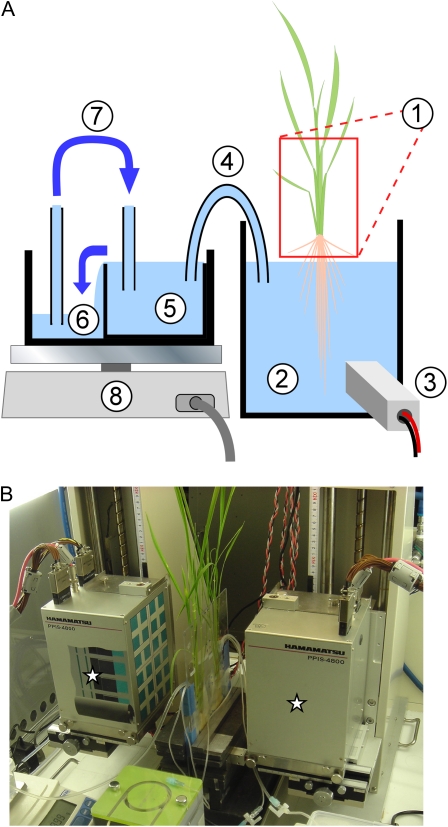
Figure 1.
Figure 1.
A, Schematic illustration of the controlling and monitoring system for the culture solution. Numbers are as follows: 1, FOV of PETIS; 2, culture solution in the plastic bag; 3, monitoring of radioactivity of the culture solution using a detector; 4, siphon tube; 5, primary reservoir; 6, secondary reservoir; 7, pump; 8, automatic balance. B, Test plants and the detector heads of PETIS (stars).
Figure 2.
Figure 2.
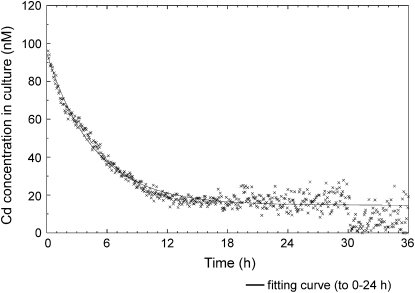
A typical time course of Cd concentration in culture solution during the PETIS experiment. A total of 96 nm Cd (containing 2 nmol of nonradioactive Cd and 2.7 pmol [48 MBq] of 107Cd) was fed at the beginning of the experiment in this case. The culture solution was exchanged with a fresh solution without Cd at 30 h.
Figure 3.
Figure 3.
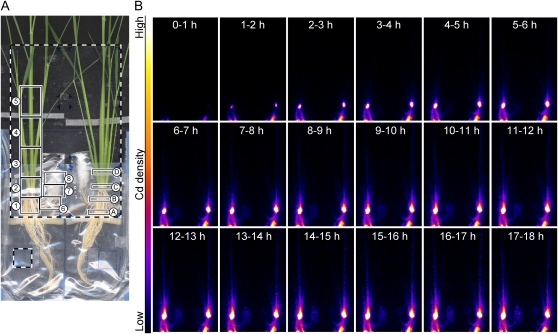
Imaging of Cd transport to the shoot at the vegetative stage. A, FOV of PETIS and ROIs for analysis. The dotted large rectangle indicates the FOV of PETIS. The dotted small square indicates the position of the monitoring probe for the radioactivity of the culture solution. ROIs A and B, Root; ROI C, shoot base; ROI D, leaf sheath; ROI 1, root; ROI 2, shoot base; ROIs 3 to 5, leaf sheath; ROIs 6 to 8, crown root. B, Serial images of Cd movement (0–18 h). Each frame comes from the integration of 15 original images collected every 4 min. The images after 18 h were omitted because of little change after this time point.
Figure 4.
Figure 4.
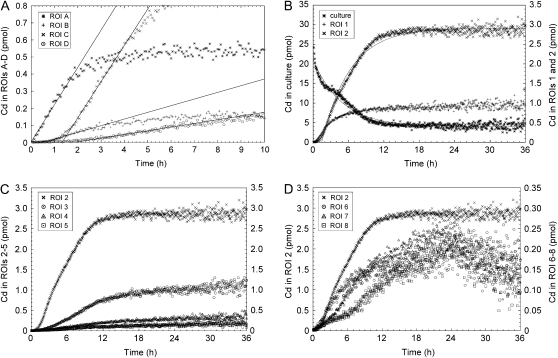
Time courses of Cd amount in the ROIs shown in Figure 3A. A, Estimation of arrival times at ROIs A, B, C, and D. Fitting lines are indicated. B, Time courses of Cd distribution in the culture solution, roots (ROI 1), and shoot base (ROI 2). Fitting curves for culture and ROI 2 are indicated. C, Time courses of Cd distribution in the shoot base (ROI 2) and leaf sheath (ROIs 3–5). D, Time courses of Cd distribution in the shoot base (ROI 2) and crown root (ROIs 6–8).
Figure 5.
Figure 5.
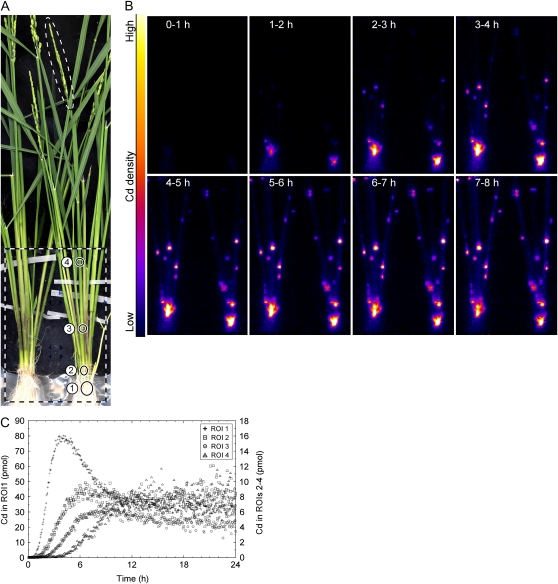
Imaging and analysis of Cd transport into shoot at the grain-filling stage. A, FOV of PETIS (dotted rectangle) and ROIs for analysis (numbered ellipses). ROI 1, Stem base; ROIs 2 to 4, nodes. These nodes aligned in the culm connected to the panicle indicated with a dotted ellipse. B, Serial images of Cd movement (0–8 h). Each frame comes from the integration of 15 original images collected every 4 min. The images after 8 h were omitted because of little change after this time point. C, Time courses of Cd distribution in the stem base (ROI 1) and the nodes (ROIs 2–4). A total of 690 pmol of Cd (10 nm) was fed initially in this experiment.
Figure 6.
Figure 6.
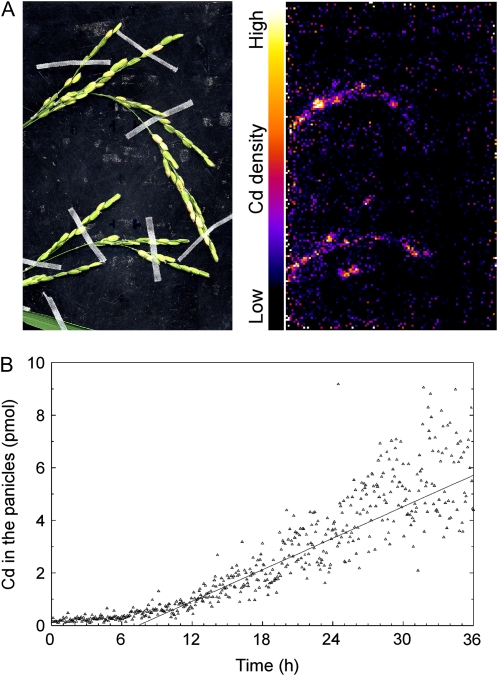
Imaging and analysis of Cd transport into panicles. A, Photograph (left) and PETIS image (right) in the same view. The PETIS image comes from the integration of 360 original images obtained in the first 24 h. B, Time course of Cd accumulation into the panicles. The sum of Cd amounts in the two panicles is indicated. A total of 1,200 pmol of Cd (9.4 nm) was fed initially in this experiment.
Figure 7.
Figure 7.
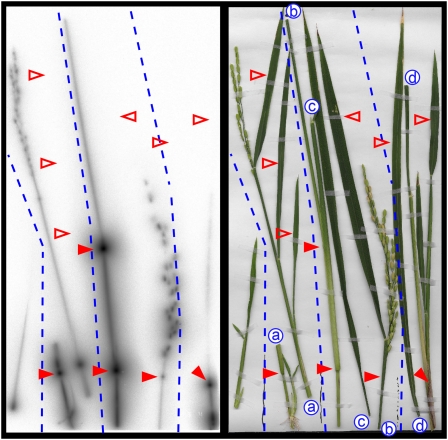
Autoradiography of detached parts of shoots at the grain-filling stage 36 h after feeding of tracer. Four tillers of the plant in Figure 5A, right, are presented as a representative. An autoradiograph (left) and photograph (right) of the same view are shown. The pairs of letters and the dotted lines indicate the cut sites and borders between the tillers, respectively. Strong accumulation of Cd in the nodes was observed (closed arrowheads), but no signal was detected from the leaf blades (open arrowheads).

References

    1. Clemens S, Palmgren MG, Krämer U. (2002) A long way ahead: understanding and engineering plant metal accumulation. Trends Plant Sci 7: 309–315 - PubMed
    1. Fujimaki S. (2007) The positron emitting tracer imaging system (PETIS), a most-advanced imaging tool for plant physiology. ITE Lett Batteries New Technol Med 8: 404–413
    1. Fujimaki S, Ishii S, Ishioka NS. (2010) Non-invasive imaging and analyses of transport of nitrogen nutrition in intact plants using a positron-emitting tracer imaging system (PETIS). Ohyama T, Sueyoshi K, , Nitrogen Assimilation in Plants. Research Signpost, Kerala, India: (in press)
    1. Harris NS, Taylor GJ. (2004) Cadmium uptake and translocation in seedlings of near isogenic lines of durum wheat that differ in grain cadmium accumulation. BMC Plant Biol 4: 4. - PMC - PubMed
    1. Hart JJ, Welch RM, Norvell WA, Sullivan LA, Kochian LV. (1998) Characterization of cadmium binding, uptake, and translocation in intact seedlings of bread and durum wheat cultivars. Plant Physiol 116: 1413–1420 - PMC - PubMed

Publication types

LinkOut - more resources