


Comment
doi: 10.1073/pnas.0914478107.
Epub 2010 Feb 19.
Membrane protein folding makes the transition
Affiliations
- PMID: 20173094
- PMCID: PMC2840139
- DOI: 10.1073/pnas.0914478107
Item in Clipboard
Comment
Membrane protein folding makes the transition
Proc Natl Acad Sci U S A.
.
No abstract available
Conflict of interest statement
The authors declare no conflict of interest.
Figures
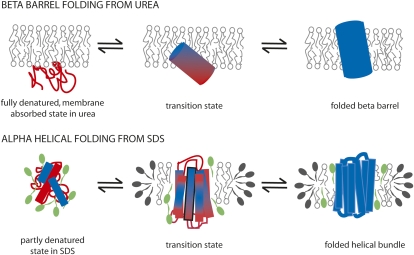
Schematic diagrams of proposed folding models for β-barrel and α-helical membrane proteins, highlighting potential transition state structures from φ-value studies. Folding of a β-barrel protein occurs from a fully denatured, membrane-absorbed state in urea with a tilted, partly inserted transition state as proposed by Huysmans et al. (1). In contrast, folding of an α-helical protein such as bacteriorhodopsin occurs from a partly denatured state in SDS, which contains some helical content. The transition state is proposed to have significant native helix content. Only one transmembrane helix has been analyzed by φ-values (3), and this suggests a largely formed helix with partial helix formation at the cytoplasmic side (shown in the bottom of this diagram, with this helix outlined in black). The degree of structure in other helices is estimated from previous studies (e.g., ref 15). Unfolded structure is shown in red and folded structure in blue. SDS is shown in green. PagP was folded into lipid bilayers vesicles, whereas bacteriorhodopsin was folded into mixed DMPC/CHAPS micelles (the detergent CHAPS is shown here capping the edges of a DMPC disc).
Comment on
-
The transition state for folding of an outer membrane protein.Proc Natl Acad Sci U S A. 2010 Mar 2;107(9):4099-104. doi: 10.1073/pnas.0911904107. Epub 2010 Feb 1. Proc Natl Acad Sci U S A. 2010. PMID: 20133664 Free PMC article.
References
-
- Fersht AR, Matouschek A, Serrano L. The folding of an enzyme. I. Theory of protein engineering analysis of the stability and pathway of protein folding. J Mol Biol. 1992;224:771–782. - PubMed
Publication types
MeSH terms
Substances
Grants and funding
LinkOut - more resources
Full Text Sources
