. 2010 Mar 18;464(7287):409-12.
doi: 10.1038/nature08801. Epub 2010 Feb 21.

Targeted deletion of the 9p21 non-coding coronary artery disease risk interval in mice

Affiliations

Targeted deletion of the 9p21 non-coding coronary artery disease risk interval in mice

Axel Visel et al. Nature. .

Abstract

Sequence polymorphisms in a 58-kilobase (kb) interval on chromosome 9p21 confer a markedly increased risk of coronary artery disease (CAD), the leading cause of death worldwide. The variants have a substantial effect on the epidemiology of CAD and other life-threatening vascular conditions because nearly one-quarter of Caucasians are homozygous for risk alleles. However, the risk interval is devoid of protein-coding genes and the mechanism linking the region to CAD risk has remained enigmatic. Here we show that deletion of the orthologous 70-kb non-coding interval on mouse chromosome 4 affects cardiac expression of neighbouring genes, as well as proliferation properties of vascular cells. Chr4(Delta70kb/Delta70kb) mice are viable, but show increased mortality both during development and as adults. Cardiac expression of two genes near the non-coding interval, Cdkn2a and Cdkn2b, is severely reduced in chr4(Delta70kb/Delta70kb) mice, indicating that distant-acting gene regulatory functions are located in the non-coding CAD risk interval. Allele-specific expression of Cdkn2b transcripts in heterozygous mice showed that the deletion affects expression through a cis-acting mechanism. Primary cultures of chr4(Delta70kb/Delta70kb) aortic smooth muscle cells exhibited excessive proliferation and diminished senescence, a cellular phenotype consistent with accelerated CAD pathogenesis. Taken together, our results provide direct evidence that the CAD risk interval has a pivotal role in regulation of cardiac Cdkn2a/b expression, and suggest that this region affects CAD progression by altering the dynamics of vascular cell proliferation.


Figures
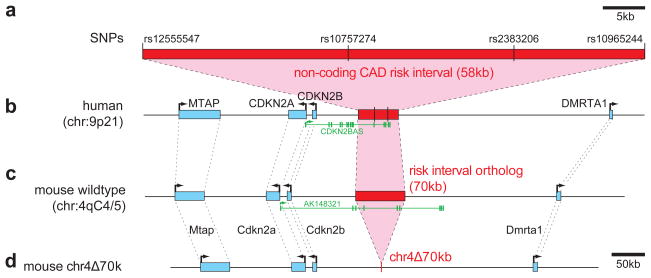
Figure 1
Figure 1. Deletion of the noncoding region orthologous to the 58kb CAD risk interval on human chromosome 9p21
a) Noncoding CAD risk interval with SNPs found to be most significantly associated with CAD in genome-wide association studies , and SNPs defining the boundaries of the linkage disequilibrium block. b)Overview of the human locus including neighboring genes (blue, intron/exon structure not shown). A noncoding RNA of unknown function transcribed from this locus is shown in green (CDKN2BAS, also known as ANRIL, GenBank NR_003529.3). c)Orthologous region on mouse chromosome 4. The exon structure of a noncoding transcript of unknown function, AK148321, is shown in green. d)Chr4Δ70kb after successful targeting and deletion of the 70kb CAD risk interval.
Figure 2
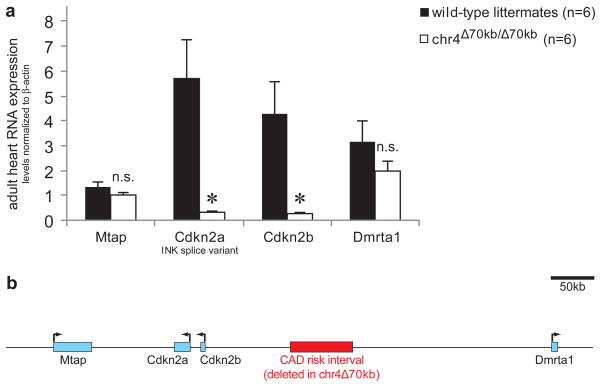
Figure 2. Deletion of the CAD risk interval affects expression of neighboring genes Cdkn2a and Cdkn2b
a) Expression levels of Cdkn2a (INK splice variant) and Cdkn2b are significantly reduced in heart tissue of chr4Δ70kb/Δ70kb mice. In contrast, expression of the neighboring genes Mtap and Dmrta1 is not significantly altered. b) Overview of locus with locations of genes. Error bars are standard error of the mean; asterisks indicate P ≤ 0.005 (t-test, one-tailed).
Figure 3
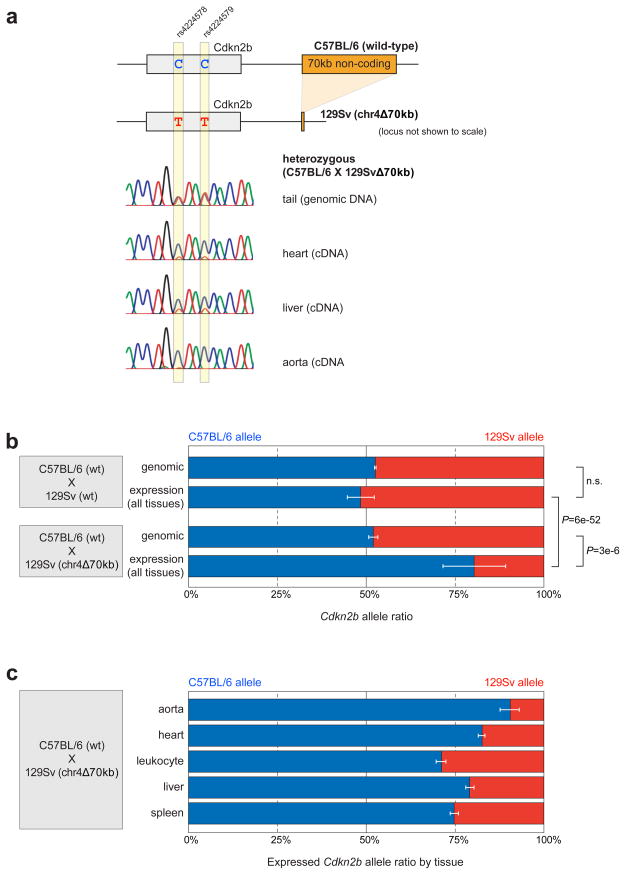
Figure 3. Deletion of the CAD risk interval affects gene expression through a cis-regulatory mechanism
a) Two of seven transcribed single nucleotide polymorphisms (SNPs) that were used to distinguish expression of the C57BL/6 and 129Sv strain alleles of the Cdkn2b gene. Representative electropherograms from direct Sanger sequencing of PCR product are shown. b) No differences between alleles are observed in genomic DNA or tissue-derived cDNA in chr4+(C57BL/6)/+(129Sv) mice or in genomic DNA of chr4+(C57BL/6)/Δ70kb(129Sv) mice. In contrast, in tissues of chr4+(C57BL/6)/Δ70kb(129Sv) mice, the C57BL/6 allele is expressed four-fold higher than the 129Sv allele (all tissues combined). c) Allelic expression differences shown by individual tissues. Error bars indicate standard deviation (b) and standard error of means (c). P-values: t-test, two-tailed.
Figure 4
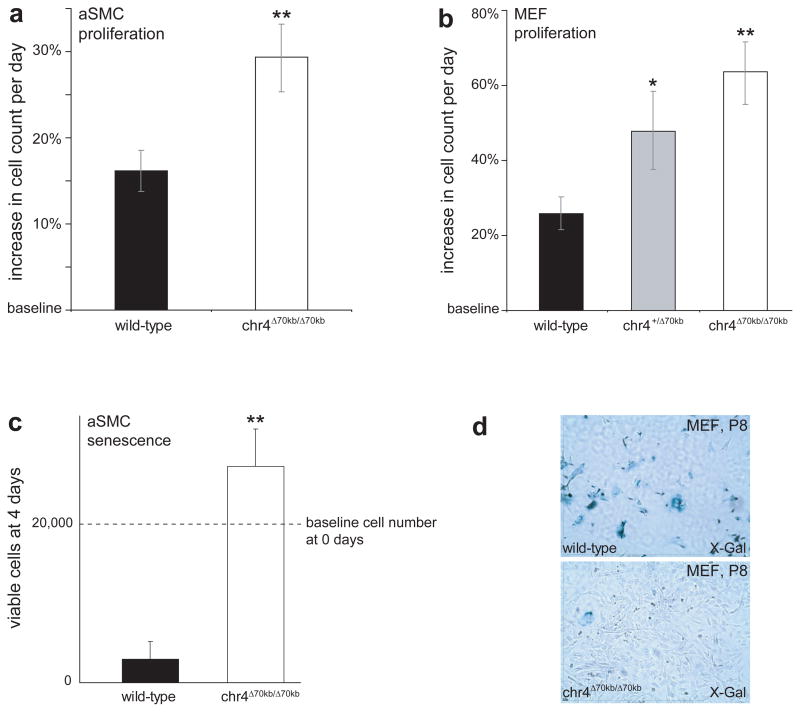
Figure 4. Deletion of the CAD risk interval disrupts normal dynamics of cellular proliferation and senescence
a) Increased proliferation of primary aSMC cultures. b) Increased proliferation of primary MEF cultures. c) Failure of normal cellular senescence of primary aSMC cultures in late passages. Cells derived from wild-type and chr4Δ70kb/Δ70kb mice were grown to senescence under identical conditions, seeded at equal densities and cell counts were determined after 4 days. d) Chr4Δ70kb/Δ70kb-derived MEFs fail to enter cellular senescence, as evident from absence of senescence staining by X-Gal in comparison to wild-type MEFs . Mean daily proliferation rates are shown in a) and b), viable cell count at day 4 is shown in c). Error bars indicate SEM. *, P<0.05; **, P<0.01; t-test.

References

    1. Helgadottir A, et al. A common variant on chromosome 9p21 affects the risk of myocardial infarction. Science. 2007;316 (5830):1491–1493. - PubMed
    1. McPherson R, et al. A common allele on chromosome 9 associated with coronary heart disease. Science. 2007;316 (5830):1488–1491. - PMC - PubMed
    1. Lloyd-Jones D, et al. Heart disease and stroke statistics--2009 update: a report from the American Heart Association Statistics Committee and Stroke Statistics Subcommittee. Circulation. 2009;119 (3):e21–181. - PubMed
    1. Topol EJ, Smith J, Plow EF, Wang QK. Genetic susceptibility to myocardial infarction and coronary artery disease. Hum Mol Genet. 2006;15(Spec No 2):R117–123. - PubMed
    1. Schunkert H, et al. Repeated replication and a prospective meta-analysis of the association between chromosome 9p21.3 and coronary artery disease. Circulation. 2008;117 (13):1675–1684. - PMC - PubMed

Publication types

MeSH terms

Substances