


Realtime PCR is more sensitive than multiplex PCR for diagnosis and serotyping in children with culture negative pneumococcal invasive disease
- PMID: 20174571
- PMCID: PMC2824814
- DOI: 10.1371/journal.pone.0009282
Realtime PCR is more sensitive than multiplex PCR for diagnosis and serotyping in children with culture negative pneumococcal invasive disease
Abstract
Background: Pneumococcal serotyping is usually performed by Quellung reaction, considered the gold standard test. However the method cannot be used on culture-negative samples. Molecular methods can be a useful alternative. The aim of the study was to evaluate the use of Multiplex-sequential-PCR (MS-PCR) or Realtime-PCR on blood samples for diagnosis and serotyping of invasive pneumococcal disease (IPD) in a pediatric clinical setting.
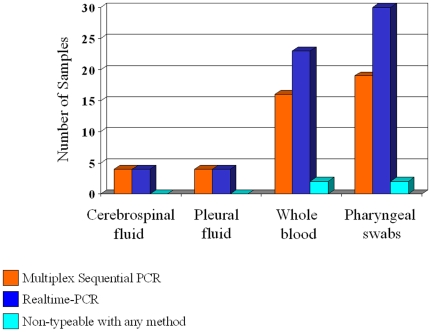
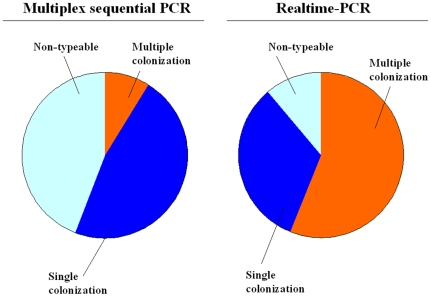
Methodology/principal findings: Sensitivity and specificity of MS-PCR and Realtime-PCR have been evaluated both on 46 well characterized pneumococcal isolates and on 67 clinical samples from children with culture-negative IPD. No difference in sensitivity and specificity between MS-PCR and Realtime PCR was found when the methods were used on isolates: both methods could type 100% isolates and the results were always consistent with culture-based methods. On the contrary, when used on clinical samples 43/67 (64.2%) were typeable by MS-PCR and 61/67 (91.0%) by Realtime-PCR (p = 0.0004,K Cohen 0.3, McNemar's p<0.001). Non-typeability by MS-PCR was associated in 18/20 cases (90.0%) with low bacterial load. The difference between the two methods was present both when they were used on normally sterile fluids (respectively 31/33 (93.9%) typeable samples for Realtime-PCR and 24/33 (72.7%) for MS-PCR, p = 0.047, 95%CL 0.03-0.98; K Cohen 0.3; McNemar's p = 0.0016) and when they were used on nasopharyngeal swabs (respectively 30/34 (88.2%) typeable samples for Realtime-PCR and 19/34 (55.9%) for MS-PCR, p = 0.007, 95%CL 0.04-0.66); the presence of multiple pneumococcal serotypes in nasopharyngeal swabs was found more frequently by Realtime PCR (19/30; 63.3%) than by Multiplex-sequential PCR (3/19; 15.8%; p = 0.003;95%CL 1.87-39.97).
Conclusions/significance: In conclusion, both MS-PCR and Realtime PCR can be used for pneumococcal serotyping of most serotypes/serogroups directly on clinical samples from culture-negative patients but Realtime-PCR appears more sensitive.
Conflict of interest statement
Figures
References
-
- Bridy-Pappas AE, Margolis MB, Center KJ, Isaacman DJ. Streptococcus pneumoniae: description of the pathogen, disease epidemiology, treatment, and prevention. Pharmacotherapy. 2005;25:1193–1212. - PubMed
-
- World Health Organization (WHO) Pneumococcal conjugate vaccine for childhhood immunization-WHO position paper. Wkly Epidemiol Rec. 2007;82:93–104. - PubMed
-
- Jin P, Kong F, Xiao M, Oftadeh S, Zhou F, et al. First Report of Putative Streptococcus pneumoniae Serotype 6D among Nasopharyngeal Isolates from Fijian Children. J Infect Dis. 2009;200(9):1375–80. - PubMed
-
- Whitney CG, Farley MM, Hadler J, Harrison LH, Bennett NM, et al. Decline in invasive pneumococcal disease after the introduction of protein-polysaccharide conjugate vaccine. N Engl J Med. 2003;348:1737–1746. - PubMed
-
- Arai S, Konda T, Wad A, Matsunaga Y, Okabe N, et al. Use of antiserum-coated latex particles for serotyping Streptococcus pneumoniae. Microbiol Immunol. 2001;45:159–162. - PubMed
Publication types
MeSH terms
Substances
LinkOut - more resources
Full Text Sources
Other Literature Sources
Medical
Molecular Biology Databases
