


Epidemiology of fractures in children and adolescents
- PMID: 20175744
- PMCID: PMC2856220
- DOI: 10.3109/17453671003628780
Epidemiology of fractures in children and adolescents
Abstract
Background and purpose: Fractures are most common in youth and in the elderly, with differences in incidence over time and between regions. We present the fracture pattern in a population of youths <or= 19 years of age, who were seen at Umeå University Hospital, Sweden.
Material and methods: All injuries seen at the hospital have been recorded in a database since 1993. The data include variables such as age, sex, date, type of injury, mechanism of injury, and treatment. For the period 1993-2007, there were 10,203 injury events that had resulted in at least 1 fracture.
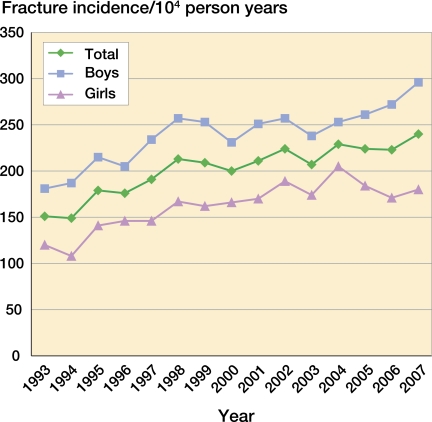
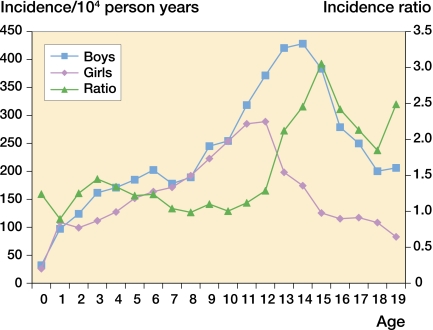
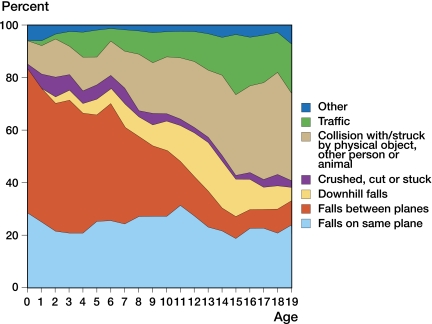
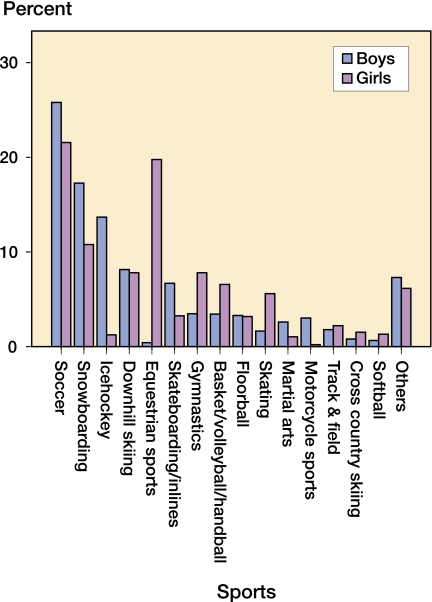
Results: The incidence for the whole period was 201/10(4) person years. The incidence increased by 13% during the period 1998-2007, when we were able to control for registration errors. The most common fracture site was the distal forearm. The most common type of injury mechanism was falling. The peak incidence occurred at 11-12 years in girls and at 13-14 years in boys, with a male-to-female incidence ratio of 1.5. We found variations in mechanisms and activities at injury with age, and over time.
Interpretation: Fractures are caused by a combination of intrinsic and extrinsic factors that vary with age. We believe the increase in incidence is partly explained by changes in children's activity patterns over time. Further research may help to identify preventive measures to reduce the number of fractures, in particular those involving hospital care, surgical treatment, and-most importantly-long-term impairment.
Figures
Comment in
-
Increasing wrist fracture rates in children may have major implications for future adult fracture burden.Acta Orthop. 2016 Jun;87(3):296-300. doi: 10.3109/17453674.2016.1152855. Epub 2016 Feb 24. Acta Orthop. 2016. PMID: 26905618 Free PMC article.
References
-
- Albertsson Wikland K, Luo ZC, Niklasson A, Karlberg J. Swedish population-based longitudinal reference values from birth to 18 years of age for height, weight and head circumference. Acta Paediatr. 2002;91:739–54. - PubMed
-
- Bergström U, Björnstig U, Stenlund H, Jonsson H, Svensson O. Fracture mechanisms and fracture pattern in men and women aged 50 years and older: a study of a 12-year population-based injury register, Umeå, Sweden. Osteoporos Int. 2008;19((9)):1267–73. - PubMed
-
- Brudvik C, Hove LM. Childhood fractures in Bergen Norway: Identifying High-risk Groups and Activities. J Pediatr Orthop. 2003;23:629–34. - PubMed
-
- Cooper C, Dennison EM, Leufkens HG, Bishop N, van Staa TP. Epidemiology Of Childhood Fractures in Britain: a study using the general practice research database. J Bone Miner Res. 2004;19:1976–81. - PubMed
-
- Engström L-M. Chapter 20: Sweden. Worldwide trends in youth sports (Eds) In: De Knop P, Engström L-M, Skirstad B, Weiss MR, editors. Vol. 20. Human Kinetics; Champaign, Illinois: 1996. pp. 231–43.
MeSH terms
LinkOut - more resources
Full Text Sources
Medical