


Genetic approaches to functional gastrointestinal disorders
- PMID: 20176021
- PMCID: PMC3829382
- DOI: 10.1053/j.gastro.2010.02.037
Genetic approaches to functional gastrointestinal disorders
Erratum in
- Gastroenterology. 2010 Jul;139(1):360
Abstract
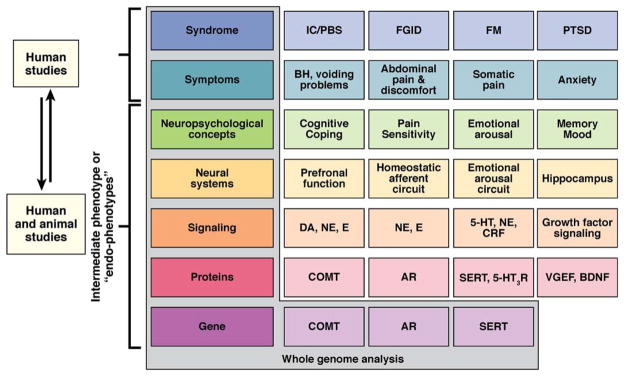
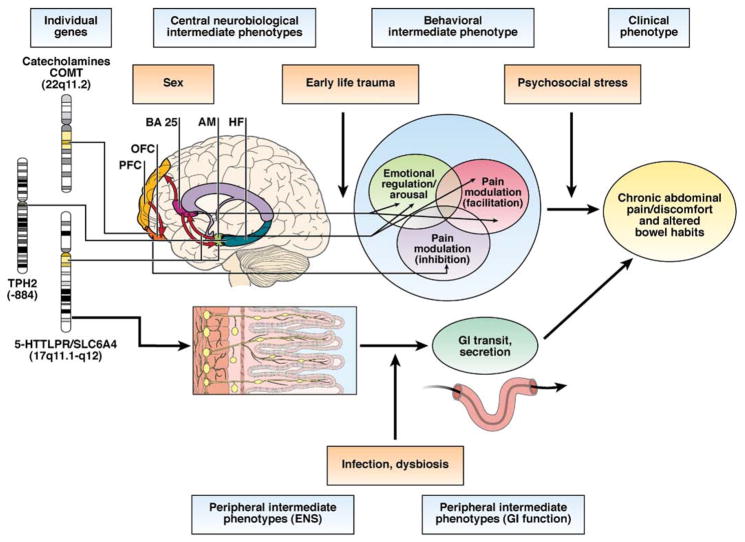
Functional gastrointestinal disorders are complex symptom-based disorders without agreed upon biomarkers or pathophysiology. A better understanding of the genetic architecture of these disorders would help to better identify their complex biology and explain the common comorbidity with other disorders of persistent pain, mood, and affect, as well as possibly make it possible to identify subgroups of patients who respond to customized therapies. In contrast to monogenic diseases, polygenic diseases and traits are characterized by the contribution of common variants in a large number of genes, as well as environmental factors, to the vulnerability of an individual. Family and twin studies have clearly established a genetic component in irritable bowel syndrome. Although candidate gene studies have identified a few gene polymorphisms that may be correlated with the syndrome, small sample size, lack of reproducibility in large data sets, and the unreliability of the clinical phenotype require caution when extrapolating to a major role of any of the reported polymorphisms in the pathophysiology of irritable bowel syndrome. Future progress in this area will require better characterization of intermediate phenotypes with large effect size for the clinical phenotype, as well as consideration of gene-gene, environment-gene (epigenetics), and sex-gene interactions, genome-wide association, and whole genome sequencing approaches in large data sets.
2010 AGA Institute. Published by Elsevier Inc. All rights reserved.
Conflict of interest statement
Conflicts of interest
The authors disclose no conflicts.
Figures
References
-
- Mayer EA, Bushnell MC. Functional pain disorders: time for a paradigm shift? In: Mayer EA, Bushnell MC, editors. Functional pain syndromes: presentation and pathophysiology. Seattle, WA: IASP Press; 2009. pp. 531–565.
-
- Longstreth GF, Thompson WG, Chey WD, et al. Functional bowel disorders. Gastroenterology. 2006;130:1480–1491. - PubMed
-
- Chadwick VS, Chen W, Shu D, et al. Activation of the mucosal immune system in irritable bowel syndrome. Gastroenterology. 2002;122:1778–1783. - PubMed
-
- Diatchenko L, Nackley AG, Slade GD, et al. Idiopathic pain disorders—pathways of vulnerability. Pain. 2006;123:226–230. - PubMed
-
- Diatchenko L, Slade GD, Nackley AG, et al. Genetic basis for individual variations in pain perception and the development of chronic pain condition. Hum Mol Genet. 2005;14:135–143. - PubMed
Publication types
MeSH terms
Grants and funding
LinkOut - more resources
Full Text Sources
