. 2010 Feb 23:10:59.
doi: 10.1186/1471-2180-10-59.

The ecology of nasal colonization of Streptococcus pneumoniae, Haemophilus influenzae and Staphylococcus aureus: the role of competition and interactions with host's immune response

Affiliations

The ecology of nasal colonization of Streptococcus pneumoniae, Haemophilus influenzae and Staphylococcus aureus: the role of competition and interactions with host's immune response

Elisa Margolis et al. BMC Microbiol. .

Abstract

Background: The first step in invasive disease caused by the normally commensal bacteria Streptococcus pneumoniae, Staphylococcus aureus and Haemophilus influenzae is their colonization of the nasal passages. For any population to colonize a new habitat it is necessary for it to be able to compete with the existing organisms and evade predation. In the case of colonization of these species the competition is between strains of the same and different species of bacteria and the predation is mediated by the host's immune response. Here, we use a neonatal rat model to explore these elements of the ecology of nasal colonization by these occasionally invasive bacteria.

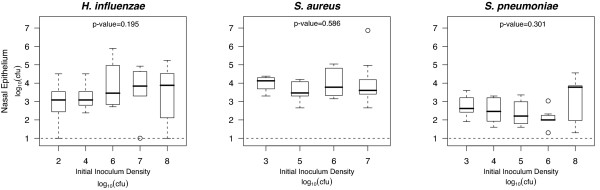
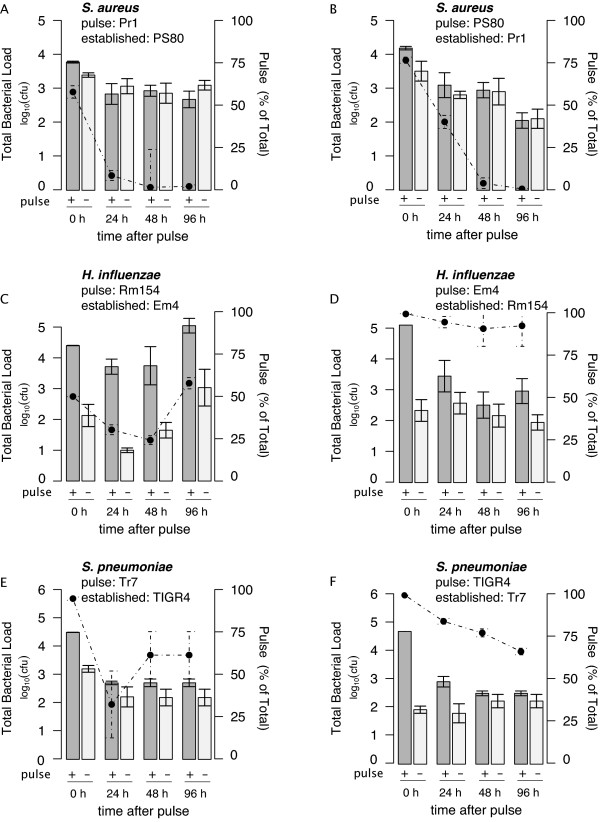
Results: When neonatal rats are colonized by any one of these species the density of bacteria in the nasal passage rapidly reaches a steady-state density that is species-specific but independent of inoculum size. When novel populations of H. influenzae and S. pneumoniae are introduced into the nasal passages of neonatal rats with established populations of the same species, residents and invaders coexisted. However, this was not the case for S. aureus - the established population inhibited invasion of new S. aureus populations. In mixed-species introductions, S. aureus or S. pneumoniae facilitated the invasion of another H. influenzae population; for other pairs the interaction was antagonistic and immune-mediated. For example, under some conditions H. influenzae promoted an immune response which limited the invasion of S. pneumoniae.

Conclusions: Nasal colonization is a dynamic process with turnover of new strains and new species. These results suggest that multiple strains of either H. influenzae or S. pneumoniae can coexist; in contrast, S. aureus strains require a host to have no other S. aureus present to colonize. Levels of colonization (and hence the possible risk of invasive disease) by H. influenzae are increased in hosts pre-colonized with either S. aureus or S. pneumoniae.


Figures

Figure 1
Figure 1
Population dynamics of nasal colonization. Population dynamics of nasal colonization. Five-day-old neonatal rats were inoculated with 107 (black circles) or 104 cfu (diamonds) of either S. pneumoniae, H. influenzae or S. aureus. The geometric mean bacteria density in the nasal epithelium of 4-16 rats at each time-point is plotted. Dashed line represents limit of detection. Error bars represent SE.
Figure 2
Figure 2
Bacterial load is independent of inoculum density. Groups of 7-16 five-day-old neonatal rats were inoculated with 102-108 cfu of either S. pneumoniae, H. influenzae or S. aureus. The 25th to 75th percentiles of nasal wash and epithelium samples taken 48 hours after bacterial challenge are represented by the box plots, with the bold horizontal bar indicating the median value, circles outlying values and dotted error bars SE. P values were determined by Kruskal-Wallis rank sum which tested the null hypothesis that the bacterial load are distributed the same in all of the inoculum groups. Dashed line represents limit of detection.
Figure 3
Figure 3
Pulse on established populations of same species. Established populations were inoculated into 3-day-old neonatal rats 48 hours prior to pulsing 104 cfu of a marked strain of the same species or PBS. The total bacterial density in nasal epithelium of 6-8 rats with the established and pulsed population (dark grey) and just the established population (light grey) were tracked over 96 hours after the pulse and expressed as the geometric mean with error bars indicating SE. In addition, the percent of the bacterial density that is pulsed is marked with points with dotted error bars indicating SE. Antibiotic marked strains were switched to be either pulsed or established for H. influenzae (in A and B), S. aureus (in C and D) and S. pneumoniae (in E and F).
Figure 4
Figure 4
Invasion of a host colonized with another species. Established populations were inoculated into groups of 10-22 three-day-old neonatal rats 48 hours prior to pulsing 105 cfu of a different species or PBS. The 25th to 75th percentiles of nasal wash and epithelium samples taken 48 hours after bacterial challenge are represented by the box plots, with the bold horizontal bar indicating the median value, circles outlying values and dotted error bars. T-test P values < 0.005 are represented by **. Resident bacterial density was not significantly different from un-invaded rats in any combination of species.
Figure 5
Figure 5
Neutrophil- and Complement- Mediated Competition. Three-day-old neonatal rats were treated with either anti-neutrophil serum (-neutrophil) or cobra venom factor (-complement) or PBS and inoculated with either 106cfu of H. influenzae or PBS (alone). Forty-eight hours later, 104 cfu of Poland(6b)-20 S. pneumoniae was inoculated. The 25th to 75th percentiles of nasal wash samples taken 48 hours after S. pneumoniae inoculation are represented by the box plots, with the horizontal bar indicating the median value and circles outlying values. P-value from Mann Whitney U test comparing the bacterial density of previously uninfected rats and those with established populations of H. influenzae. Dashed line represents limit of detection.
Figure 6
Figure 6
Neutrophil infiltration: comparison of strains and species at 48 hours and dynamics over 96 hours. A) Neutrophils in the nasal epithelium from rats inoculated 48 hours earlier with 104 cfu of bacteria from a single species (Rm154, TIGR4 and Poland(6b)-20) or from rats inoculated 96 hours earlier with 106 cfu of H. influenzae and 48 hours earlier with 104 cfu of Poland(6b)-20 were quantified using the MPO assay. Lines indicate median MPO values. P-value is calculated by the Wilcoxon rank sum test. B) Dynamics of neutrophil infiltration in response to nasal colonization by S. pneumoniae (TIGR4) or H. influenzae. Following inoculation groups of 5-8 rats were sacrificed and neutrophil infiltration was measured by MPO assay. Median MPO Units are plotted. Error bars represent SE. Dashed line represents median MPO of uninoculated rats.
Figure 7
Figure 7
Dynamic Process of Nasal Colonization. Graphical interpretation of Pulse and Invasion Experiments.

References

    1. Lipsitch M. Bacterial vaccines and serotype replacement: lessons from Haemophilus influenzae and prospects for Streptococcus pneumoniae. Emerg Infect Dis. 1999;5(3):336–345. doi: 10.3201/eid0503.990304. - DOI - PMC - PubMed
    1. Uehara Y, Nakama H, Agematsu K, Uchida M, Kawakami Y, Fattah ASA, Maruchi N. Bacterial interference among nasal inhabitants: eradication of Staphylococcus aureus from nasal cavities by artificial implantation of Corynebacterium sp. J Hosp Infect. 2000;44(2):127–133. doi: 10.1053/jhin.1999.0680. - DOI - PubMed
    1. Schuchat A, Robinson K, Wenger JD, Harrison LH, Farley M, Reingold AL, Lefkowitz L, Perkins BA. Bacterial meningitis in the United States in 1995. Active Surveillance Team. N Engl J Med. 1997;337(14):970–976. doi: 10.1056/NEJM199710023371404. - DOI - PubMed
    1. Bogaert D, van Belkum A, Sluijter M, Luijendijk A, de Groot R, Rumke HC, Verbrugh HA, Hermans PWM. Colonisation by Streptococcus pneumoniae and Staphylococcus aureus in healthy children. Lancet. 2004;363(9424):1871–1872. doi: 10.1016/S0140-6736(04)16357-5. - DOI - PubMed
    1. Hardin G. The competitive exclusion principle. Science. 1960;131:1292–1297. doi: 10.1126/science.131.3409.1292. - DOI - PubMed

Publication types

MeSH terms

LinkOut - more resources