


Reading component skills of learners in adult basic education
- PMID: 20179306
- PMCID: PMC3196667
- DOI: 10.1177/0022219409359342
Reading component skills of learners in adult basic education
Abstract
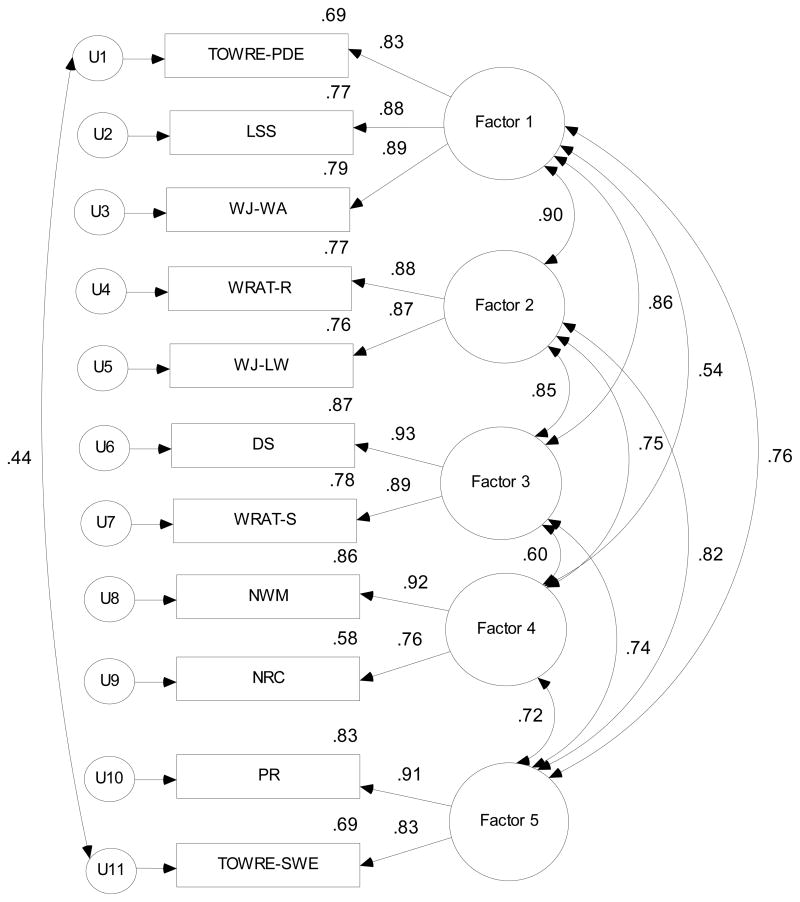
The purposes of this study were to investigate the reliability and construct validity of measures of reading component skills with a sample of adult basic education (ABE) learners, including both native and nonnative English speakers, and to describe the performance of those learners on the measures. Investigation of measures of reading components is needed because available measures were neither developed for nor normed on ABE populations or with nonnative speakers of English. The study included 486 students, 334 born or educated in the United States (native) and 152 not born or educated in the United States (nonnative) but who spoke English well enough to participate in English reading classes. All students had scores on 11 measures covering five constructs: decoding, word recognition, spelling, fluency, and comprehension. Confirmatory factor analysis (CFA) was used to test three models: a two-factor model with print and meaning factors; a three-factor model that separated out a fluency factor; and a five-factor model based on the hypothesized constructs. The five-factor model fit best. In addition, the CFA model fit both native and nonnative populations equally well without modification, showing that the tests measure the same constructs with the same accuracy for both groups. Group comparisons found no difference between the native and nonnative samples on word recognition, but the native sample scored higher on fluency and comprehension and lower on decoding than did the nonnative sample. Students with self-reported learning disabilities scored lower on all reading components. Differences by age and gender were also analyzed.
Figures
References
-
- Aaron PG, Joshi RM, Gooden R, Bentum KE. Diagnosis and treatment of reading disabilities based on the component model of reading: An alternative to the discrepancy model of LD. Journal of Learning Disabilities. 2008;41(1):67–84. - PubMed
-
- Alamprese JA, Stickney EM. Building a knowledge base for teaching adult decoding: Training and reference manual for data collectors. Bethesda, MD: Abt Associates Inc; 2003.
-
- Alamprese JA. Developing learners’ reading skills in adult basic education programs. In: Reder S, Bynner J, editors. Tracking Adult Literacy and Numeracy Skills: Findings from Longitudinal Research. New York, NY: Routledge; in press.
-
- Arbuckle JL, Wothke W. Amos 4.0 user’s guide. Chicago: Small Waters; 1999.
-
- Bentler PM, Bonett DG. Significance tests and goodness-of-fit in the analysis of covariance structures. Psychological Bulletin. 1980;88:588–606.
Publication types
MeSH terms
Grants and funding
LinkOut - more resources
Full Text Sources
