


Noble gas xenon is a novel adenosine triphosphate-sensitive potassium channel opener
- PMID: 20179498
- PMCID: PMC2935677
- DOI: 10.1097/ALN.0b013e3181cf894a
Noble gas xenon is a novel adenosine triphosphate-sensitive potassium channel opener
Abstract
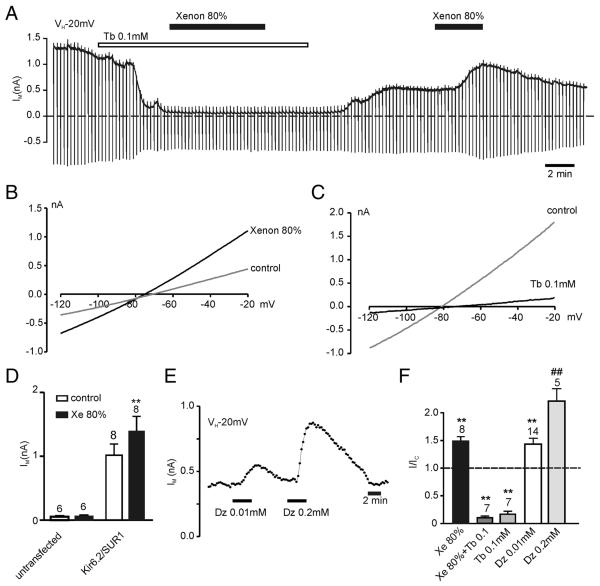
Background: Adenosine triphosphate-sensitive potassium (KATP) channels in brain are involved in neuroprotective mechanisms. Pharmacologic activation of these channels is seen as beneficial, but clinical exploitation by using classic K channel openers is hampered by their inability to cross the blood-brain barrier. This is different with the inhalational anesthetic xenon, which recently has been suggested to activate KATP channels; it partitions freely into the brain.
Methods: To evaluate the type and mechanism of interaction of xenon with neuronal-type KATP channels, these channels, consisting of Kir6.2 pore-forming subunits and sulfonylurea receptor-1 regulatory subunits, were expressed in HEK293 cells and whole cell, and excised patch-clamp recordings were performed.
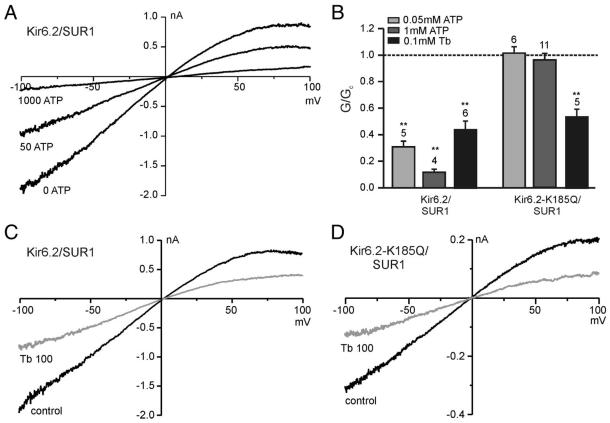
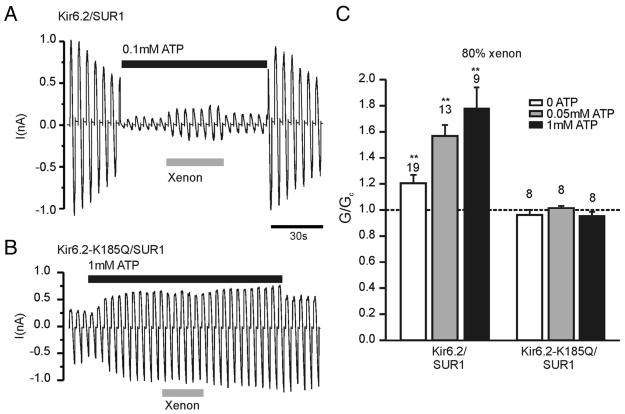
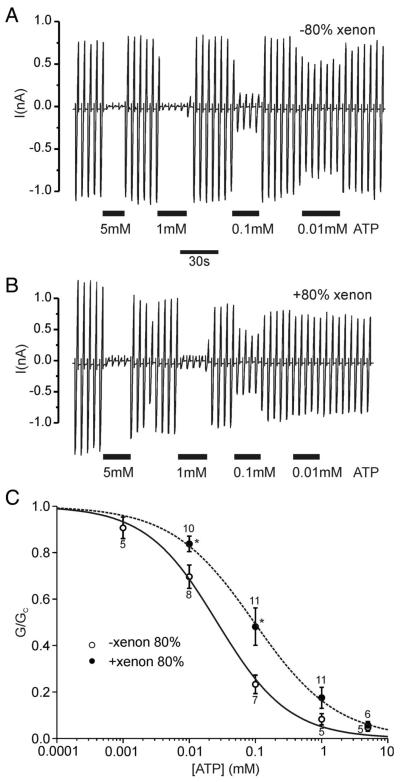
Results: Xenon, in contrast to classic KATP channel openers, acted directly on the Kir6.2 subunit of the channel. It had no effect on the closely related, adenosine triphosphate (ATP)-regulated Kir1.1 channel and failed to activate an ATP-insensitive mutant version of Kir6.2. Furthermore, concentration-inhibition curves for ATP obtained from inside-out patches in the absence or presence of 80% xenon revealed that xenon reduced the sensitivity of the KATP channel to ATP. This was reflected in an approximately fourfold shift of the concentration causing half-maximal inhibition (IC50) from 26 +/- 4 to 96 +/- 6 microm.
Conclusions: Xenon represents a novel KATP channel opener that increases KATP currents independently of the sulfonylurea receptor-1 subunit by reducing ATP inhibition of the channel. Through this action and by its ability to readily partition across the blood-brain barrier, xenon has considerable potential in clinical settings of neuronal injury, including stroke.
Figures

References
-
- Nichols CG. KATP channels as molecular sensors of cellular metabolism. Nature. 2006;440:470–6. - PubMed
-
- Karschin C, Ecke C, Ashcroft FM, Karschin A. Overlapping distribution of K(ATP) channel-forming Kir6.2 subunit and the sulfonylurea receptor SUR1 in rodent brain. FEBS Lett. 1997;401:59–64. - PubMed
-
- Yamada K, Ji JJ, Yuan H, Miki T, Sato S, Horimoto N, Shimizu T, Seino S, Inagaki N. Protective role of ATP-sensitive potassium channels in hypoxia-induced generalized seizure. Science. 2001;292:1543–6. - PubMed
-
- Gumina RJ, Pucar D, Bast P, Hodgson DM, Kurtz CE, Dzeja PP, Miki T, Seino S, Terzic A. Knockout of Kir6.2 negates ischemic preconditioning-induced protection of myocardial energetics. Am J Physiol Heart Circ Physiol. 2003;284:H2106–13. - PubMed
Publication types
MeSH terms
Substances
Grants and funding
LinkOut - more resources
Full Text Sources
Other Literature Sources
