


Comparison of AAV serotypes for gene delivery to dorsal root ganglion neurons
- PMID: 20179682
- PMCID: PMC2862541
- DOI: 10.1038/mt.2010.19
Comparison of AAV serotypes for gene delivery to dorsal root ganglion neurons
Abstract
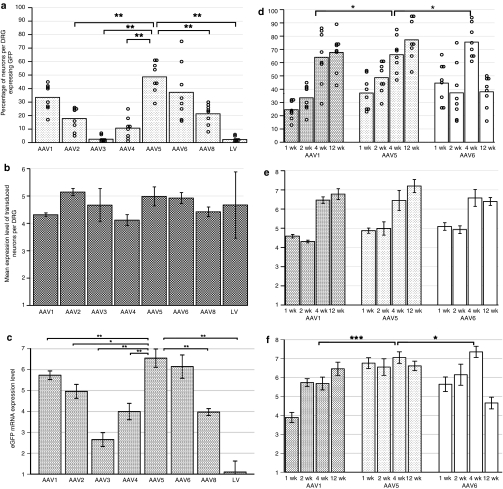
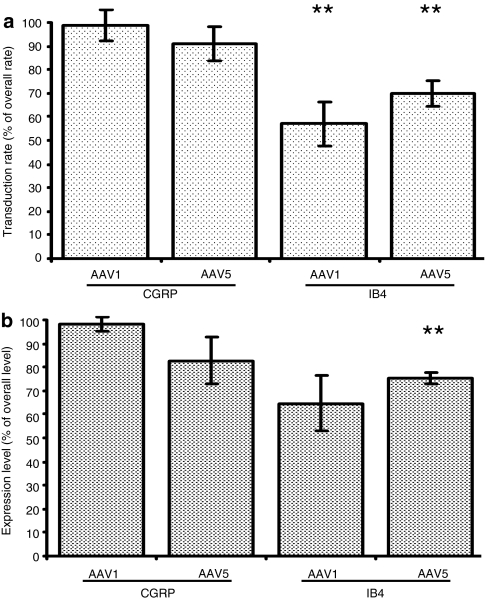
For many experiments in the study of the peripheral nervous system, it would be useful to genetically manipulate primary sensory neurons. We have compared vectors based on adeno-associated virus (AAV) serotypes 1, 2, 3, 4, 5, 6, and 8, and lentivirus (LV), all expressing green fluorescent protein (GFP), for efficiency of transduction of sensory neurons, expression level, cellular tropism, and persistence of transgene expression following direct injection into the dorsal root ganglia (DRG), using histological quantification and qPCR. Two weeks after injection, AAV1, AAV5, and AAV6 had transduced the most neurons. The time course of GFP expression from these three vectors was studied from 1 to 12 weeks after injection. AAV5 was the most effective serotype overall, followed by AAV1. Both these serotypes showed increasing neuronal transduction rates at later time points, with some injections of AAV5 yielding over 90% of DRG neurons GFP(+) at 12 weeks. AAV6 performed well initially, but transduction rates declined dramatically between 4 and 12 weeks. AAV1 and AAV5 both transduced large-diameter neurons, IB4(+) neurons, and CGRP(+) neurons. In conclusion, AAV5 is a highly effective gene therapy vector for primary sensory neurons following direct injection into the DRG.
Figures




Comment in
-
AAV provides an alternative for gene therapy of the peripheral sensory nervous system.Mol Ther. 2010 Apr;18(4):670-3. doi: 10.1038/mt.2010.41. Mol Ther. 2010. PMID: 20357781 Free PMC article. No abstract available.
References
-
- Kaplitt MG, Leone P, Samulski RJ, Xiao X, Pfaff DW, O'Malley KL, et al. Long-term gene expression and phenotypic correction using adeno-associated virus vectors in the mammalian brain. Nat Genet. 1994;8:148–154. - PubMed
-
- McCown TJ, Xiao X, Li J, Breese GR., and , Samulski RJ. Differential and persistent expression patterns of CNS gene transfer by an adeno-associated virus (AAV) vector. Brain Res. 1996;713:99–107. - PubMed
-
- Peel AL, Zolotukhin S, Schrimsher GW, Muzyczka N., and , Reier PJ. Efficient transduction of green fluorescent protein in spinal cord neurons using adeno-associated virus vectors containing cell type-specific promoters. Gene Ther. 1997;4:16–24. - PubMed
-
- Klein RL, Meyer EM, Peel AL, Zolotukhin S, Meyers C, Muzyczka N, et al. Neuron-specific transduction in the rat septohippocampal or nigrostriatal pathway by recombinant adeno-associated virus vectors. Exp Neurol. 1998;150:183–194. - PubMed
-
- Peel AL., and , Klein RL. Adeno-associated virus vectors: activity and applications in the CNS. J Neurosci Methods. 2000;98:95–104. - PubMed
Publication types
MeSH terms
LinkOut - more resources
Full Text Sources
Other Literature Sources
Medical
Research Materials
