


Obesity diagnosis and care practices in the Veterans Health Administration
- PMID: 20180155
- PMCID: PMC2869413
- DOI: 10.1007/s11606-010-1279-z
Obesity diagnosis and care practices in the Veterans Health Administration
Abstract
Background: In response to dramatic increases in obesity prevalence, clinical guidelines urge health care providers to prevent and treat obesity more aggressively.
Objective: To describe the proportion of obese primary care patients receiving obesity care over a 5-year period and identify factors predicting receipt of care.
Design: Retrospective cohort study utilizing VHA administrative data from 6 of 21 VA administrative regions.
Patients: Veterans seen in primary care in FY2002 with a body mass index (BMI) > or =30 kg/m(2) based on heights and weights recorded in the electronic medical record (EMR), survival through FY2006, and active care (1 or more visits in at least 3 follow-up years FY2003-2006).
Main measures: Receipt of outpatient visits for individual or group education or instruction in nutrition, exercise, or weight management; receipt of prescriptions for any FDA-approved medications for weight reduction; and receipt of bariatric surgery.
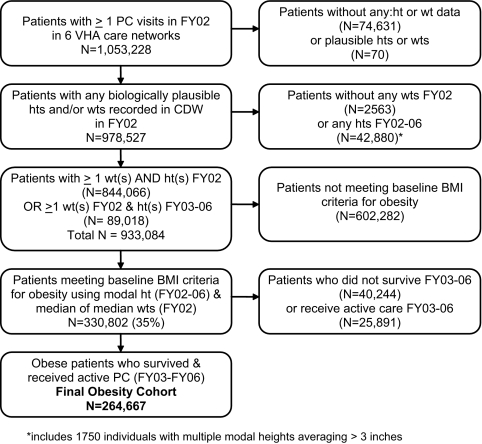
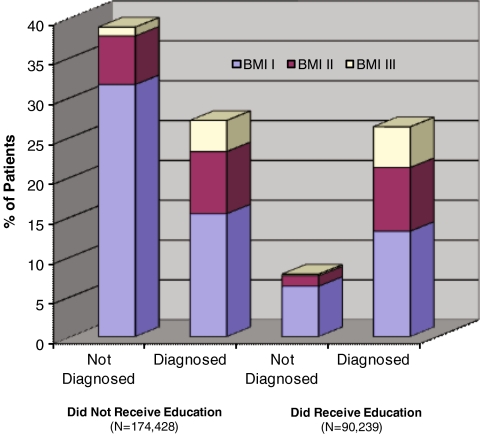
Key results: Of 933,084 (88.6%) of 1,053,228 primary care patients who had recorded heights and weights allowing calculation of BMI, 330,802 (35.5%) met criteria for obesity. Among obese patients who survived and received active care (N = 264,667), 53.5% had a recorded obesity diagnosis, 34.1% received at least one outpatient visit for obesity-related education or counseling, 0.4% received weight-loss medications, and 0.2% had bariatric surgery between FY2002-FY2006. In multivariable analysis, patients older than 65 years (OR = 0.62; 95% CI: 0.60-0.64) were less likely to receive obesity-related education, whereas those prescribed 5-7 or 8 or more medication classes (OR = 1.41; 1.38-1.45; OR = 1.94; 1.88-2.00, respectively) or diagnosed with obesity (OR = 4.0; 3.92-4.08) or diabetes (OR = 2.23; 2.18-2.27) were more likely to receive obesity-related education.
Conclusions: Substantial numbers of VHA primary care patients did not have sufficient height or weight data recorded to calculate BMI or have recorded obesity diagnoses when warranted. Receipt of obesity education varied by sociodemographic and clinical factors; providers may need to be cognizant of these when engaging patients in treatment.
Figures
References
-
- Clinical guidelines on the identification, evaluation, and treatment of overweight and obesity in adults: the evidence report. Washington: National Institutes of Health; 1998. - PubMed
-
- Lyznicki JM, Young DC, Riggs JA, Davis RM. Council on Scientific Affairs American Medical Association. Obesity: assessment and management in primary care. Am Fam Physician. 2001;63:2185–96. - PubMed
-
- National Task Force on the Prevention and Treatment of Obesity Medical care for obese patients: advice for health care professionals. Am Fam Physician. 2002;65:81–8. - PubMed
Publication types
MeSH terms
LinkOut - more resources
Full Text Sources
Medical
Miscellaneous
