. 2010 Jul;51(7):3354-61.
doi: 10.1167/iovs.10-5193. Epub 2010 Feb 24.

Alterations of the 5'untranslated region of SLC16A12 lead to age-related cataract

Affiliations

Alterations of the 5'untranslated region of SLC16A12 lead to age-related cataract

Jurian Zuercher et al. Invest Ophthalmol Vis Sci. 2010 Jul.

Abstract

PURPOSE. Knowledge of genetic factors predisposing to age-related cataract is very limited. The aim of this study was to identify DNA sequences that either lead to or predispose for this disease. METHODS. The candidate gene SLC16A12, which encodes a solute carrier of the monocarboxylate transporter family, was sequenced in 484 patients with cataract (134 with juvenile cataract, 350 with age-related cataract) and 190 control subjects. Expression studies included luciferase reporter assay and RT-PCR experiments. RESULTS. One patient with age-related cataract showed a novel heterozygous mutation (c.-17A>G) in the 5'untranslated region (5'UTR). This mutation is in cis with the minor G-allele of the single nucleotide polymorphism (SNP) rs3740030 (c.-42T/G), also within the 5'UTR. Using a luciferase reporter assay system, a construct with the patient's haplotype caused a significant upregulation of luciferase activity. In comparison, the SNP G-allele alone promoted less activity, but that amount was still significantly higher than the amount of the common T-allele. Analysis of SLC16A12 transcripts in surrogate tissue demonstrated striking allele-specific differences causing 5'UTR heterogeneity with respect to sequence and quantity. These differences in gene expression were mirrored in an allele-specific predisposition to age-related cataract, as determined in a Swiss population (odds ratio approximately 2.2; confidence intervals, 1.23-4.3). CONCLUSIONS. The monocarboxylate transporter SLC16A12 may contribute to age-related cataract. Sequences within the 5'UTR modulate translational efficiency with pathogenic consequences.


Figures
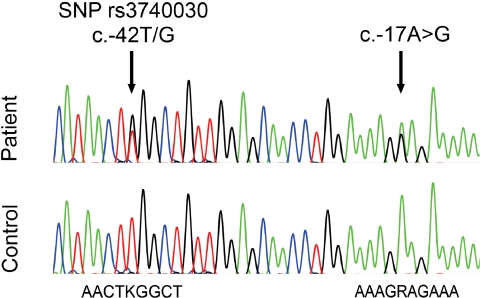
Figure 1.
Figure 1.
Electropherogram showing genomic DNA of 5′UTR section from control subject and ARC patient. Nucleotides of the immediate surroundings of SNP rs3740030 (c.-42) and the mutation (c.-17) are given. K = T and G; R = A and G.
Figure 2.
Figure 2.
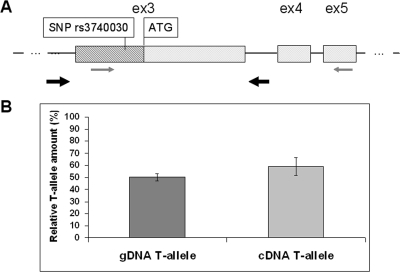
Quantitative sequencing analysis. (A) Drawing of exons (ex) 3, 4, and 5 of SLC16A12. Exon 3 contains the coding region beginning with ATG (light gray box) and 5′UTR (hatched box) containing SNP rs3740030. gDNA and transcript representing cDNA were obtained from vascular smooth muscle cells of a subject heterozygous for SNP rs3740030 (c.-42T/G). RT-PCR primers are indicated by thin arrows in exons 3 and exon 5. Locations of primers for genomic DNA amplification are indicated with thick arrows in intronic regions flanking exon 3. (B) Quantitative analysis expressed as relative amount of T-allele containing transcripts, given in percentages, for gDNA and mRNA (cDNA). Confidence intervals are shown for eight technical replicas.
Figure 3.
Figure 3.
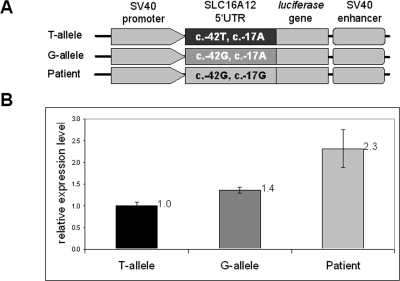
Luciferase reporter activity. (A) Schematic representation of cloned constructs. T-allele (c.-42T) and G-allele (c.-42G) contain 122 bp of SLC16A12 5′UTR. Patient construct contains c.-42G and c.-17G. (B) Relative luciferase activity. Values obtained for the T-allele were set to 1, to which other values were normalized. Displayed are the means (numerically) and confidence intervals (graphically) of three technical replicas. Results are from two independent experiments. The presence of the G-allele alone shows 1.4-fold and the presence of the G-allele in combination with the mutation (patient) shows 2.3-fold elevated luciferase expression levels.
Figure 4.
Figure 4.
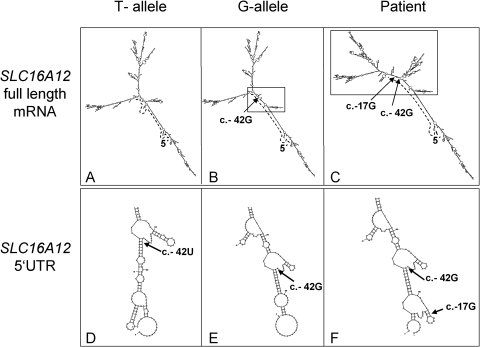
Predicted SLC16A12 RNA foldings. T-allele and G-allele refer to the SNP rs3740030 (c.-42T/G). Patient has sequences c.-42G and c.-17G. (AC) RNA foldings for the entire SLC16A12 transcript. Differences in mRNA structure are highlighted (box). The 5′-end is marked (5′). Dotted line: 5′UTR. Arrows: positions c.-42G, c.42U, and c.-17G. (DF) Predicted RNA foldings for 5′UTR sequences only.
Figure 5.
Figure 5.
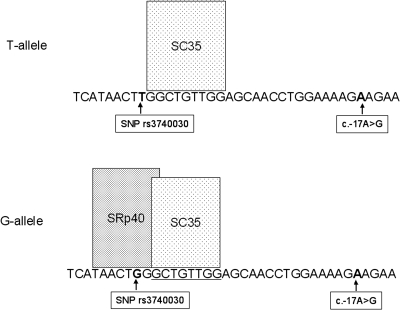
Prediction of splice factor binding site for SLC16A12 5′UTR. ESEfinder predictions were applied to cDNA from T- and G-alleles of SNP rs3740030. Factor SC35 binds independently of the allele sequence. In contrast, the binding of splice factor SRp40 is predicted only for the G-allele sequence. At the c.-17 position, no splice factor binding sites are predicted for G or A.
Figure 6.
Figure 6.
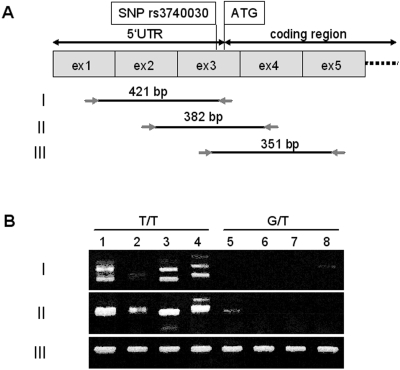
SLC16A12 transcript analysis by RT-PCR. (A) Schematic representation of exons 1 through 5 (size not to scale). Position of SNP rs3740030 and the ATG initiation codon as well as the 5′UTR and coding regions are indicated above the exons. Primer combinations (I, II, III) and their respective sizes (bp) are shown. (B) Electrophoretically separated RT-PCR products from homozygous T/T (1–4) and heterozygous G/T (5–8) donors of vascular smooth muscle cells.

References

    1. Brian G, Taylor H. Cataract blindness—challenges for the 21st century. Bull World Health Organ 2001;79:249–256 - PMC - PubMed
    1. Congdon NG, Friedman DS, Lietman T. Important causes of visual impairment in the world today. JAMA 2003;290:2057–2060 - PubMed
    1. Shiels A, Hejtmancik JF. Genetic origins of cataract. Arch Ophthalmol 2007;125:165–173 - PubMed
    1. Francis PJ, Berry V, Bhattacharya SS, Moore AT. The genetics of childhood cataract. J Med Genet 2000;37:481–488 - PMC - PubMed
    1. Shiels A, Bennett TM, Knopf HL, et al. CHMP4B, a novel gene for autosomal dominant cataracts linked to chromosome 20q. Am J Hum Genet 2007;81:596–606 - PMC - PubMed

Publication types