. 2009:2009:704706.
doi: 10.1155/2009/704706. Epub 2010 Feb 16.

Oxymatrine downregulates TLR4, TLR2, MyD88, and NF-kappaB and protects rat brains against focal ischemia

Affiliations

Oxymatrine downregulates TLR4, TLR2, MyD88, and NF-kappaB and protects rat brains against focal ischemia

Hongguang Fan et al. Mediators Inflamm. 2009.

Abstract

Inflammatory damage plays an important role in cerebral ischemic pathogenesis and may represent a target for treatment. Toll-like receptor-4 (TLR4), toll-like receptor-2 (TLR2), myeloid differentiation factor 88 (MyD88), and nuclear factor kappa-B (NF-kappaB) have been linked to inflammatory reactions. Our previous studies have proved that oxymatrine (OMT) protected ischemic brain injury and this effect may be through the decreasing of NF-kappaB expression. However, little is known regarding the mechanism of OMT in the acute phase of ischemic stroke. We therefore investigated the OMT's potential neuroprotective role and the underlying mechanisms. Male, Sprague-Dawley rats were randomly divided into sham, saline and OMT treatment groups. We used a middle cerebral artery occlusion (MCAO) model and administered OMT intraperitoneally immediately after cerebral ischemia and once daily on the following days. At time points after MCAO, brain water content and infarct size were measured. Immunohistochemistry and RT-PCR were used to analyse the expression of TLR4, TLR2, MyD88, and NF-kappaB at gene and protein level in ischemic brain tissue. The result indicated that OMT protected the brain from damage caused by MCAO; this effect may be through downregulation of the TLR4, TLR2, MyD88, and NF-kappaB.


Figures
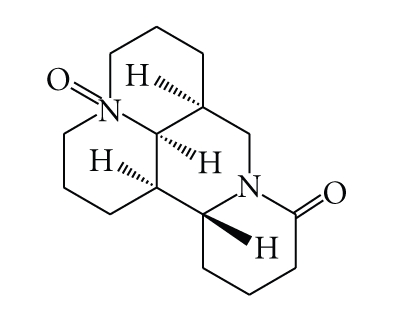
Figure 1
Figure 1
The chemical structure of OMT.
Figure 2
Figure 2
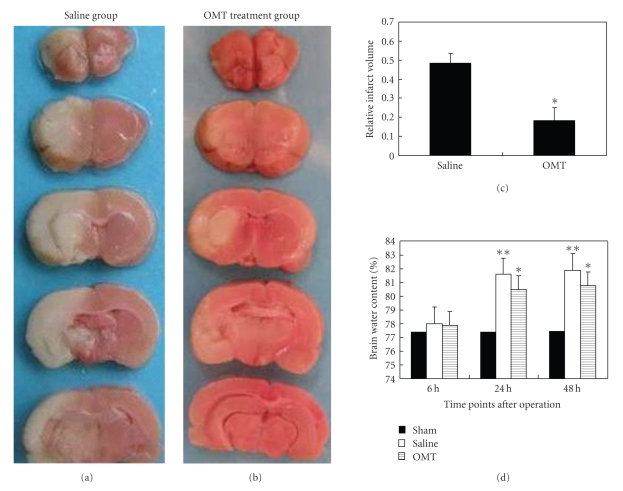
Relative infarct volume and water content in the brain. (a) and (b) TTC stain: comparison of infarct size between the saline group and OMT treatment group at 24 hours. The white region was the infarction and the red region was normal brain tissue. (c) Relative infarct volume: calculating and comparing the percentage of infarct region occupying the whole brain tissue area in one section revealed that it decreased by 32% in the OMT treatment group compared with the saline group at 24 hours. *P < .05 compared with saline group. (d) Water content of cerebral tissue: there was no difference at 6 hours among the test groups. It increased at 24 hours in the saline group and lasted up to 48 hours in the saline group at identical time points. Water content in the OMT treatment group decreased at 24 hours and 48 hours after the operation compared with that in the saline group at the same time points. Results are means ± SD of each group. **P < .01 and *P < .05 compared with Sham.
Figure 3
Figure 3
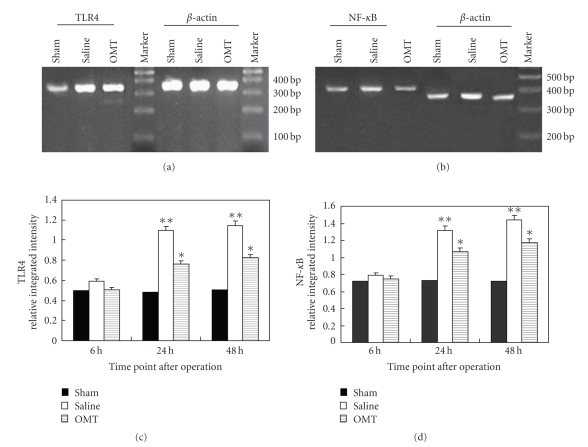
RT-PCR results of TLR4 and NF-κB. (a) RT-PCR of TLR4 at 24 hours after the operation in each group: expression of TLR4 mRNA was evidently higher in the saline group compared with the OMT treatment group, and the difference was significant (P < .05). (b) RT-PCR of NF-κB 24 hours after the operation in each group: expression of NF-κB mRNA was similar to that of TLR4 mRNA. (c) RT-PCR of TLR4 at all time points: expression of TLR4 mRNA showed no difference among all test groups at 6 hours. It was evidently higher in the saline group at 12 hours and lasted up to 48 hours. Compared with the saline group at identical time points, expression of TLR4 mRNA was lower in the OMT treatment group, and the difference was significant **P < .01 and *P < .05 compared with Sham. (d) RT-PCR of NF-κB at all time points: expression of NF-κB mRNA was similar to that of TLR4 mRNA  **P < .01 and *P < .05 compared with Sham.
Figure 4
Figure 4
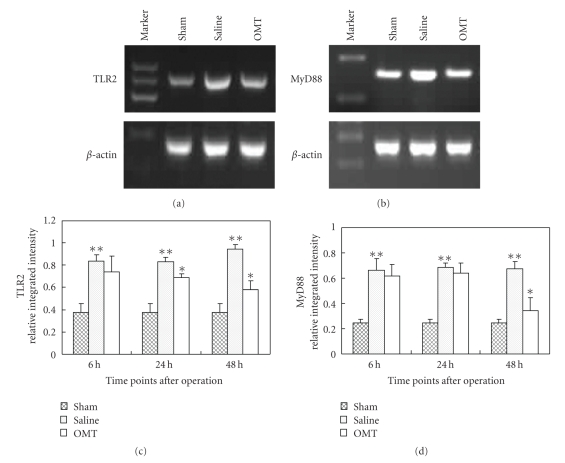
RT-PCR results of TLR2 and MyD88. (a) RT-PCR of TLR2 at 24 hours after the operation in each group: expression of TLR2 mRNA was evidently higher in the saline group compared with that in the OMT treatment group, and the difference was significant (P < .05). (b) RT-PCR of MyD88 at 48 hours after the operation in each group: expression of MyD88 mRNA was similar to that of TLR2 mRNA. (c) RT-PCR of TLR2 at all time points: expression of TLR2 mRNA was evidently higher in the saline group at 6 hours and lasted up to 48 hours. There was no difference between saline and OMT group at 6 hours. Compared with the saline group at 24 hours and 48 hours, expression of TLR2 mRNA was lower in the OMT treatment group, and the difference was significant **P < .05 compared with Sham and *P < .05 compared with saline group. (d) RT-PCR of MyD88 at all time points: expression of mRNA was similar to that of TLR2 mRNA. **P < .05 compared with Sham and *P < .05 compared with saline group.
Figure 5
Figure 5
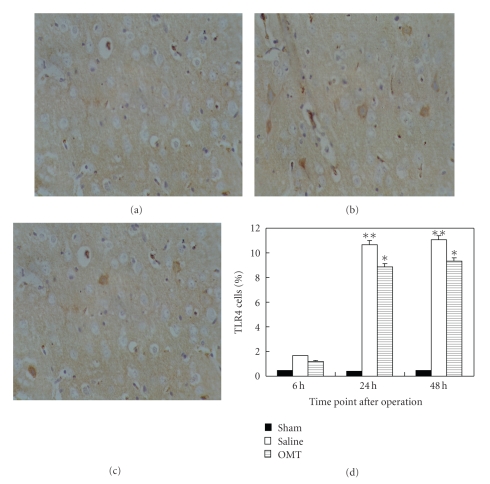
TLR4 expression detected by immunohistochemistry. (a) TLR4 expression in the sham group: TLR4 expression could not be observed in the sham group at 24 hours. (b) TLR4 expression in the saline group: TLR4 expression evidently increased in the saline group at 24 hours. Positive cells were defined as having buffy grains in the cytoplasm. (c) TLR4 expression in the OMT treatment group: TLR4 expression decreased relatively in the OMT treatment group at 24 hours. (d) TLR4 expression in each group at all time points: TLR4 expression showed no difference among all the test groups at 6 hours. It was evidently higher in the saline group at 24 hours and lasted up to 48 hours. Compared with the saline group at identical time points, TLR4 expression was lower in the OMT treatment group, and the difference was significant **P < .01 and *P < .05 compared with Sham.
Figure 6
Figure 6
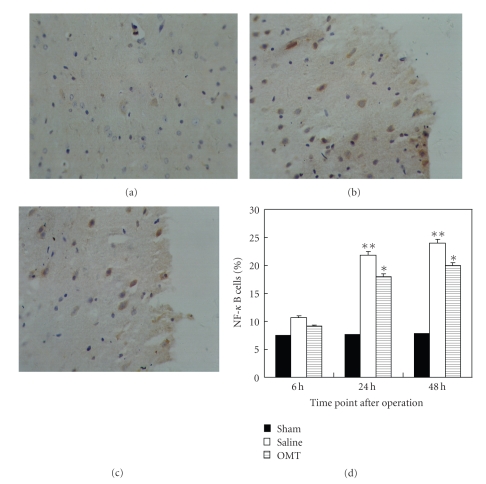
NF-κB expression detected by immunohistochemistry. (a) NF-κB expression in the sham group: NF-κB expression could be observed periodically in the sham group at 24 hours. (b) NF-κB expression in the saline group: NF-κB expression evidently increased in the saline group at 24 hours. Positive cells were defined as haning buffy grains in the cellular nucleus and cytoplasm. (c) NF-κB expression in the OMT treatment group: NF-κB expression decreased relatively in the OMT treatment group at 24 hours. (d) NF-κB expression in each group at all time points: there was no difference among all test groups at 6 hours. It was evidently higher in the saline group at 24 hours and lasted up to 48 hours. Compared with the saline group at identical time points, NF-κB expression was lower in the OMT treatment group, and the difference was significant **P < .01 and *P < .05 compared with Sham.
Figure 7
Figure 7
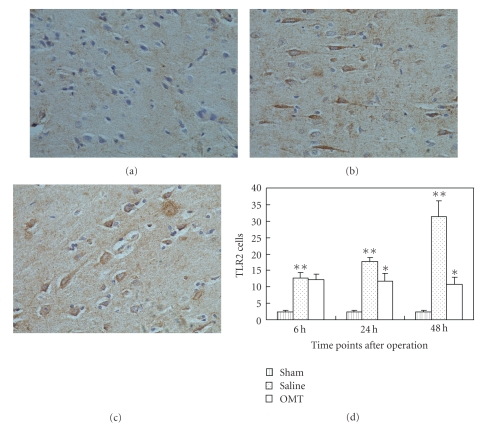
TLR2 expression detected by immunohistochemistry. (a) TLR2 expression in the sham group: TLR2 expression could be observed periodically in the sham group at 24 hours. (b) TLR2 expression in the saline group: TLR2 expression evidently increased in the saline group at 24 hours. Positive cells were defined as presenting buffy grains in cytoplasm. (c) TLR2 expression in the OMT treatment group: TLR2 expression decreased relatively in the OMT treatment group at 24 hours. (d) TLR2 expression in each group at all time points: expression of TLR2 protein was evidently higher in the saline group at 6 hours and lasted up to 48 hours. There was no difference between saline and OMT group at 6 hours. Compared with the saline group at 24 hours and 48 hours, expression of TLR2 protein was lower in the OMT treatment group, and the difference was significant **P < .05 compared with Sham and *P < .05 compared with saline group.
Figure 8
Figure 8
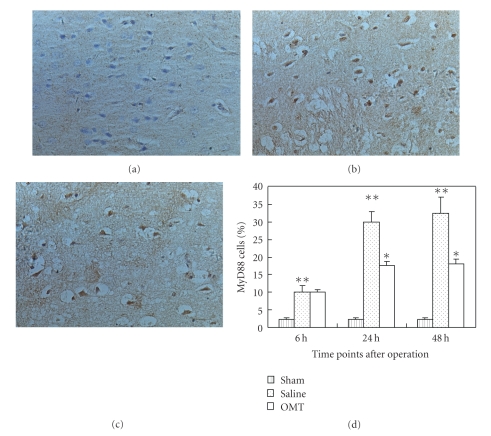
MyD88 expression detected by immunohistochemistry. (a) MyD88 expression in the sham group: MyD88 expression could be observed periodically in the sham group at 24 hours. (b) MyD88 expression in the saline group: MyD88 expression evidently increased in the saline group at 24 hours. Positive cells were defined as presenting buffy grains in cytoplasm. (c) MyD88 expression in the OMT treatment group: MyD88 expression decreased relatively in the OMT treatment group at 24 hours. (d) MyD88 expression in each group at all time points: Expression of MyD88 protein was evidently higher in the saline group at 6 hours and lasted up to 48 hours. There was no difference between saline and OMT group at 6 hours. Compared with the saline group at 24 hours and 48 hours, expression of MyD88 protein was lower in the OMT treatment group, and the difference was significant **P < .05 compared with Sham and *P < .05 compared with saline group.

References

    1. Zhang X, Li H, Hu S, et al. Brain edema after intracerebral hemorrhage in rats: the role of inflammation. Neurology India. 2006;54(4):402–407. - PubMed
    1. Li C, Ha T, Kelley J, et al. Modulating Toll-like receptor mediated signaling by (1 → 3)-β-D-glucan rapidly induces cardioprotection. Cardiovascular Research. 2004;61(3):538–547. - PubMed
    1. Akira S, Uematsu S, Takeuchi O. Pathogen recognition and innate immunity. Cell. 2006;124(4):783–801. - PubMed
    1. Fan H, Cook JA. Molecular mechanisms of endotoxin tolerance. Journal of Endotoxin Research. 2004;10(2):71–84. - PubMed
    1. Soysa NS, Alles N. NF-κB functions in osteoclasts. Biochemical and Biophysical Research Communications. 2009;378(1):1–5. - PubMed

MeSH terms

LinkOut - more resources