


Inefficient or insufficient encoding as potential primary deficit in neurodevelopmental performance among children with OSA
- PMID: 20183722
- PMCID: PMC2937157
- DOI: 10.1080/87565640903133566
Inefficient or insufficient encoding as potential primary deficit in neurodevelopmental performance among children with OSA
Abstract
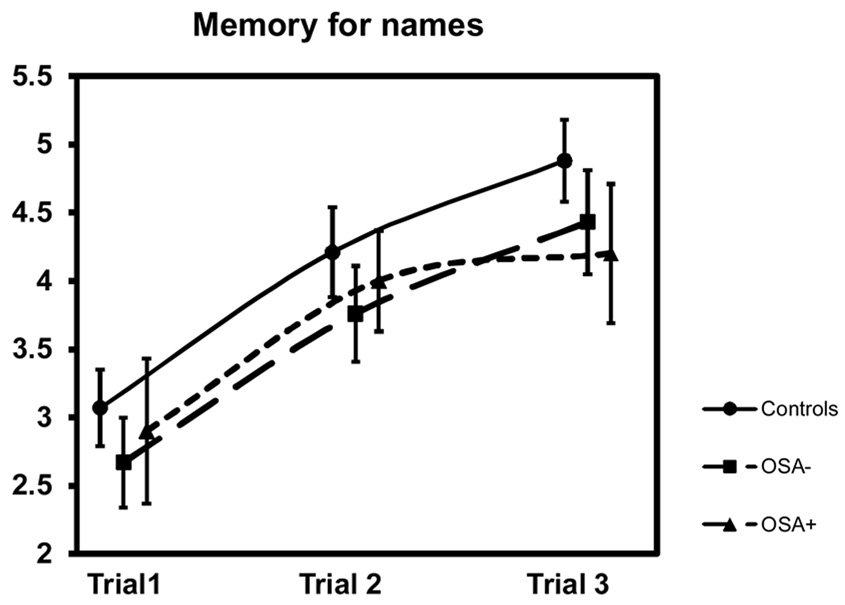
Memory (M) impairments have been suggested in pediatric Obstructive Sleep Apnea along with attention and executive (AE), language (L), and visuospatial (V) dysfunctions. NEPSY assessment of children aged 5-9 years who were either healthy (N = 43), or who had OSA without L, V, AE (OSA(-), N = 22) or with L (N = 6), V (N = 1), AE (N = 3) (OSA(+), N = 10) dysfunctions revealed no gross memory problems in OSA; however, over the three learning trials of cross-modal association learning of name with face, the OSA(-) progressively improved performance, whereas the OSA(+) failed to progress. No within-group differences between immediate and delayed memory tasks were apparent. The data suggest the presence of slower information processing, and/or secondary memory problems, in the absence of retrieval or recall impairments among a subset of children with OSA. We hypothesize that inefficient/insufficient encoding may account for the primary deficit.
Figures
References
-
- Bartlett DJ, Rae C, Thompson CH, Byth K, Joffe DA, Enright T, et al. Hippocampal area metabolites relate to severity and cognitive function in obstructive sleep apnea. Sleep Medicine. 2004;5(6):593–596. - PubMed
-
- Beebe DW. Neurobehavioral morbidity associated with disordered breathing during sleep in children: a comprehensive review. Sleep. 2006;29(9):1115–1134. - PubMed
-
- Beebe DW, Gozal D. Obstructive sleep apnea and the prefrontal cortex: towards a comprehensive model linking nocturnal upper airway obstruction to daytime cognitive and behavioral deficits. Journal of Sleep Research. 2002;11(1):1–16. - PubMed
-
- Blunden S, Lushington K, Kennedy D, Martin J, Dawson D. Behavior and neurocognitive performance in children aged 5–10 years who snore compared to controls. Journal of Clinical and Experimental Neuropsychology. 2000;22(5):554–568. - PubMed
-
- Bruni O, Ferri R. Neurocognitive deficits in pediatric obstructive sleep apnea: A multifaceted pathogenetic model. Sleep Medicine. 2009;10(2):161–163. - PubMed
Publication types
MeSH terms
Grants and funding
LinkOut - more resources
Full Text Sources
Medical
