


Genetic dissection of rice grain shape using a recombinant inbred line population derived from two contrasting parents and fine mapping a pleiotropic quantitative trait locus qGL7
- PMID: 20184774
- PMCID: PMC2846863
- DOI: 10.1186/1471-2156-11-16
Genetic dissection of rice grain shape using a recombinant inbred line population derived from two contrasting parents and fine mapping a pleiotropic quantitative trait locus qGL7
Abstract
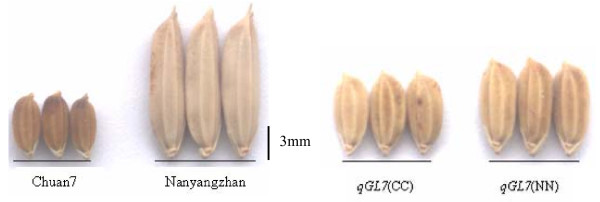
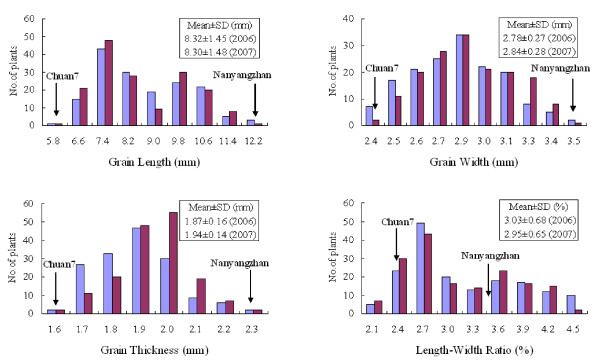
Background: The three-dimensional shape of grain, measured as grain length, width, and thickness (GL, GW, and GT), is one of the most important components of grain appearance in rice. Determining the genetic basis of variations in grain shape could facilitate efficient improvements in grain appearance. In this study, an F7:8 recombinant inbred line population (RIL) derived from a cross between indica and japonica cultivars (Nanyangzhan and Chuan7) contrasting in grain size was used for quantitative trait locus (QTL) mapping. A genetic linkage map was constructed with 164 simple sequence repeat (SSR) markers. The major aim of this study was to detect a QTL for grain shape and to fine map a minor QTL, qGL7.
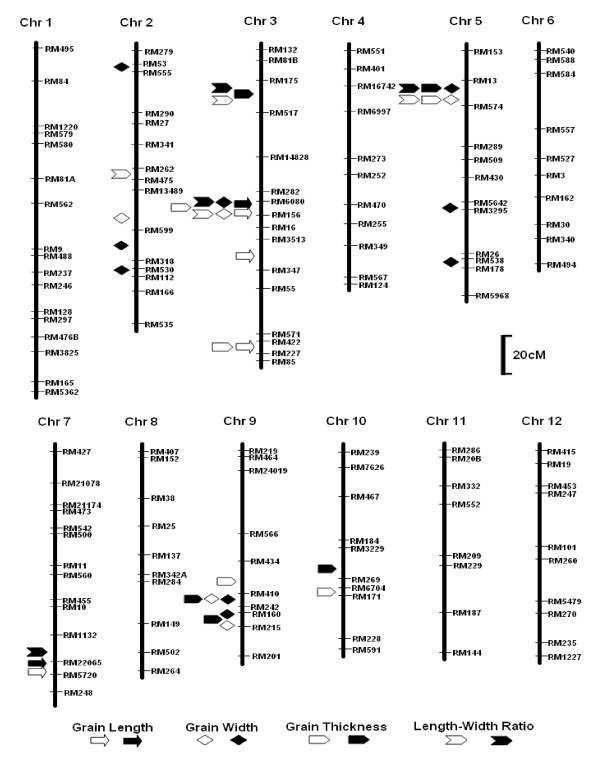
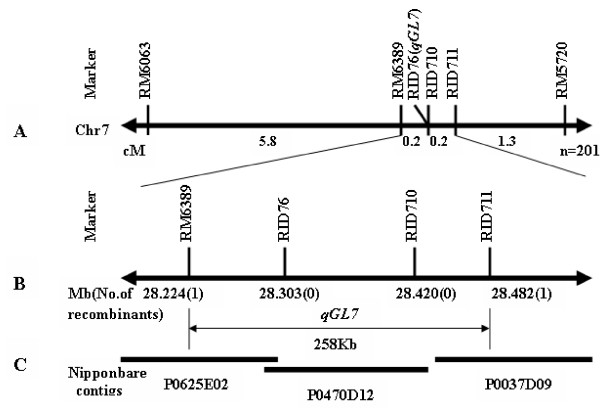
Results: Four QTLs for GL were detected on chromosomes 3 and 7, and 10 QTLs for GW and 9 QTLs for GT were identified on chromosomes 2, 3, 5, 7, 9 and 10, respectively. A total of 28 QTLs were identified, of which several are reported for the first time; four major QTLs and six minor QTLs for grain shape were also commonly detected in both years. The minor QTL, qGL7, exhibited pleiotropic effects on GL, GW, GT, 1000-grain weight (TGW), and spikelets per panicle (SPP) and was further validated in a near isogenic F2 population (NIL-F2). Finally, qGL7 was narrowed down to an interval between InDel marker RID711 and SSR marker RM6389, covering a 258-kb region in the Nipponbare genome, and cosegregated with InDel markers RID710 and RID76.
Conclusion: Materials with very different phenotypes were used to develop mapping populations to detect QTLs because of their complex genetic background. Progeny tests proved that the minor QTL, qGL7, could display a single mendelian characteristic. Therefore, we suggested that minor QTLs for traits with high heritability could be isolated using a map-based cloning strategy in a large NIL-F2 population. In addition, combinations of different QTLs produced diverse grain shapes, which provide the ability to breed more varieties of rice to satisfy consumer preferences.
Figures
References
-
- Unnevehr LJ, Duff B, Juliano BO. Consumer demand for rice grain quality. International Rice Research Institute, Manila, The Philippines/International Development Research Centre, Ottawa, Canada; 1992.
-
- Juliano BO, Villareal. Grain quality evaluation of world rices. International Rice Research Institute. Manila, The Philippines; 1993.
-
- Yang LS, Bai YS, Zhang PJ, Xu CW, Hu XM, Wang WM, She DH, Chen GZ. Studies on the correlation between grain shape and grain quality in rice. Hybrid Rice. 2001;16:48–50. [in Chinese]
-
- Luo YK, Zhu ZW, Chen N, Duan BW, Zhang LP. Grain types and related quality characteristics of rice in China. Chinese J Rice Sci. 2004;18:135–139.
MeSH terms
Substances
LinkOut - more resources
Full Text Sources
Miscellaneous
