Clinical measures identify vitamin D deficiency in dialysis
- PMID: 20185603
- PMCID: PMC2827576
- DOI: 10.2215/CJN.06440909
Clinical measures identify vitamin D deficiency in dialysis
Abstract
Background and objectives: Vitamin D deficiency (defined by serum levels of 25-hydroxyvitamin D) is common in patients with ESRD on hemodialysis, but risk factors are unknown. This study was conducted to determine whether routinely measured clinical and demographic parameters could identify dialysis patients who are vitamin D deficient.
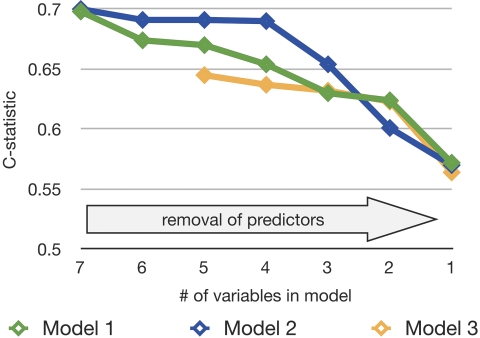
Design, setting, participants, & measurements: Nine-hundred eight patients with 25-hydroxyvitamin D levels were identified from the Accelerated Mortality on Renal Replacement (ArMORR) cohort of incident U.S. dialysis patients and were divided into training (60%) and validation (40%) sets. Predictive models were generated from routinely assessed clinical and demographic data in the training set using logistic regression modeling, neural networks, and decision trees with vitamin D deficiency as the dependent variable. Models underwent progressive variable reduction to identify the simplest model that remained predictive.
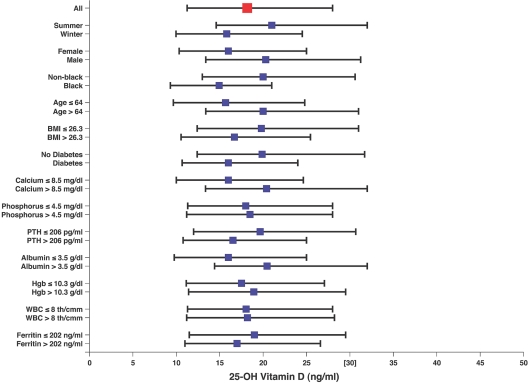
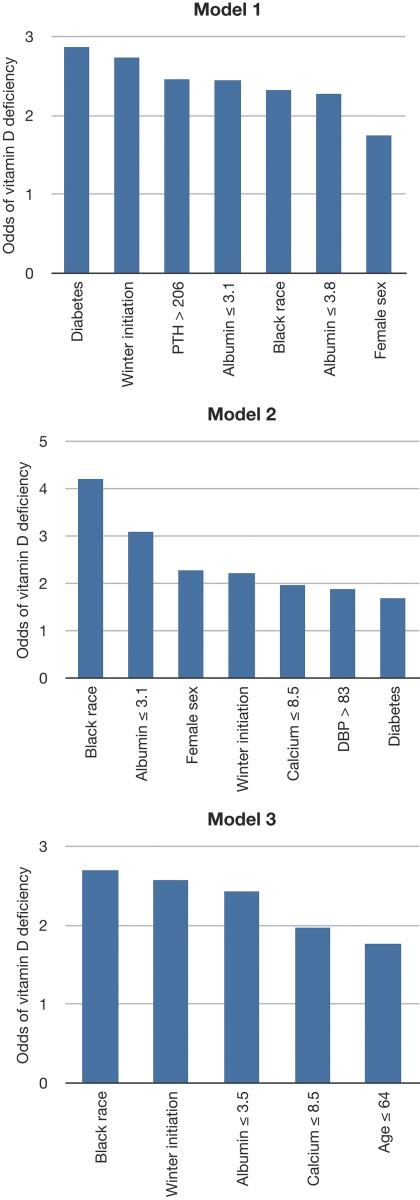
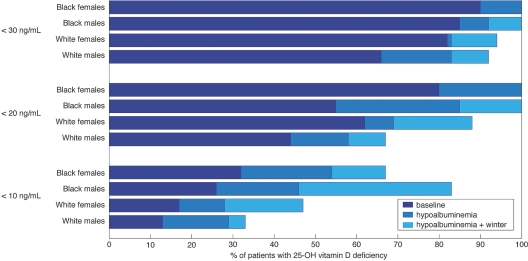
Results: Seventy-nine percent of the population was vitamin D deficient (25-hydroxyvitamin D <30 ng/ml). Black race, female sex, winter season, and hypoalbuminemia (serum albumin < or =3.1 g/dl) were the strongest predictors of vitamin D deficiency. In the validation set, the presence of hypoalbuminemia and winter season increased the likelihood of vitamin D deficiency in black women (from 90% to 100%), black men (from 85% to 100%), white women (from 82% to 94%), and white men (from 66% to 92%).
Conclusions: Deficiency of 25-hydroxyvitamin D is nearly universal among patients with hypoalbuminemia initiating chronic hemodialysis in winter.
Figures
References
-
- Ishimura E, Nishizawa Y, Inaba M, Matsumoto N, Emoto M, Kawagishi T, Shoji S, Okuno S, Kim M, Miki T, Morii H: Serum levels of 1,25-dihydroxyvitamin D, 24,25-dihydroxyvitamin D, and 25-hydroxyvitamin D in nondialyzed patients with chronic renal failure. Kidney Int 55: 1019–1027, 1999 - PubMed
-
- Foundation NK: K/DOQI clinical practice guidelines for bone metabolism and disease in chronic kidney disease. Am J Kidney Dis 42: S1–S201, 2003 - PubMed
-
- Holick MF: Vitamin D deficiency. N Engl J Med 357: 266–281, 2007 - PubMed
-
- Reichel H, Koeffler HP, Norman AW: Synthesis in vitro of 1,25-dihydroxyvitamin D3 and 24,25-dihydroxyvitamin D3 by interferon-gamma-stimulated normal human bone marrow and alveolar macrophages. J Biol Chem 262: 10931–10937, 1987 - PubMed
Publication types
MeSH terms
Substances
Grants and funding
LinkOut - more resources
Full Text Sources
Other Literature Sources
Medical
Molecular Biology Databases