Glomerular hyperfiltration in adult sickle cell anemia: a frequent hemolysis associated feature
- PMID: 20185605
- PMCID: PMC2863976
- DOI: 10.2215/CJN.08511109
Glomerular hyperfiltration in adult sickle cell anemia: a frequent hemolysis associated feature
Abstract
Background and objectives: Sickle cell anemia-associated nephropathy is a growing matter of concern because renal failure affects most aging sickle cell anemia patients. Glomerular damage is a common feature revealed by a microalbuminuria or a macroalbuminuria. Although glomerular hyperfiltration has been described for decades in this population, its prevalence in young adults is unknown.
Design, setting, participants, & measurements: To address this issue, as well as the clinical and biologic correlates of hyperfiltration, a single-center, cross-sectional study of 280 homozygous SS disease patients was performed.
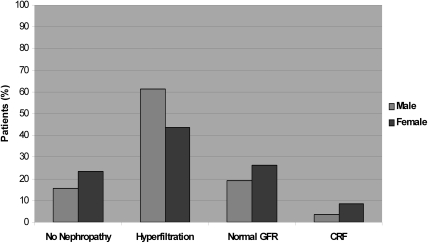
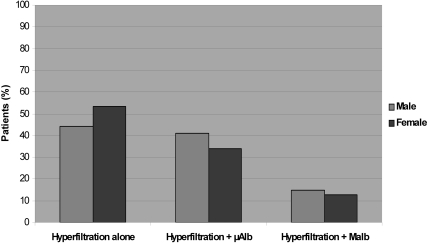
Results: The prevalence of hyperfiltration assessed by Modification of Diet in Renal Disease estimated GFR was 51%. Among patients with hyperfiltration, 49% had hyperfiltration alone, whereas 36% and 15% had an associated microalbuminuria or macroalbuminuria, respectively. Estimated GFR sensitivity and specificity for hyperfiltration were 94% and 63%, respectively, in a selected subgroup of 48 patients (measured GFR was assessed by urinary (51)Cr EDTA clearance). In patients with no albuminuria, hyperfiltration status was significantly associated with a young age (years), the absence of alpha thalassemia, a lower hemoglobin level (g/dl), and a lower fetal hemoglobin. The role of chronic hemolysis was further strengthened by multivariate analysis showing a correlation between estimated GFR and a low plasma fetal hemoglobin level, a young age, and a high reticulocyte count (r(2) = 0.54).
Conclusions: Together, the data suggest that the pathophysiology of hyperfiltration would rather be attributable to the hemolysis-associated vasculopathy rather than a viscosity-vaso-occlusive process.
Figures
Comment in
-
Glomerular hyperfiltration in sickle cell disease.Clin J Am Soc Nephrol. 2010 May;5(5):748-9. doi: 10.2215/CJN.01340210. Epub 2010 Mar 18. Clin J Am Soc Nephrol. 2010. PMID: 20299367 No abstract available.
References
-
- Falk RJ, Scheinman J, Phillips G, Orringer E, Johnson A, Jennette JC: Prevalence and pathologic features of sickle cell nephropathy and response to inhibition of angiotensin-converting enzyme. N Engl J Med 326: 910– 952, 1992 - PubMed
-
- Powars DR, Chan LS, Hiti A, Ramicone H, Johnson C: Outcome of sickle cell anemia: A 4-decade observational study of 1056 patients. Medicine 84: 363– 376, 2005 - PubMed
-
- Serjeant GR, Higgs DR, Hambleton IR: Elderly survivors with homozygous sickle cell disease. N Engl J Med 356: 642– 643, 2007 - PubMed
-
- Levey AS, Eckardt KU, Tsukamoto Y, Levin A, Coresh J, Rossert J, De Zeeuw D, Hostetter TH, Lameire N, Eknoyan G: Definition and classification of chronic kidney disease: A position statement from kidney disease: Improving global outcomes (KDIGO). Kidney Int 67: 2089– 2100, 2005 - PubMed
-
- Dharnidharka VA, Dabbagh S, Atiyeh B, Simpson P, Sarnaik S: Prevalence of microalbuminuria in children with sickle cell disease. Pediatr Nephrol 12: 475– 478, 1998 - PubMed
MeSH terms
Substances
LinkOut - more resources
Full Text Sources
Other Literature Sources
Medical