doi: 10.1371/journal.pbio.1000318.
Genomic responses to abnormal gene dosage: the X chromosome improved on a common strategy
Affiliations
- PMID: 20186268
- PMCID: PMC2826375
- DOI: 10.1371/journal.pbio.1000318
Item in Clipboard
Genomic responses to abnormal gene dosage: the X chromosome improved on a common strategy
PLoS Biol.
.
Abstract
This new primer, which discusses a study by Zhang et al., provides an overview of the process by which chromosomes achieve dose compensation and the mechanisms underlying this phenomenon in Drosophila S2 cells.
Conflict of interest statement
The authors have declared that no competing interests exist.
Figures
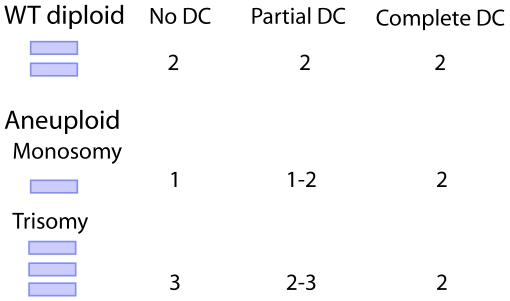
The transcript output from a given pair of chromosomes in normal WT diploid cells is set as a value of 2. In case of aneuploidy (monosomy or trisomy), the amount of transcript would be strictly correlated with gene dose in the absence of a dosage compensation mechanism (No DC). In the presence of partial DC, the expression level per copy would be partially increased in monosomy or partially decreased in trisomy, relative to the diploid level. In the presence of complete DC, expression levels would be adjusted so that the amount of transcripts is the same in monosomic or trisomic cells compared to diploid cells.
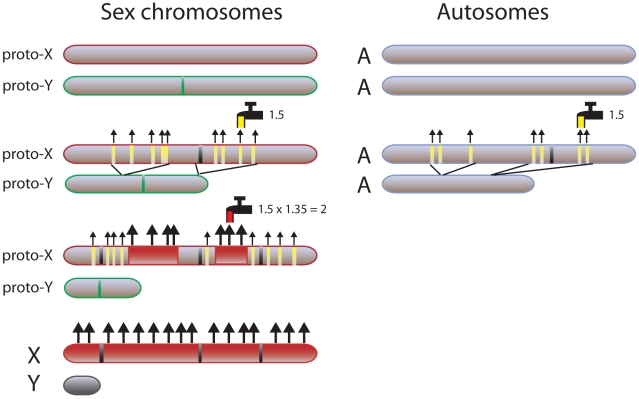
After the proto-Y chromosome evolved a gene with a male-determining function (green bar), it became subject to gradual gene loss on a gene-by-gene or segment-by-segment basis due to lack of recombination between the proto-sex chromosomes. If the lost region on the proto-Y chromosome contained dosage sensitive genes such as those that encode transcriptional factors (yellow bars), this would have triggered a basal dosage compensation response (yellow faucet) on the proto-X chromosome and led to a partial (1.5-fold) increase of expression (small arrows). The same basal dosage compensation process would also modify a deleted region on an autosome (A) in an abnormal cell. Dosage-insensitive genes (black bars) may escape this process. When broader regions were lost on the proto-Y chromosome, the collective imbalance effects of multiple aneuploid genes would have become highly deleterious and the increased load of aneuploidy could have stressed the basal mechanism of dosage compensation. Survival was achieved by recruiting regulatory complexes such as the MSL complex (red faucet) to aneuploid X segments (red regions), to further increase gene expression (big arrows) and rescue the X monosomy. This feed-forward sex chromosome–specific regulation would provide 1.35-fold increase in expression, which together with the basal dosage compensation (1.5-fold increase) would achieve the approximate two-fold upregulation of most genes on the present day X chromosome. In contrast, large-scale deleterious autosomal aneuploidy would be lost due to lack of a specific sex-driven compensatory mechanism.
Comment on
- PLoS Biol. 8:e1000320.
References
-
- Birchler J. A, Riddle N. C, Auger D. L, Veitia R. A. Dosage balance in gene regulation: biological implications. Trends Genet. 2005;21:219–226. - PubMed
-
- Veitia R. A, Bottani S, Birchler J. A. Cellular reactions to gene dosage imbalance: genomic, transcriptomic and proteomic effects. Trends Genet. 2008;24:390–397. - PubMed
-
- Zhang Y, Oliver B. Dosage compensation goes global. Curr Opin Genet Dev. 2007;17:113–120. - PubMed
-
- Edger P. P, Pires J. C. Gene and genome duplications: the impact of dosage-sensitivity on the fate of nuclear genes. Chromosome Res. 2009;17:699–717. - PubMed
Publication types
MeSH terms
Grants and funding
LinkOut - more resources
Full Text Sources
Molecular Biology Databases