Comparative Study
. 2010 Jul;19(7):1104-14.
doi: 10.1007/s00586-010-1326-9. Epub 2010 Feb 26.

Comparative anatomical dimensions of the complete human and porcine spine

Affiliations
Comparative Study

Comparative anatomical dimensions of the complete human and porcine spine

Iris Busscher et al. Eur Spine J. 2010 Jul.

Abstract

New spinal implants and surgical procedures are often tested pre-clinically on human cadaver spines. However, the availability of fresh frozen human cadaver material is very limited and alternative animal spines are more easily available in all desired age groups, and have more uniform geometrical and biomechanical properties. The porcine spine is said to be the most representative model for the human spine but a complete anatomical comparison is lacking. The goal of this descriptive study was to compare the anatomical dimensions of the cervical, thoracic, and lumbar vertebrae of the human and porcine spine in order to determine whether the porcine spine can be a representative model for the human spine. CT scans were made of 6 human and 6 porcine spines, and 16 anatomical dimensions were measured per individual vertebrae. Comparisons were made for the absolute values of the dimensions, for the patterns of the dimensions within four spinal regions, and normalised values of the dimensions within each individual vertebra. Similarities were found in vertebral body height, shape of the end-plates, shape of the spinal canal, and pedicle size. Furthermore, regional trends were comparable for all dimensions, except for spinal canal depth and spinous processus angle. The size of the end-plates increased more caudally in the human spine. Relating the dimensions to the size of the vertebral body, similarities were found in the size of the spinal canal, the transverse processus length, and size of the pedicles. Taking scaling differences into account, it is believed that the porcine spine can be a representative anatomical model for the human spine in specific research questions.


Figures
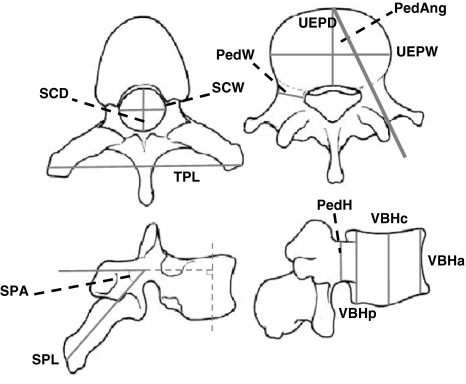
Fig. 1
Fig. 1
Anatomical dimensions measured per vertebra. Abbreviations are explained in Table 1
Fig. 2
Fig. 2
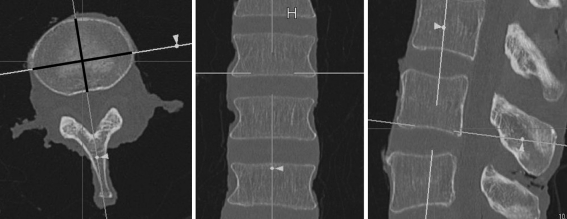
Example of a multiplanar view of a human L3 vertebra. From left to right: a transverse, frontal, and sagittal view. In this example, the lower end-plate width and depth were measured in the transverse view. The axes were placed in the correct position in the frontal and sagittal views so that the measurement was performed in the correct anatomical plane
Fig. 3
Fig. 3
a Upper end-plate dimensions of the human and porcine vertebra. Bars indicate the positive SD. h Human, p porcine, UEPW upper end-plate width, UEPD upper end-plate depth. b Lower end-plate dimensions of the human and porcine vertebra. Bars indicate the positive SD. h Human, p porcine, LEPW lower end-plate width, LEPD lower end-plate depth
Fig. 4
Fig. 4
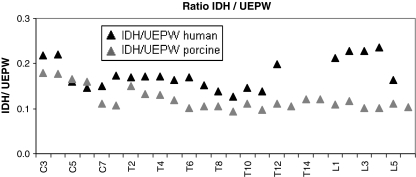
Ratios of intervertebral disc height/upper end-plate width for human and porcine vertebrae. IDH intervertebral disc height, UEPW upper end-plate width
Fig. 5
Fig. 5
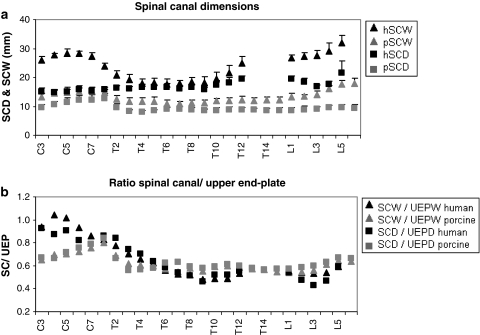
a Spinal canal dimensions of the human and porcine vertebra. Bars indicate the positive SD. h Human, p porcine, SCW spinal canal width, SCD spinal canal depth. b Ratios of spinal canal width/upper end-plate width, and spinal canal depth/upper end-plate depth for human and porcine vertebrae. SCW spinal canal width, SCD spinal canal depth, UEPW upper end-plate width, UEPD upper end-plate depth
Fig. 6
Fig. 6
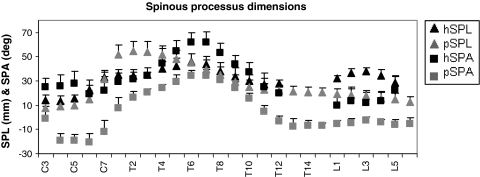
Spinous processus dimensions of the human and porcine vertebra. Bars indicate the positive SD. h Human, p porcine, SPL spinous processus length, SPA spinous processus angle
Fig. 7
Fig. 7
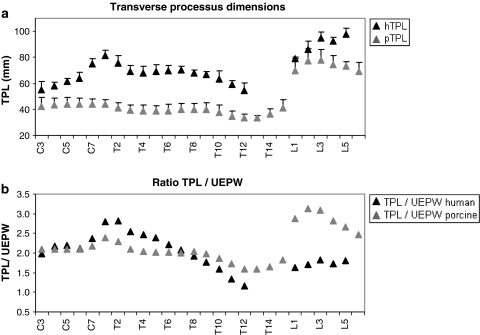
a Transverse processus dimensions of the human and porcine vertebra. Bars indicate the positive SD. h Human, p porcine, TPL transverse processus length. b Ratios of transverse processus length/upper end-plate width for human and porcine vertebrae. TPL transverse processus length, UEPW upper end-plate width
Fig. 8
Fig. 8
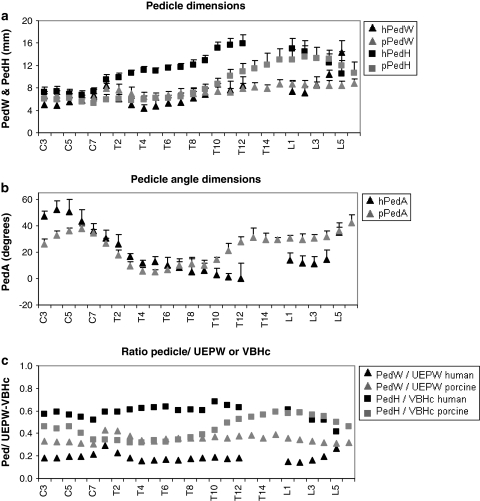
a Pedicle dimensions of the human and porcine vertebra. Bars indicate the positive SD. h Human, p porcine, PedW pedicle width, PedH pedicle height. b Pedicle angle dimensions of the human and porcine vertebra. Bars indicate the positive SD. h Human, p porcine, PedA pedicle angle. c Ratios of pedicle width/upper end-plate width, and pedicle height/central vertebral body height for human and porcine vertebrae. PedW pedicle width, PedH pedicle height, UEPW upper end-plate width, VBHc central vertebral body height

References

    1. Bozkus H, Crawford NR, Chamberlain RH, Valenzuela TD, Espinoza A, Yüksel Z, Dickman CA. Comparative anatomy of the porcine and human thoracic spines with reference to thoracoscopic surgical techniques. Surg Endosc. 2005;19:1652–1665. doi: 10.1007/s00464-005-0159-9. - DOI - PubMed
    1. McLain RF, Yerby SA, Moseley TA. Comparative morphometry of L4 vertebrae: comparison of large animal models for the human lumbar spine. Spine. 2002;27:E200–E206. doi: 10.1097/00007632-200204150-00005. - DOI - PubMed
    1. Smit TH. The use of a quadruped as an in vivo model for the study of the spine—biomechanical considerations. Eur Spine J. 2002;11:137–144. doi: 10.1007/s005860100346. - DOI - PMC - PubMed
    1. Goertzen DJ, Lane C, Oxland TR. Neutral zone and range of motion in the spine are greater with stepwise loading than with a continuous loading protocol. An in vitro porcine investigation. J Biomech. 2004;37:257–261. doi: 10.1016/S0021-9290(03)00307-5. - DOI - PubMed
    1. Kettler A, Liakos L, Haegele B, Wilke HJ. Are the spines of calf, pig and sheep suitable models for pre-clinical implant tests? Eur Spine J. 2007;16:2186–2192. doi: 10.1007/s00586-007-0485-9. - DOI - PMC - PubMed

Publication types

LinkOut - more resources