


Critical environmental limits for exercising heat-acclimated lean and obese boys
- PMID: 20187283
- PMCID: PMC2948628
- DOI: 10.1007/s00421-009-1290-4
Critical environmental limits for exercising heat-acclimated lean and obese boys
Abstract
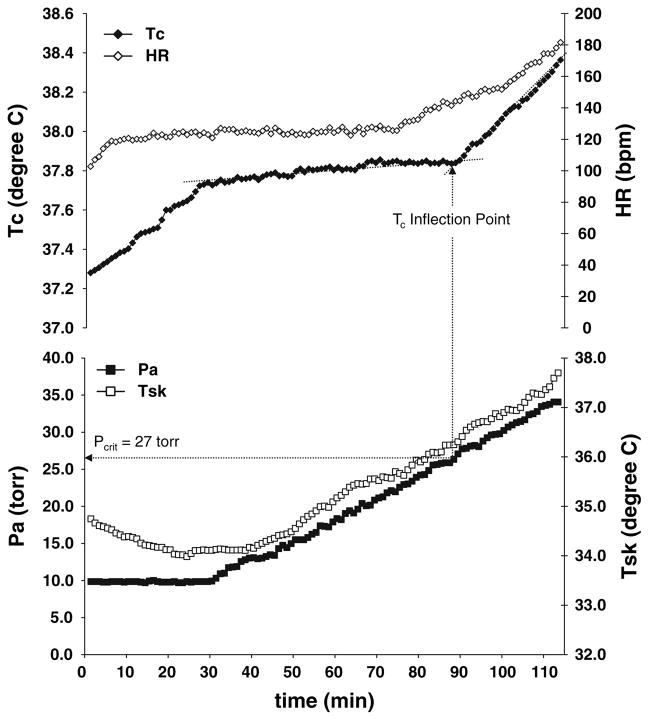
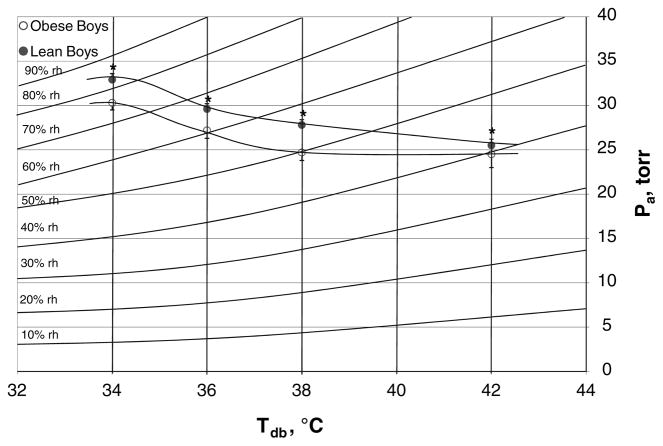
Environmental limits for uncompensable heat stress, above which an imbalance between heat gain and heat loss forces body core temperature upward (i.e., the upper limits of the prescriptive zone), are unknown for children. To determine these limits, 7 lean and 7 obese 9- to 12-year-old heat-acclimated boys performed four randomized trials each on separate days to determine the critical water vapor pressure (P (crit)) forcing an upward inflection of body core temperature at several ambient temperatures. Subjects walked continuously on a treadmill at 30% maximal aerobic capacity at a constant dry bulb temperature (T (db) = 34, 36, 38 or 42 degrees C). After a 30-min equilibration period at 9 torr, ambient water vapor pressure increased approximately 1 torr every 5-min until a distinct breakpoint in the core temperature versus time curve was evident. Compared to the lean subjects, obese subjects had significantly lower environmental limits (P < 0.03) in warm environments (P (crit), for lean vs. obese, respectively = 32.9 +/- 0.7 vs. 30.3 +/- 0.8 torr at T (db) = 34 degrees C; 29.6 +/- 0.6 vs. 27.2 +/- 0.9 torr at T (db) = 36 degrees C; 27.8 +/- 0.6 vs. 24.7 +/- 0.9 torr at T (db) = 38 degrees C; 25.5 +/- 0.7 vs. 24.5 +/- 1.5 torr at T (db) = 42 degrees C). These results suggest that separate critical environmental guidelines should be tailored to lean and obese children exercising in the heat.
Conflict of interest statement
Figures
References
-
- American Academy of Pediatrics: Committee on Sports Medicine, Fitness. Climatic heat stress and the exercising child and adolescent. American Academy of Pediatrics. Committee on Sports Medicine and Fitness. Pediatrics. 2000;106:158–159. - PubMed
-
- Armstrong LE, Maresh CM, Castellani JW, Bergeron MF, Kenefick RW, LaGasse KE, Riebe D. Urinary indices of hydration status. Int J Sport Nutr. 1994;4:265–279. - PubMed
-
- Armstrong LE, Epstein Y, Greenleaf JE, Haymes EM, Hubbard RW, Roberts WO, Thompson PD. American College of Sports Medicine position stand. Heat and cold illnesses during distance running. Med Sci Sports Exerc. 1996;28:i–x. - PubMed
-
- Bar-Or O. Age-related changes in exercise perception. In: Borg G, editor. Physical work and effort. Pergamon Press; Oxford: 1977. pp. 255–266.
-
- Bar-Or O, Inbar O. Relationship between perceptual and physiological changes during heat acclimatization in 8–10 year old boys. In: Lavallee H, Shephard R, editors. Frontiers of activity and child health: proceedings of the VIIth international symposium of paediatric work physiology. Editions du Pelican; Ottawa, Canada: 1977. pp. 205–214.
Publication types
MeSH terms
Grants and funding
LinkOut - more resources
Full Text Sources
Medical
Miscellaneous
